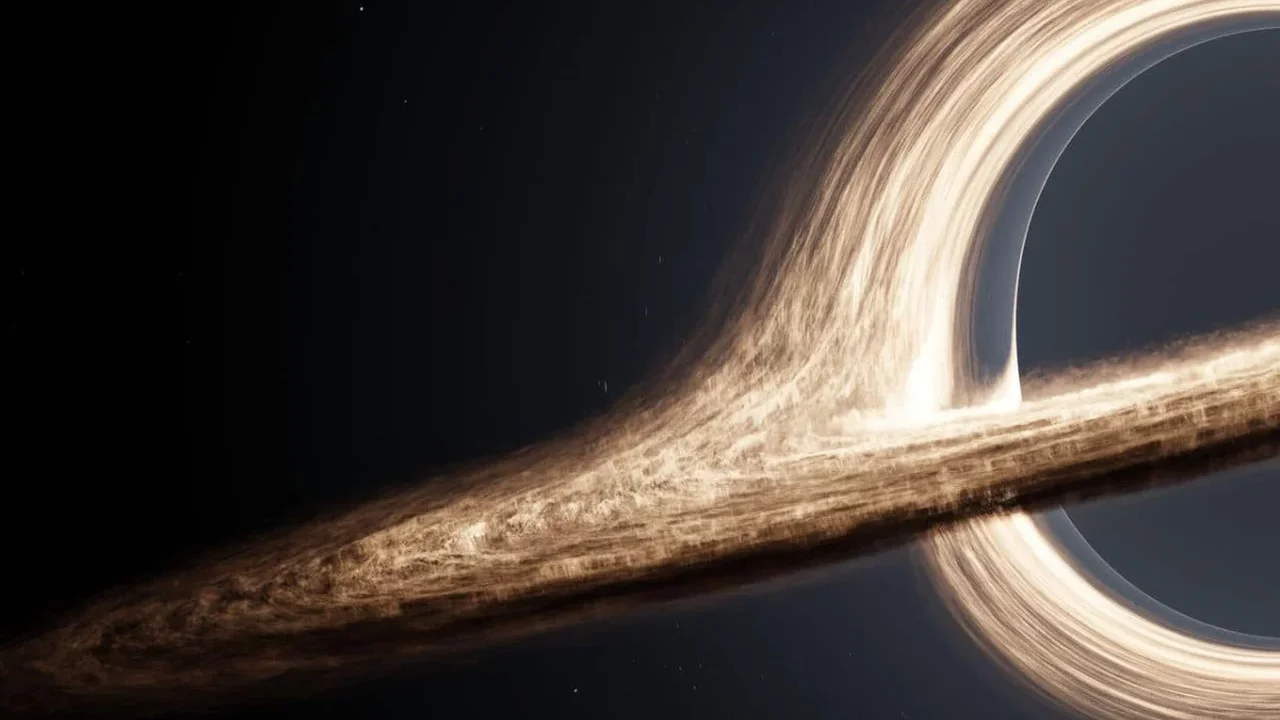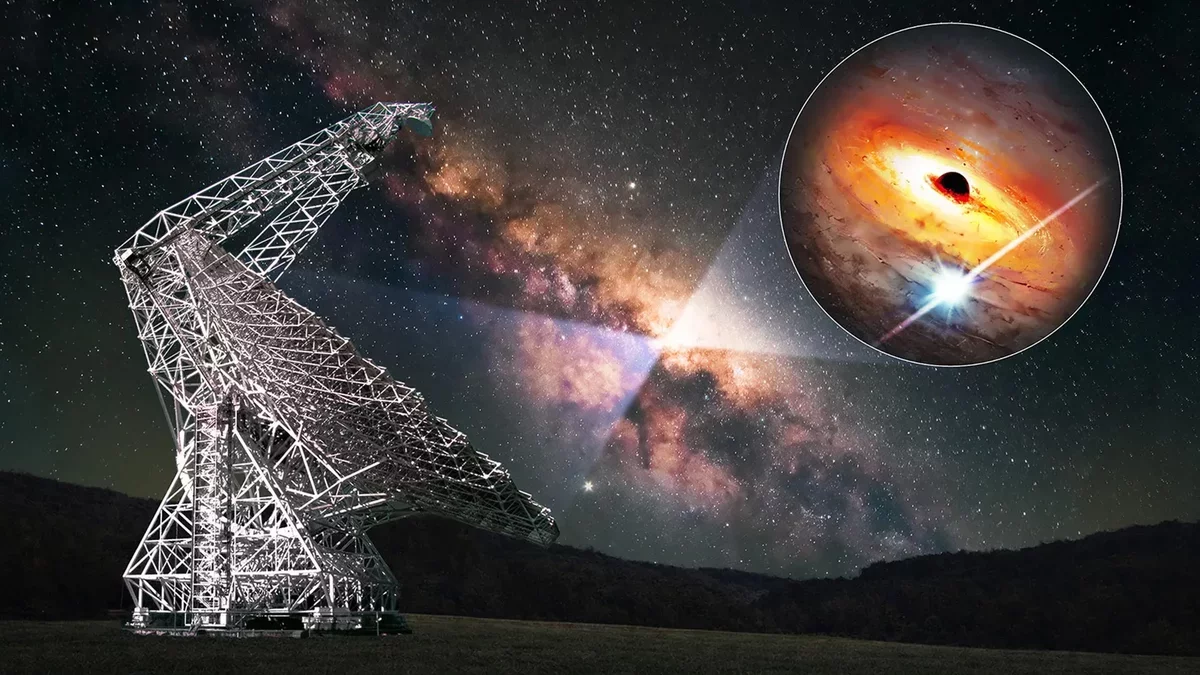
In a recent survey, scientists have pinpointed an intriguing pulsar candidate with a rotation period of 8.19 milliseconds, situated in close proximity to Sagittarius A*, the supermassive black hole at the heart of our galaxy.
A Unique Opportunity to Test Einstein's Theory
Should astronomers validate this discovery and accurately track its pulse timing, it could provide a rare chance to examine General Relativity in extreme environments. Monitoring a pulsar in such a setting would enable researchers to achieve precise measurements of the space-time fabric surrounding a supermassive black hole.
Pulsars are the remnants of colossal stars, specifically neutron stars, that have collapsed. They rotate at high speeds and generate strong magnetic fields, emitting concentrated beams of radio waves that traverse the cosmos akin to a lighthouse beam.
When unaffected by external forces, the radio signals from a pulsar arrive on Earth with exceptional regularity. This consistent rhythm allows pulsars to act as incredibly reliable cosmic timepieces. Millisecond pulsars, in particular, exhibit rapid spins, enhancing their timing precision and stability.
The Impact of Gravity on Pulsar Signals
According to Slavko Bogdanov, a research scientist at Columbia Astrophysics Laboratory and co-author of the study, "Any external factors influencing a pulsar, like the gravitational force of a massive body, can cause variations in the regularity of pulse arrivals, which can be measured and analyzed. Moreover, as the pulses pass near a substantial mass, they may be redirected and delayed due to the curvature of space-time as predicted by Einstein's General Theory of Relativity."
Sagittarius A* possesses a mass approximately 4 million times that of the Sun, exerting a significant gravitational influence on nearby celestial bodies.
Ongoing Follow-Up Observations
Given its potential scientific importance, researchers are currently conducting further observations to verify the authenticity of the pulsar candidate.
To promote wider scientific collaboration, Breakthrough Listen is making the collected data accessible to the public, allowing research teams globally to perform independent analyses and investigate related scientific inquiries.
"We are eager to see what follow-up studies will uncover about this pulsar candidate," stated Perez. "If validated, it could enhance our understanding of both our galaxy and the principles of General Relativity."