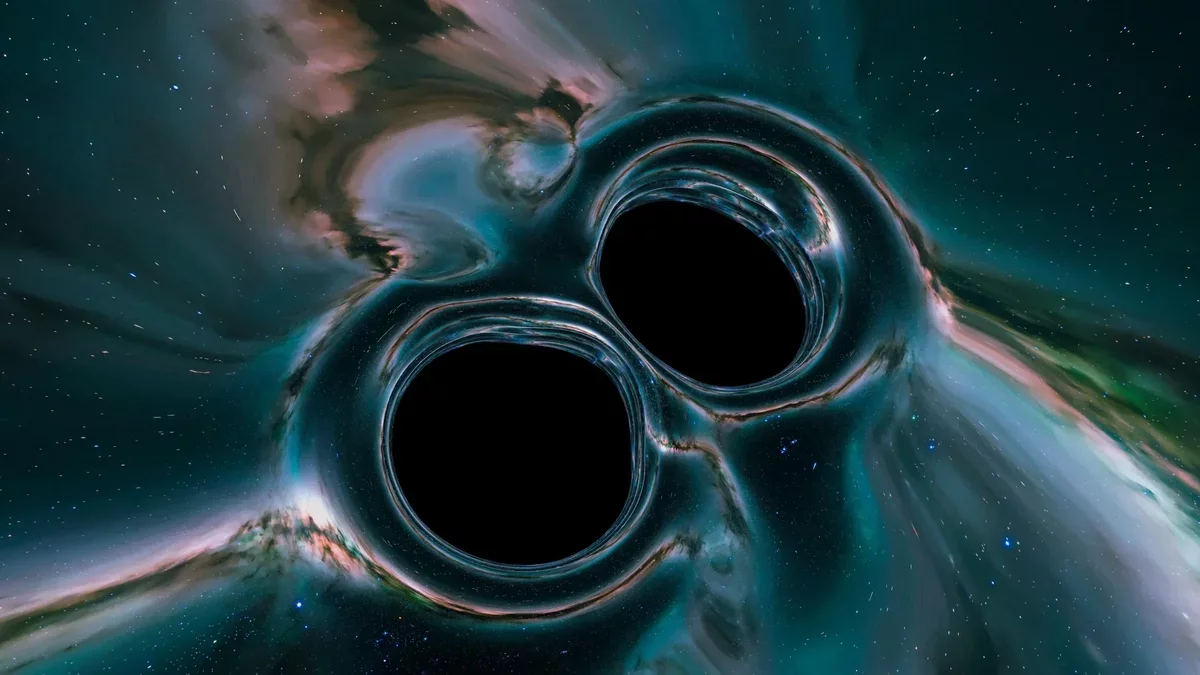
Recent research spearheaded by Cardiff University has provided intriguing insights into the formation of the universe's largest black holes. This study analyzed version 4.0 of the Gravitational-Wave Transient Catalog (GWTC4), which includes 153 confirmed instances of merging black holes.
The researchers investigated whether the most massive black holes identified could be classified as "second-generation" objects. This concept suggests that black holes created from the remnants of dying stars can collide and subsequently merge again in environments where stars are densely packed--up to a million times more concentrated than the vicinity of our Sun.
Published in Nature Astronomy, the findings indicate that the most substantial black holes detected through gravitational waves belong to a distinct category with a markedly different formation history compared to their smaller counterparts.
Gravitational Waves Uncover Two Distinct Black Hole Populations
Dr. Fabio Antonini, the lead author from Cardiff University's School of Physics and Astronomy, stated, "Gravitational-wave astronomy is evolving beyond merely counting black hole mergers. It is beginning to illuminate how black holes develop, where they originate, and what this reveals about the lifecycle of massive stars. This is thrilling as it allows us to refine our understanding of stellar and cluster evolution in the universe."
Through their analysis of gravitational-wave signals, the team identified two separate populations:
- A lower-mass group consistent with typical stellar collapse
- A higher-mass group exhibiting spin characteristics indicative of hierarchical mergers within dense star clusters
The unique spin behavior of the heavier black holes was particularly enlightening. Co-author Dr. Isobel Romero-Shaw noted, "What astonished us was how distinctly the high-mass black holes emerged as a separate population. Unlike the lower-mass systems, which generally exhibited slow spins, the higher-mass systems displayed rapid spins oriented in seemingly random directions, a signature consistent with repeated mergers in dense clusters."
Strengthening the Evidence for the Black Hole "Mass Gap"
This study also reinforces the existence of a "mass gap," a phenomenon theorized by astrophysicists for many years. It posits that stars above a certain mass threshold should explode violently, leaving no remnants to form black holes. This creates a range where black holes formed directly from stars are not expected to exist.
The researchers pinpointed this transition in black holes with masses around 45 times that of the Sun. Dr. Antonini remarked, "Our findings provide evidence for the long-anticipated pair-instability mass gap--indicating that black holes around 45 solar masses challenge our current models of stellar evolution."
Black Holes as a Gateway to Nuclear Physics
These discoveries may eventually enable scientists to explore processes occurring deep within massive stars. The team utilized the transition near the mass gap to examine a crucial nuclear reaction associated with helium burning in stellar cores. Co-author Dr. Fani Dosopoulou added, "In the future, gravitational-wave data could aid in studying nuclear physics, as the mass limit set by pair instability is contingent on the nuclear reactions in massive star cores."