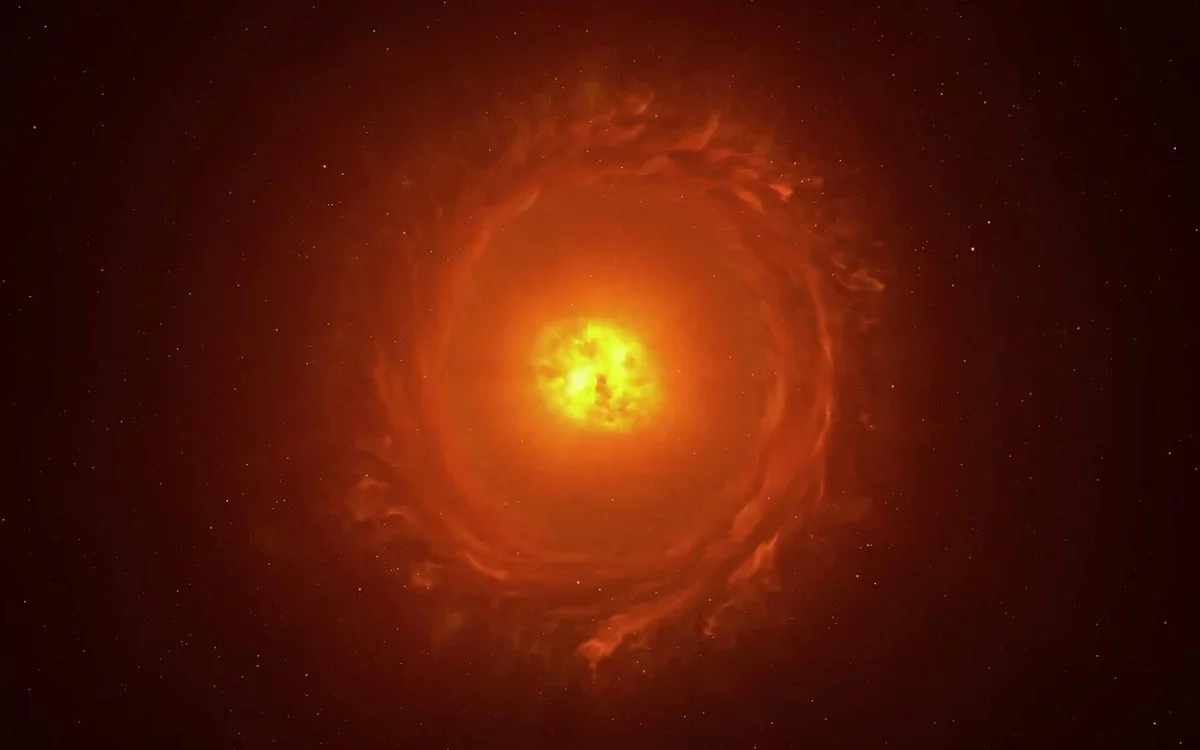
Recent research has revealed a fascinating transformation in one of the largest stars known to humanity, WOH G64, which appears to be on the brink of a supernova explosion. A study led by Gonzalo Muñoz-Sanchez at the National Observatory of Athens, published in Nature Astronomy, indicates that this colossal star has shifted from a red supergiant phase to a rare yellow hypergiant stage, signaling a potential end to its life cycle.
WOH G64, located in the Large Magellanic Cloud, was first identified in the 1970s. This star is not only incredibly luminous but also boasts a size more than 1,500 times that of our Sun. In 2024, it became the first star outside our galaxy to be captured in detail, revealing a dusty cocoon that highlighted its mass loss over time.
A Unique Stellar Evolution
At less than 5 million years old, WOH G64 is relatively young in cosmic terms, especially when compared to our Sun, which is approximately 4.6 billion years old. This star's rapid life cycle is characterized by a swift evolution from hydrogen fusion in its core to helium burning, ultimately leading to its current hypergiant state. Not all supergiants transition to hypergiants, a process theorized to occur when massive stars quickly evolve and shed their outer layers.
Understanding the Change
The transformation observed in WOH G64 is believed to have begun around 2014, possibly due to the ejection of a significant portion of its surface. This event may have been influenced by interactions with a companion star, as indicated by spectral analysis. Another compelling theory suggests that WOH G64 is entering a pre-supernova phase characterized by a "superwind," a phenomenon driven by intense internal pulsations as the star exhausts its nuclear fuel.
Looking Ahead
While most stars have lifespans spanning millions to billions of years, the observable changes in WOH G64 offer a rare opportunity for scientists to document a stellar transformation in real-time. Should the star explode within our lifetimes, it will not only provide a spectacular cosmic event but also enhance our understanding of stellar evolution and the life cycles of massive stars.
As we continue to explore the universe, the fate of WOH G64 could unlock new insights into the life and death of stars, shaping our knowledge of cosmic phenomena for generations to come.