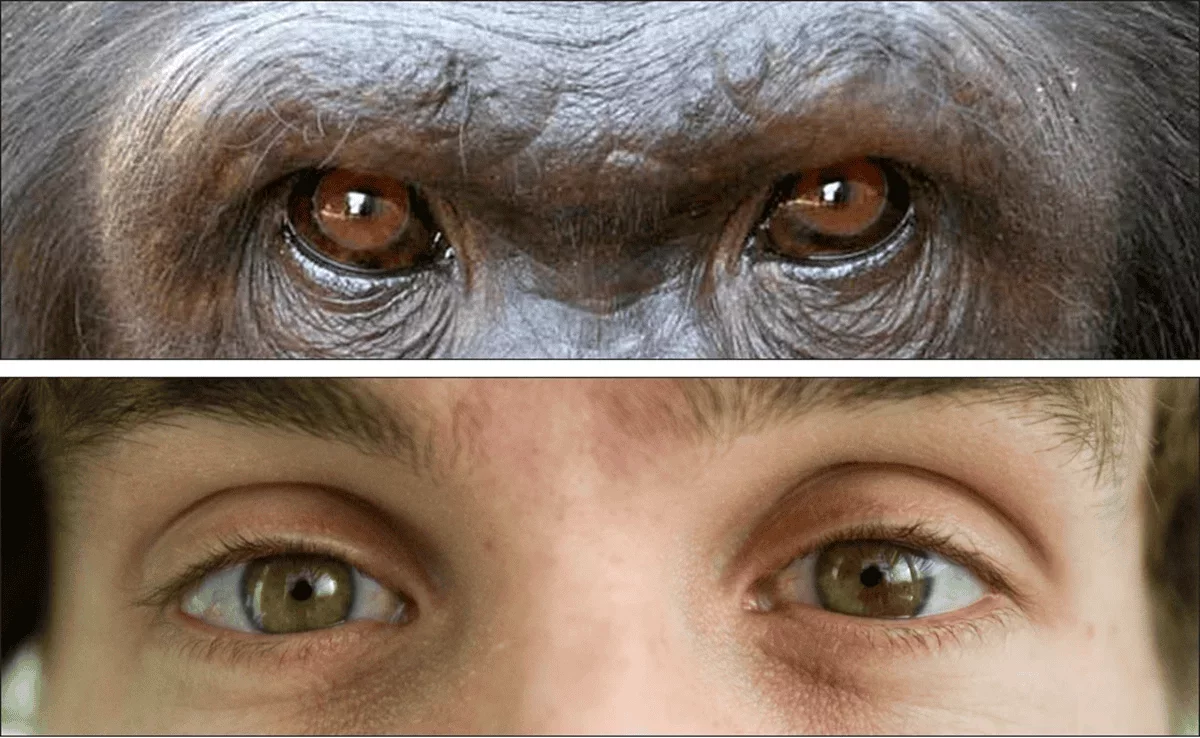
When observing a chimpanzee, one might notice a distinct difference in eye appearance compared to humans. The sclera, the tissue surrounding the iris, typically appears dark in apes, making it challenging to discern their gaze direction. In contrast, humans possess bright white sclerae that enhance our ability to communicate non-verbally through eye movement.
Most mammals have dark sclerae, likely as a survival mechanism to avoid detection by predators. This camouflage aligns with their eye color and often only allows a small portion of the sclera to be visible. However, humans have evolved sclerae that are not only brighter but also more elongated and proportionately larger than those of most apes, such as gorillas, who have massive bodies but relatively small eyes.
The Cooperative Eye Hypothesis
Researchers have long pondered the reason behind this unique trait in humans. The leading explanation, known as the Cooperative Eye Hypothesis, emerged in 2001 from the Tokyo Institute of Technology. This theory posits that the ability to instantly read another's gaze is fundamental to non-verbal communication.
Further studies, including a pivotal 2007 experiment published in the Journal of Human Evolution, demonstrated that human infants show a remarkable tendency to follow eye movements, unlike great apes, who primarily track head movements. This suggests that the visibility of our sclera plays a crucial role in facilitating effective communication.
A Signal of Cooperation
The contrast between a dark iris and a white sclera may have offered early humans advantages in social settings, especially while hunting in the African savanna. A quick glance could silently alert others to potential prey. This trait isn't unique to humans; studies show that canines that hunt in packs also tend to have visible sclerae, indicating a correlation between eye visibility and social behavior.
Moreover, a 2022 study in Scientific Reports revealed that primates with lighter sclerae exhibited higher levels of cooperation and lower aggression rates. This trend persists even under challenging visibility conditions, where humans consistently outperformed apes in interpreting gaze direction.
The Self-Domestication Hypothesis
Another perspective, the Self-Domestication Hypothesis, suggests that the evolution of white sclerae may have been an unintended consequence of humans becoming more sociable and less aggressive. As our ancestors developed greater social tolerance, changes in their neural crest cells led to reduced pigmentation, resulting in brighter sclerae.
Additionally, a bright sclera serves as an indicator of health, as conditions like hepatitis can change its color. This aspect may have influenced sexual selection, favoring individuals with brighter sclerae as signs of youth and vitality.
Geographic Variations
Interestingly, a 2022 study from the National University of Singapore highlighted that eye color and sclera brightness vary geographically among primate species. As populations move away from the equator, their sclera tend to lighten, suggesting environmental factors also play a role in eye evolution.
In conclusion, the evolution of human eye color and sclera visibility offers fascinating insights into our social behavior and communication. As we continue to explore these traits, we may uncover further connections between our evolutionary past and the cooperative nature that defines humanity.