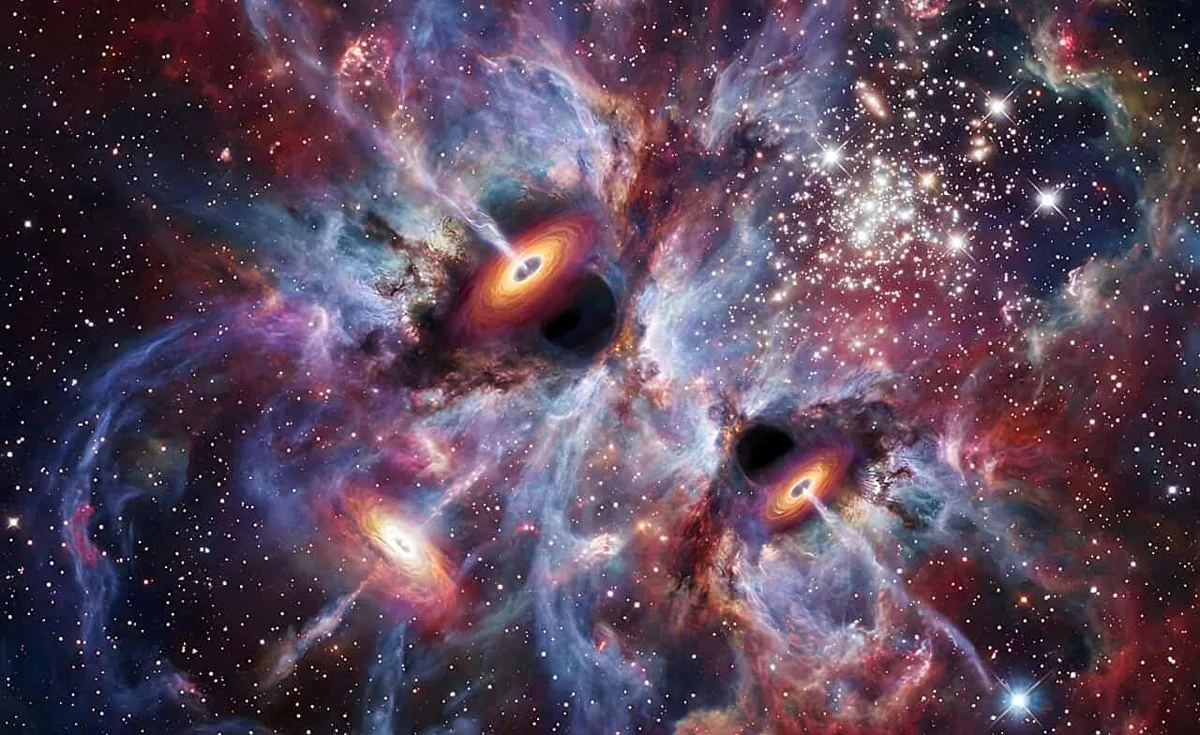
Astronomers utilizing the James Webb Space Telescope (JWST) continue to uncover astonishing revelations about ancient supermassive black holes, which are millions of times heavier than our sun and existed when the universe was still in its infancy. This intriguing phenomenon raises a compelling question: how did these colossal entities grow so quickly?
A recent study published in Nature Astronomy suggests that the early universe may have had conditions conducive to what can be described as "feeding frenzies" for black holes.
"Our research indicates that the tumultuous environment of the early universe enabled smaller black holes to evolve into the supermassive ones we observe today, as they consumed surrounding material at an accelerated rate," stated Daxal Mehta, a PhD candidate at Maynooth University in Ireland.
Exceeding Cosmic Growth Limits
Mehta and his team arrived at this conclusion by conducting highly detailed computer simulations of the universe's first galaxies. These simulations revealed that black holes, originating from the remnants of the first stars, could grow to sizes approximately ten thousand times that of the sun.
"Our advanced simulations demonstrated that the earliest black holes, emerging just a few hundred million years after the Big Bang, could expand rapidly to tens of thousands of solar masses," Mehta elaborated.
While not every early black hole reached such massive sizes, the findings indicate that many had the potential to do so if they found themselves in favorable cosmic locations.
However, this raises an intriguing issue: a theoretical growth limit for black holes has long been accepted.
The Black Hole Nursery
As gas spirals into a black hole, it heats up and emits light. If this luminosity becomes sufficiently intense, it can repel incoming gas. This balance, known as the Eddington limit, has traditionally acted as a growth constraint for black holes. Nevertheless, the high-resolution simulations conducted by the Maynooth team suggest that the early universe did not adhere to this limitation.
A crucial factor in this rapid growth was identified as a specific type of star, known as "Population III" stars. By simulating these stars, researchers captured critical growth phases that previous models overlooked.
These stars are believed to have been exceptionally bright, massive, and hot, composed entirely of hydrogen and helium. They likely played a pivotal role in producing the chemical elements necessary for planet formation. The highest-resolution simulations could resolve structures down to a tenth of a parsec, enabling a detailed examination of gas flows around small black holes.
In this context, Population III stars serve as the progenitors of black hole seeds, leading to the formation of rapidly growing black holes.
No Need for "Heavy Seeds"
Traditionally, many scientists posited that black holes needed to be born with significant mass to account for their immense size. This study challenges that notion.
It reveals that if a Population III star leaves behind a seed in a dense, cold gas environment, that seed can surpass its modest initial size.
In simpler terms, the early universe sometimes allowed black holes to exceed growth expectations, provided the conditions were optimal.
"This discovery addresses one of the significant mysteries in astronomy," remarked Lewis Prole, a postdoctoral researcher on the team. "It explains how black holes formed in the early universe, as detected by the James Webb Space Telescope, achieved such supermassive dimensions so swiftly."
Listening for Cosmic Evidence
These small black holes were once thought too diminutive to evolve into the massive black holes observed at the centers of early galaxies, according to Mehta. "Our findings demonstrate that these early black holes, while initially small, have the capacity to grow remarkably fast under the right circumstances."
Yet, many questions remain unanswered. To delve deeper, researchers plan to explore beyond telescopic observations.
If these chaotic feeding frenzies are as prevalent as the simulations suggest, scientists could potentially detect their growth through gravitational waves--ripples in spacetime that may confirm the birth of these early giants.