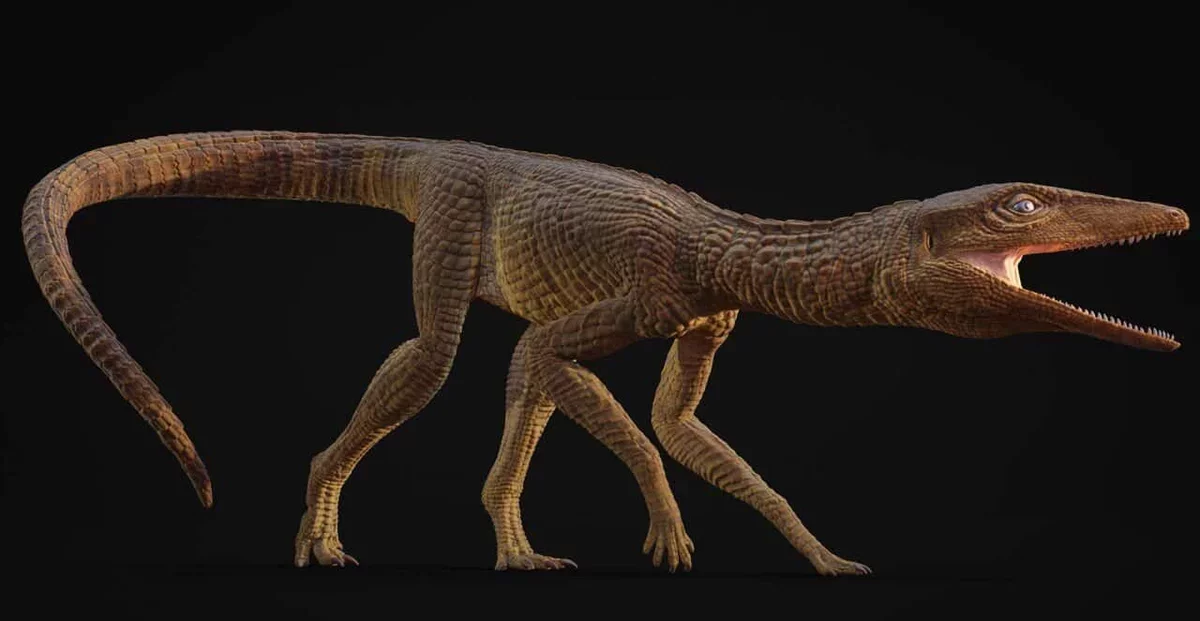
In the heart of Argentina's national natural science museum lies a remarkable fossil jaw, measuring just six inches. This intriguing specimen, belonging to Lewisuchus admixtus, features backward-curving teeth that resemble those of the formidable Komodo dragon, as noted by paleontologist Martín Ezcurra. This reptile roamed the Earth approximately 236 million years ago during the Triassic period, likely preying on small vertebrates as the first dinosaurs began to emerge.
The classification of Lewisuchus remains a topic of debate among scientists, with discussions ongoing about whether it represents an early dinosaur or a close relative that exists just outside this group.
Unanswered Questions
While the extinction of dinosaurs is well-documented, primarily due to a significant asteroid impact, their origins are shrouded in mystery. The earliest dinosaur fossils are rare, leading researchers to piece together the evolutionary tree by analyzing anatomical traits such as hip sockets, vertebrae, and skull joints. However, this process is fraught with challenges, as Paul Barrett from London's Natural History Museum highlights, noting the complexity of defining a clear dinosaur characteristic.
By the Jurassic period, around 200 million years ago, dinosaurs had established dominance across various ecosystems. Yet, the fossil record from the Late Triassic, where the earliest dinosaurs are believed to have emerged, remains sparse.
One of the earliest known dinosaurs, Saturnalia tupiniquim, hails from present-day Brazil and dates back to about 233 million years ago. Estimates suggest there may be around 20 early species confidently identified as dinosaurs, primarily belonging to two major lineages: the long-necked sauropods and the theropods. The third lineage, the ornithischians, appears to be absent from the initial fossil record, raising questions about their evolutionary timeline.
Recent research has turned towards geographical analysis to address these gaps. A modeling study published in Current Biology posits that the earliest dinosaurs likely originated near the equator in western Gondwana, an area that includes parts of today's Amazon and Sahara. This study suggests that the environment was hotter and drier than previously assumed, comprising desert and savannah-like landscapes.
Lead author Joel Heath emphasizes the significance of this research, stating, "Dinosaurs are well studied, but we still don't really know where they came from. Our modeling suggests that the earliest dinosaurs might have emerged in western, low-latitude Gondwana."
These early dinosaurs were relatively small compared to their contemporaries, such as the ancestors of crocodiles and the first pterosaurs. Heath's team found the strongest evidence supporting a low-latitude origin for dinosaurs when considering the evolutionary link between silesaurids and ornithischians. This connection may help explain the absence of early ornithischians from the fossil record.
In conclusion, the research indicates that early dinosaurs were likely well adapted to thrive in hot and arid conditions, paving the way for their eventual success as they diversified into the three main dinosaur groups.