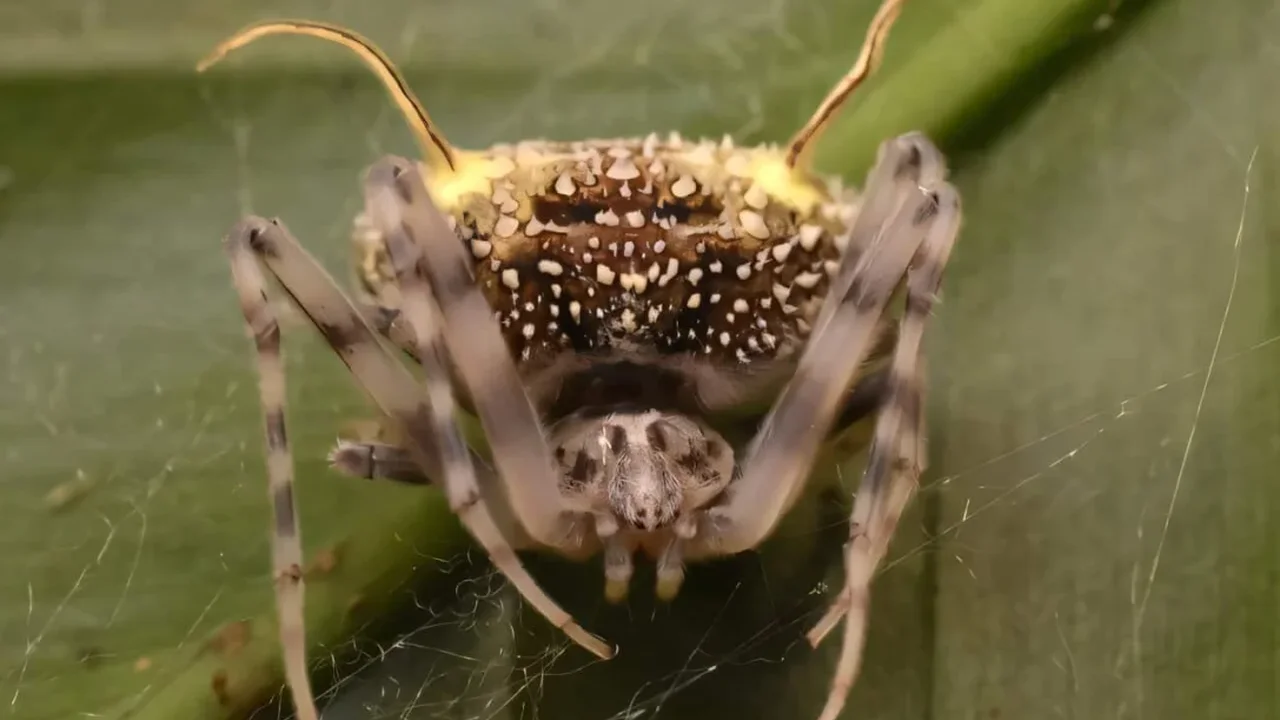
A spider discovered in Ecuador's Amazon appears to have an unusual disguise: it resembles a spider killed by a parasitic fungus. Researchers have named the previously unknown species Taczanowskia waska, describing it in the journal Zootaxa.
The encounter took place on August 8, 2025, in the Llanganates-Sangay Connectivity Corridor. The spider was found motionless beneath a leaf, with pale growth-like features that seemed to suggest fungal infection. When touched, however, it moved--and researchers determined that the structures were part of its own body.
A disguise with possible advantages
About nine millimeters long, T. waska has a pale body covered in fine hairs and small spikes. Two slender projections extend from its abdomen, giving it an appearance reminiscent of the spore-producing structures of fungi in the genus Gibellula, which infect spiders.
The researchers propose that the resemblance might help the spider avoid predators that steer clear of dead or diseased prey. It could also benefit the spider while hunting: members of its genus ambush prey rather than relying on the typical circular webs made by many orb-weavers. Both explanations remain hypotheses; scientists have not yet tested how the disguise affects predators or hunting success.
The discovery also highlights the value of museum collections. A second specimen, collected in Bolivia in 1903, was later identified as the same species. So far, researchers have examined only two individuals, both female, leaving much to learn about the spider's behavior, diet and male form.
Further study of Taczanowskia waska could reveal how mimicry evolves and help uncover more of the biodiversity still hidden in tropical forests.