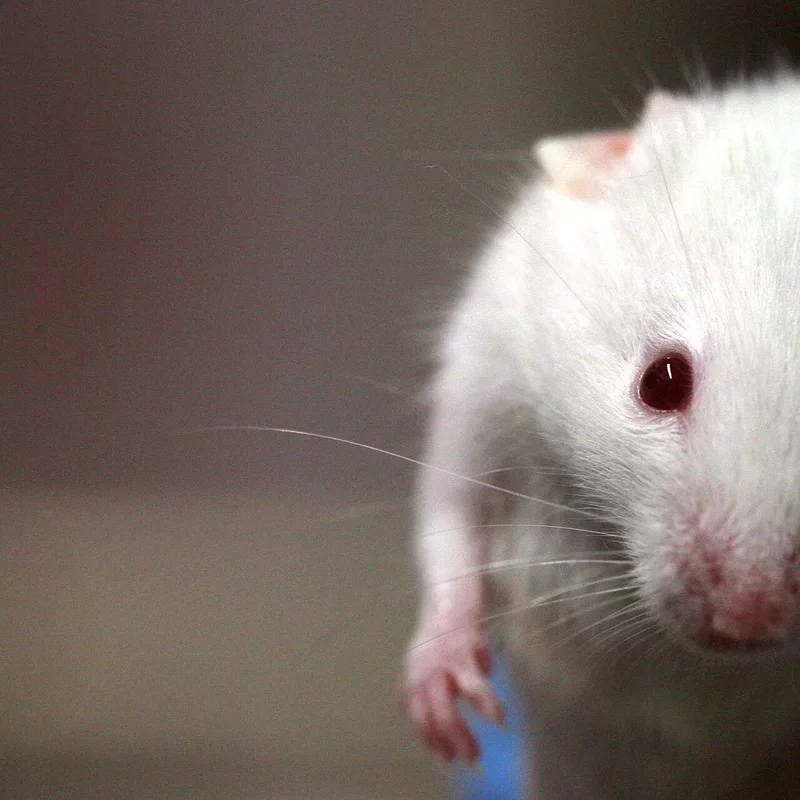
In a groundbreaking study, neuroscientists have achieved the remarkable feat of reconstructing moving images directly from the brain activity of mice. This advancement signifies a major leap from traditional brain scans to the real-time tracking of thousands of individual neurons.
While earlier research focused on static images or low-resolution human fMRI scans, this innovative work employs single-cell recordings to delve into how a mouse's brain processes a continuous visual stream. By observing the activity of 8,000 neurons in the visual cortex, the team aims to go beyond mere "mind reading" and explore how the brain consciously shapes and filters reality into a subjective experience.
Reconstruction Process
The researchers utilized two-photon calcium imaging, a microscopy technique that infers neural activity by monitoring calcium signals within cells. They studied 10 mice, tracking approximately 8,000 neurons in the primary visual cortex while the animals viewed short video clips.
These recordings were then paired with a dynamic neural encoding model, a machine-learning system designed to predict neuronal responses to specific movie segments. The model incorporated behavioral data, such as pupil size and eye position, which influence visual information processing.
The reconstruction began with a blank gray movie, gradually altering its pixels until the predicted neural activity matched the recorded activity from the mouse. This iterative process produced a reconstructed version of the clips the mice had viewed.
Although the resulting videos lack sharpness, they successfully convey motion and timing, indicating that the system captured essential features of the original scenes. The study revealed a strong correlation between the original and reconstructed movies in both spatial and temporal aspects. Enhancing the number of neurons monitored led to improved reconstruction quality.
Understanding Perception
Interestingly, the reconstructed videos were not exact replicas of the originals, which may provide insights into how the brain processes incoming information. Instead of functioning like a camera, our perception appears to be more interpretative. Dr. Joel Bauer, the study's lead author from the Sainsbury Wellcome Centre at University College London, noted that the brain's visual processing pipeline skews and modifies information, reflecting how our minds interpret sensory data.
Future research may leverage these reconstructions to investigate phenomena such as predictive coding, selective attention, and perceptual learning--critical processes that influence how the brain prioritizes information.
While the current reconstructions are limited in scope, covering only part of the mouse's visual field with low resolution, the authors emphasize the potential for sharper images and broader coverage in future studies.
This pioneering work opens new avenues for understanding animal cognition and the complexities of perception, allowing researchers to compare external reality with the brain's internal representation.
The findings have been published in eLife.