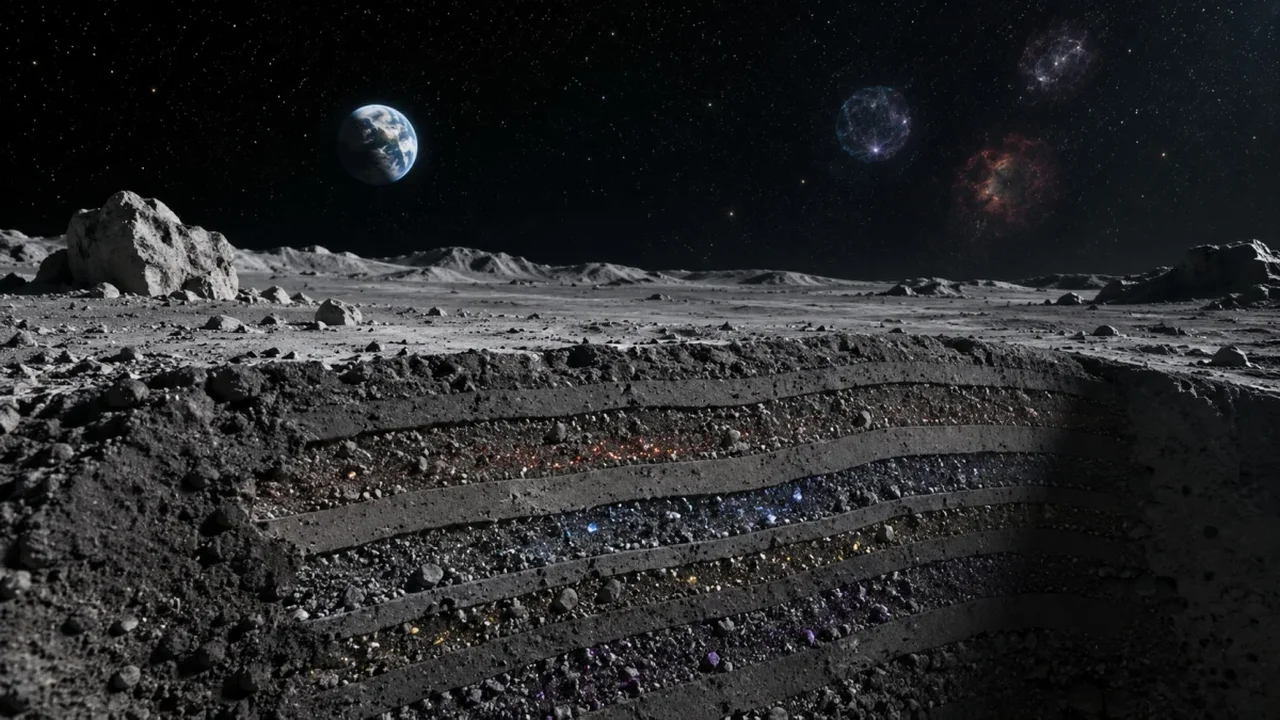
New research suggests that lunar dust may function as a long-term archive of cosmic events, preserving traces of nearby exploding stars for up to 100 million years. Published in Physical Review Letters, the study presents a model that helps decode how the Moon's soil layers store and rearrange interstellar material over time.
According to the team, led by Emily Costello of the Hawai'i Institute of Geophysics and Planetology at the University of Hawai'i at Mānoa, the Moon offers a far more durable record than Earth. While deep-sea sediments can retain evidence of cosmic debris for around 10 million years, lunar regolith may preserve a much longer timeline because the Moon lacks weather, oceans, and plate tectonics.
Reading the Moon's shuffled layers
The challenge is that the lunar surface is constantly reshaped by impact gardening. Micrometeorites and larger impacts dig up buried material, mix layers, and push particles deeper underground, turning the surface into a natural puzzle. To address this, the researchers built a unified stochastic model that combines excavation, compaction, radioactive decay, and space weathering in one framework.
They tested the model against Apollo core samples and found a strong match with measured levels of Iron-60, a radioactive isotope linked to nearby supernovae. The results reproduced depth profiles across timescales ranging from roughly 14 million to 450 million years, suggesting the Moon can preserve a surprisingly detailed cosmic history.
The model may also help scientists compare other isotopes formed in extreme events such as neutron star mergers, offering a new way to distinguish between different kinds of stellar explosions. With NASA's Artemis program preparing future lunar sample returns, deeper cores could reveal even more about the neighborhood of Earth and the Moon.
As lunar exploration advances, the Moon may become one of science's most valuable archives, turning ancient stardust into a clearer map of the solar system's past and future.