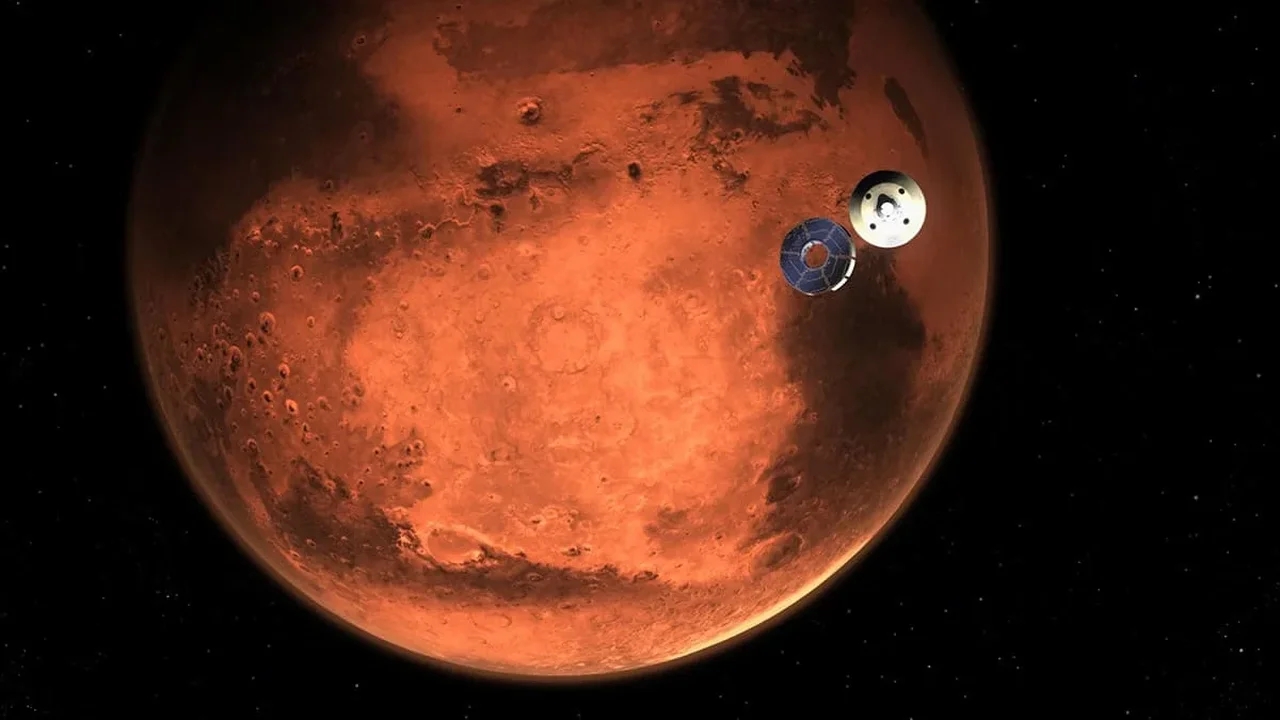
Rocks in Mars' Jezero Crater may be the cooled remains of a vast lava lake, offering new clues to the planet's early interior and volcanic history. The interpretation is based on data collected by NASA's Perseverance rover from the Séítah formation, a layer almost 4 billion years old.
A study published in Communications Earth and Environment examined the rocks' chemistry and mineral structure. Measurements from Perseverance's PIXL instrument indicate that the formation contains large, interlocking olivine crystals. On Earth, similar crystal patterns can develop as lava lakes cool over hundreds or thousands of years.
A slow-flowing ancient lava
Researchers used the chemical data to estimate how easily the original lava flowed. Their analysis suggests it had low viscosity, allowing it to spread widely before cooling. The team estimates that the flow may have travelled about 200 kilometres from its volcanic source.
This interpretation offers an alternative to the idea that the rocks formed when molten material pushed into older layers beneath the surface. That explanation would require later uplift and exposure, and could imply geological processes not supported by current evidence for Mars.
Clues to Mars' early conditions
The findings also point to similarities between the early evolution of the Martian and Earth mantles. If the lava's low viscosity reflects a warm Martian interior, conditions billions of years ago may have been more favourable for habitability. The rocks alone, however, do not establish that life existed on Mars.
By linking mineral chemistry with the movement of ancient lava, the study gives scientists another way to reconstruct planetary interiors. Future analyses of Martian rocks could sharpen our understanding of how rocky worlds evolve--and where conditions for life may emerge.