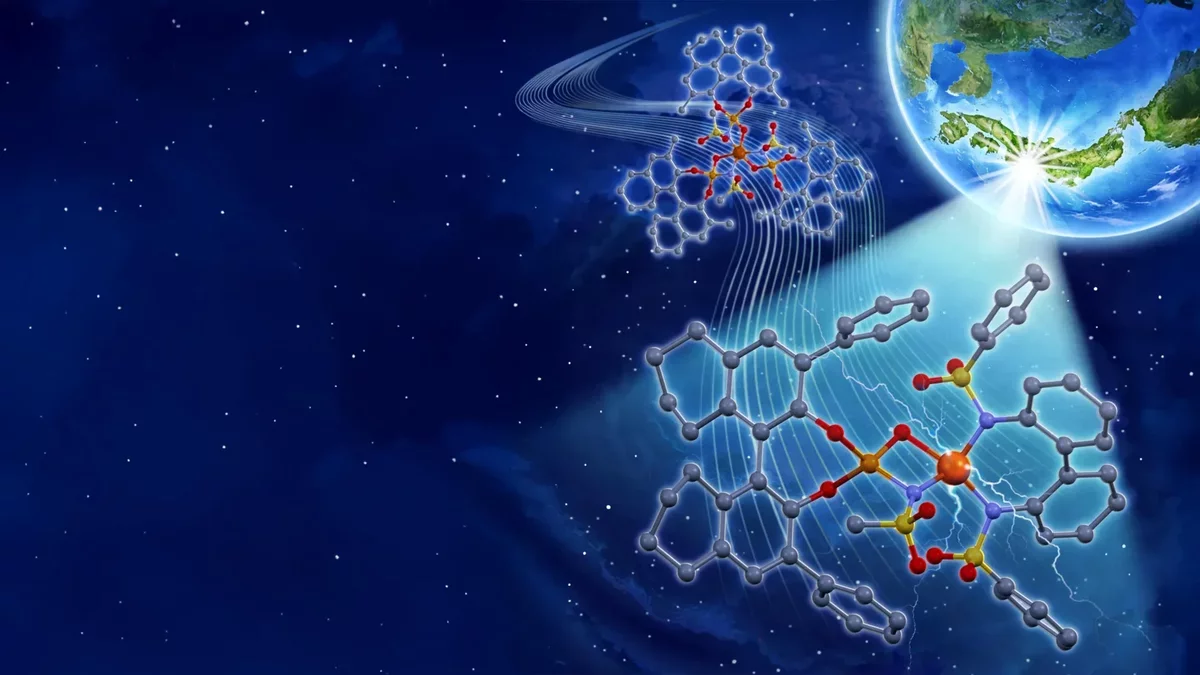
In a significant advancement in photocatalysis, researchers from Nagoya University in Japan have unveiled an innovative iron-based catalyst that outperforms traditional rare metals like ruthenium and iridium, which are both expensive and scarce. Previously, the team had introduced an iron alternative that relied heavily on costly chiral ligands, essential for shaping the three-dimensional structure of chemical products.
Published in the Journal of the American Chemical Society, the new study reveals a redesigned iron catalyst that reduces the need for chiral ligands by two-thirds. This improved system operates efficiently under blue LED light, enhancing the practicality and sustainability of the reaction conditions.
Utilizing this advanced catalyst, the researchers successfully achieved the asymmetric total synthesis of (+)-heitziamide A, a natural compound sourced from medicinal plants known for its ability to suppress respiratory bursts. The research was led by Professor Kazuaki Ishihara, Assistant Professor Shuhei Ohmura, and graduate student Hayato Akao from the Graduate School of Engineering at Nagoya University.
Enhanced Catalyst Design Boosts Performance
In their recent work, the team developed an iron photocatalyst that previously required three chiral ligands per iron atom, but only one contributed to enantioselectivity, rendering the method inefficient. The newly designed catalyst employs a more strategic combination of cost-effective achiral bidentate ligands with chiral ligands to create a specific iron(III) salt structure. The chiral ligand directs the product's three-dimensional configuration, while the achiral bidentate ligand enhances catalytic performance.
This innovative system facilitated a highly controlled radical cation (4 + 2) cyclization, where two molecular components combine to form a six-membered ring, enabling the synthesis of 1,2,3,5-substituted adducts--structural motifs frequently found in natural products like heitziamide A.
"The new catalyst design represents a significant evolution in chiral iron(III) photoredox catalysts," stated Ohmura, a co-author of the study. "We believe this achievement is a major milestone for the future of iron-based photocatalysis."
First Total Asymmetric Synthesis of (+)-Heitziamide A
While previous laboratory efforts had synthesized heitziamide A, this research marks the first total asymmetric synthesis of its naturally occurring enantiomer. By meticulously controlling the formation of the six-membered ring using a blue light-activated iron photocatalyst, the team succeeded in this groundbreaking synthesis. The findings also suggest that utilizing the mirror image of the catalyst could enable the production of (-)-heitziamide A, thereby providing selective access to both enantiomers.
Impact on Pharmaceutical Chemistry
This new iron photocatalyst opens avenues for constructing complex molecules, including pharmaceutical precursors, using abundant iron and blue LEDs instead of rare metals. "Achieving the first-ever asymmetric total synthesis of (+)-heitziamide A through this catalytic reaction is an extraordinary accomplishment," remarked Ishihara, the other corresponding author. "This method could allow access to various bioactive substances, with enantioselective radical cation (4 + 2) cycloaddition being a crucial step. We plan to publish follow-up studies on the asymmetric total synthesis of these compounds soon."