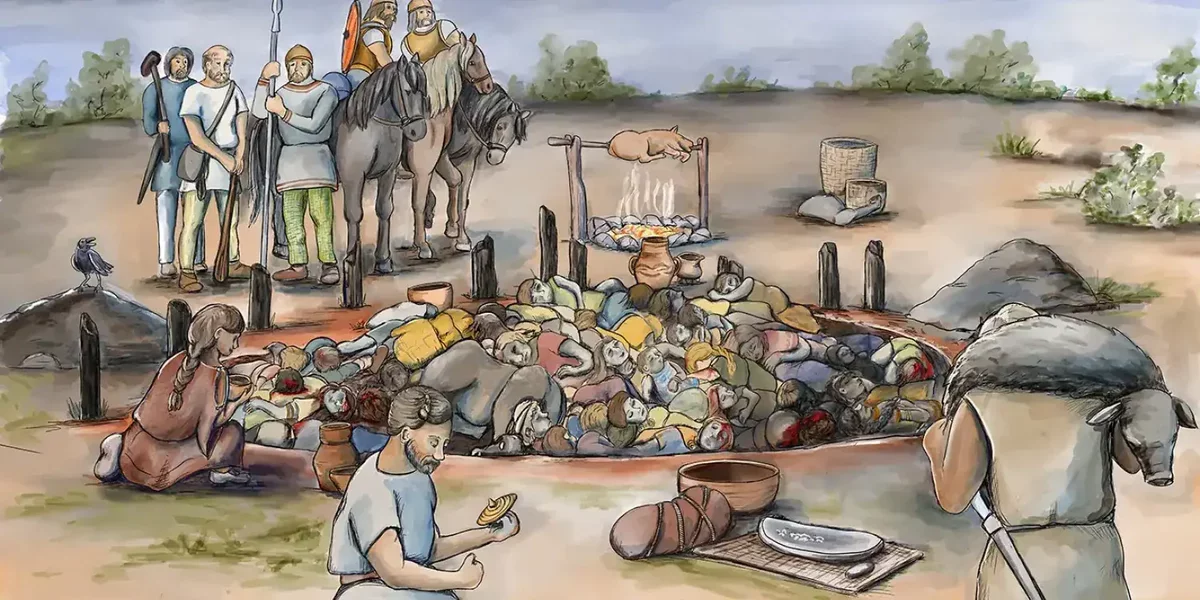
Discovered in the 1970s, the mass grave at Gomolava, Serbia, was initially believed to be the result of a pandemic. However, recent archaeological analysis has revealed a more disturbing truth. The grave, dating back to the 9th century BCE, contains the remains of 77 individuals, predominantly women and children, suggesting a brutal act of violence rather than a natural disaster.
Advanced bioarchaeological techniques have uncovered evidence of unhealed blunt-force and sharp-force trauma on the skeletons, indicating that these individuals were intentionally killed. Researcher Dr. Linda Fibiger from the University of Edinburgh noted that the nature of the injuries points to deliberate acts of violence rather than accidental deaths.
No Pandemic, But a Calculated Attack
Of the 77 victims, 40 were children aged between one and 12 years, with the majority of the adults being female. Surprisingly, genetic testing revealed that most of these children were also girls, with only one male infant found among the remains. This finding raises questions about the motivations behind such targeted violence.
Unlike typical mass graves from local raids, the genetic analysis indicates that many victims were not related, suggesting they were captured from different communities. Associate Professor Barry Molloy from University College Dublin remarked on the unexpected nature of these findings, as they indicate a lack of familial ties among the victims.
Strangers in a Strange Land
Isotopic analysis of the victims' remains revealed that over a third were not born in the Gomolava area, implying they came from various distant settlements. The collapse of Bronze Age societies around 1200 BCE led to significant social upheaval, and by the 9th century BCE, the region was marked by territorial conflicts.
Molloy highlighted the friction arising from differing land use practices, which likely resulted in violent confrontations. The targeting of women and children in this context signifies a strategy to disrupt social structures and assert dominance over rival groups.
A Ritualistic Aspect?
Interestingly, the burial of these victims was conducted with care, featuring local bronze ornaments and a substantial offering of food, including an intact calf. This meticulous burial raises the possibility of a ritualistic element to the massacre, suggesting that the event may have been designed to symbolize power and control over rival factions.
While definitive answers remain elusive due to the age of the site, researchers propose that these women and children were intentionally selected to be killed as part of a broader strategy to undermine rival communities. The Iron Age was characterized by significant territorial instability, and the targeting of non-combatants may have served to instill fear and consolidate power.
The findings, published in a recent journal, open new avenues for understanding the complexities of ancient warfare and social dynamics.