In the realm of space exploration, the weight of every kilogram is critical. Each additional item on a spacecraft increases fuel consumption, limiting how far it can travel. Interestingly, the mass of the fuel itself plays a significant role; less fuel allows for more cargo or instruments, making missions not only cheaper but also more adaptable and easier to launch.
A recent study has unveiled a novel approach to reducing costs associated with lunar travel by identifying less conventional routes. Researchers employed advanced mathematical techniques to evaluate a staggering 24 million potential pathways between Earth and the Moon.
A Looping Path to Savings
While the fuel savings from this optimized route may seem minimal--just 58.80 meters per second less than traditional paths--every increment in fuel efficiency can lead to significant reductions in launch weight and overall mission costs. "In space travel, every meter per second translates to substantial fuel savings," stated Allan Kardec de Almeida Júnior, a researcher from the University of Coimbra and the study's lead author.
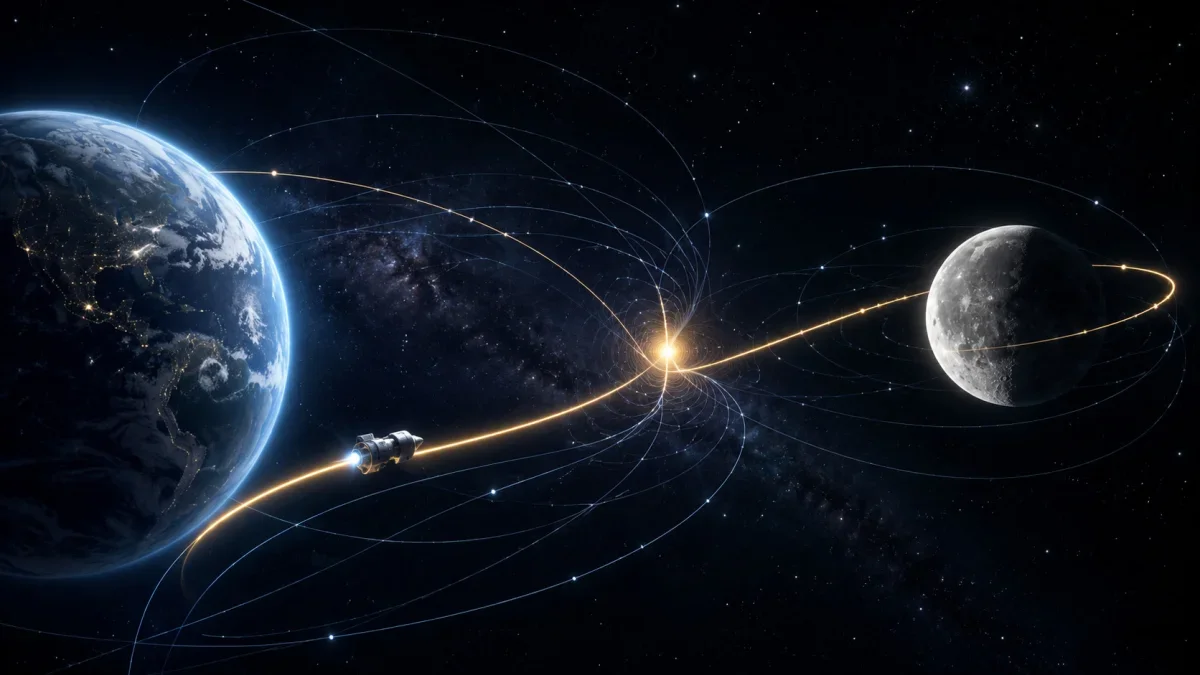
This new route prioritizes fuel efficiency over speed, taking approximately 32 days to transition from Earth orbit to lunar orbit. It first approaches the Moon closely, then enters a looping orbit around the Earth-Moon L1 Lagrange point, before finally descending into lunar orbit. While this slower trajectory may not be suitable for crewed missions, it holds promise for future cargo deliveries, especially as lunar habitats become more permanent.
Navigating Gravitational Corridors
The study leverages a mathematical framework known as the theory of functional connections (TFC), which streamlines the process of identifying optimal paths by incorporating mission constraints directly into the calculations. This innovative method enabled researchers to explore a vast array of trajectories, far exceeding previous studies that typically analyzed around 280,000 paths.
In their findings, the researchers discovered that entering the gravitational route from a position closer to the Moon is more fuel-efficient than previously assumed. "Our systematic analysis reveals that nontraditional solutions can yield significant benefits," remarked Vitor Martins de Oliveira, a postdoctoral researcher at the University of São Paulo and co-author of the study.
Leveraging L1 as a Gravitational Waypoint
The proposed trajectory treats the L1 point as a gravitational waypoint, where the spacecraft can maintain communication with Earth, avoiding potential communication blackouts experienced during lunar flybys. This aspect becomes increasingly vital as lunar missions multiply, emphasizing the need for reliable communication.
While this route may not always be the most efficient in terms of velocity change compared to direct transfers, it offers unique advantages, such as a closer lunar approach and a stable orbital position for communication.
As lunar exploration evolves, the efficiency of such routes will become essential. The findings, published in the journal Astrodynamics, highlight a promising future where advanced calculations can pave the way for more sustainable and cost-effective space missions.