The management of used nuclear fuel presents a significant challenge for the nuclear energy sector. Once a reactor ceases operation, the waste remains highly radioactive, necessitating complex and costly storage solutions that can last from tens of thousands to even hundreds of thousands of years.
However, researchers are now investigating the potential of advanced physics technologies to significantly reduce this timeline. Their approach involves transforming the most hazardous components of nuclear waste into materials that decay much more rapidly.
The proposed method combines a particle accelerator with a subcritical nuclear reactor. Traditional nuclear reactors produce isotopes such as Plutonium-239 and Americium-241, which are classified as "transuranic" elements and can remain radioactive for tens of thousands of years. These reactors often struggle to efficiently manage these isotopes due to the instability they introduce into the chain reaction.
In contrast, the accelerator-driven system operates with a subcritical reactor, which lacks sufficient fuel to sustain a chain reaction independently. It requires an external energy source--provided by a high-power particle accelerator--to maintain the reaction.
The U.S. Department of Energy's Advanced Research Projects Agency-Energy (ARPA-E) has allocated $8.17 million to the Thomas Jefferson National Accelerator Facility for two projects aimed at realizing this vision. This funding is part of the Nuclear Energy Waste Transmutation Optimized Now program (NEWTON), which seeks to explore technologies that can reduce the longevity of nuclear waste while simultaneously generating power from it.
Transforming Waste into Energy
Spent nuclear fuel, if left untreated, remains hazardous for exceedingly long periods. While the majority of its heat and radioactivity diminishes after several hundred years, certain components can still pose risks for up to 100,000 years or longer. ARPA-E suggests that by isolating and recycling the most problematic isotopes, the hazardous timeline could be reduced to approximately 300 years. Though this is still considerable, future generations will benefit from these advancements.
In accelerator-driven systems, high-energy protons are directed into a heavy target, such as liquid mercury, resulting in a burst of neutrons through a process called spallation. These neutrons interact with the long-lived isotopes in nuclear waste, converting them into shorter-lived, more manageable materials.
"These neutrons will interact with these unwanted isotopes, transforming them into isotopes that can either be repurposed or disposed of underground," explained Rongli Geng, a principal investigator on the projects. "This could reduce storage timeframes from 100,000 years to just 300."
Making Accelerators More Accessible
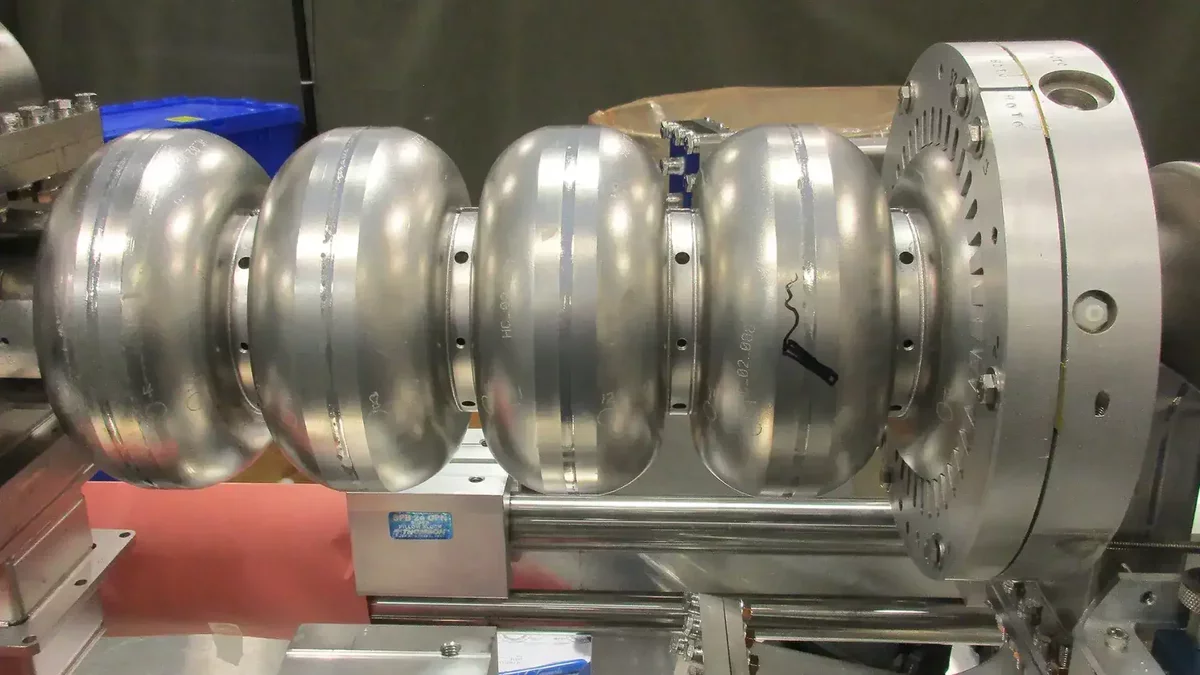
The concept of utilizing particle accelerators for nuclear waste management has been explored for years, but high costs have hindered progress. Most large accelerators depend on superconducting cavities made from niobium, which require extremely cold environments, leading to expensive cooling systems.
Researchers at Jefferson Lab are pursuing a more efficient method by applying a thin layer of tin to niobium cavities, enabling operation at higher temperatures and reducing the need for specialized cooling solutions. Additionally, they are developing a new cavity design known as a spoke cavity to enhance efficiency further.
Another project focuses on the power supply for the accelerator, exploring advanced magnetrons, similar to those used in microwave ovens, to provide the necessary energy for the particle beam.
Collaboration with industry partners, including Stellant Systems and Oak Ridge National Laboratory, aims to transition these technologies from the lab to practical applications.