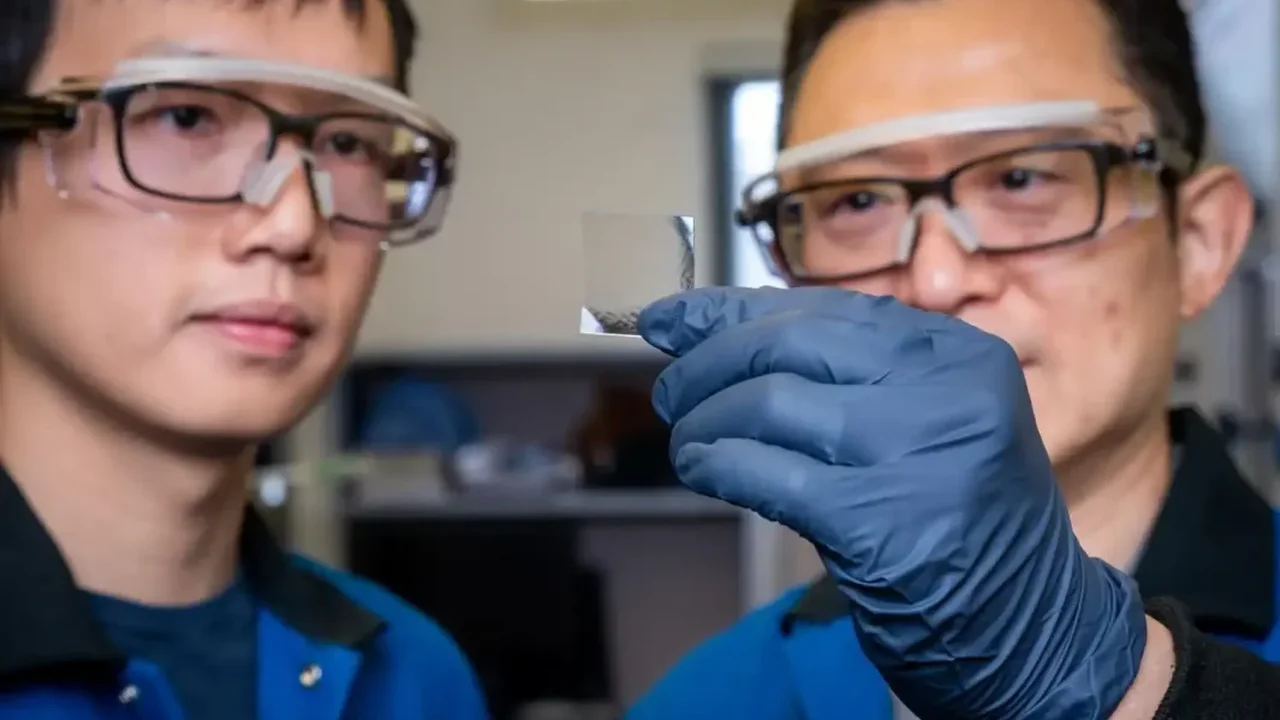
An international research collaboration, featuring scientists from TU Dortmund and the University of Birmingham, has unveiled groundbreaking findings published in Nature Chemistry on May 4. This study reveals that Metal-Organic Framework (MOF) glasses can be engineered using techniques reminiscent of those applied to traditional glass.
The researchers discovered that incorporating small chemical compounds containing sodium or lithium alters both the structure and properties of these glasses. These additives reduce the temperature at which the glass softens and enhance its flowability during heating, potentially streamlining the manufacturing process.
This breakthrough paves the way for the development of tailored MOF glasses suited for cutting-edge technologies. Applications may range from gas separation and chemical storage to advanced coatings and sustainable energy systems.
Dr. Dominik Kubicki from the University of Birmingham remarked, "Glass has been integral to human civilization for thousands of years. From ancient Mesopotamia to contemporary fiber-optic technology, minor chemical modifications facilitate the processing of glass and enhance its functional characteristics."
However, traditional MOF glasses typically soften at elevated temperatures--over 300 °C--close to their degradation point, complicating manufacturing and limiting broader applications. This discovery opens new avenues for the creation of high-performance materials.
Structural Innovations with Sodium
Among the notable MOF glasses is ZIF-62, a porous material that can transition into glass while retaining some internal pores, making it advantageous for applications such as gas separation and catalysis.
Professor Sebastian Henke from TU Dortmund University elaborated, "Our approach draws inspiration from the modifications made to conventional silicate glasses, where disrupting the network structure fine-tunes melting behavior and mechanical properties. Our findings demonstrate that this principle can be effectively applied to hybrid metal-organic glasses, bringing them closer to practical manufacturing and diverse applications."
To investigate how sodium additives impacted the material, the team employed advanced analytical methods. Researchers at the University of Birmingham, led by Drs. Dominik Kubicki and Benjamin Gallant, conducted atomic-level examinations and performed high-temperature solid-state Nuclear Magnetic Resonance (NMR) spectroscopy at the UK High-Field Solid-State NMR Facility.
The results unveiled how sodium ions integrate into the glass network, weakening certain internal connections.
AI Insights into Atomic Changes
Another team at Birmingham, under the guidance of Professor Andrew Morris and Dr. Mario Ongkiko, utilized AI-driven computational modeling to decode the intricate NMR data. Their machine-learning simulations illustrated sodium's interactions with the glass at an atomic level, corroborating experimental findings.
The combined experimental and computational insights revealed that sodium not only fills voids within the material but also replaces zinc atoms, slightly loosening the glass structure and modifying its characteristics.
With a deeper understanding of material modification, researchers emphasize the need for further investigations to enhance stability, accurately predict behaviors, and assess performance in practical applications.
This study involved contributions from Technische Universität Dortmund, the University of Birmingham, Ruhr-University Bochum, SRM University-AP, the Technical University of Munich, and the University of Cambridge.