Researchers at Binghamton University have developed a paper-based wallpaper concept that captures moisture from indoor air and converts it into a small, continuous electrical current. Designed for low-energy electronics, the material could one day help walls support connected devices while contributing to indoor humidity management.
How the wallpaper generates power
Each moist-electric unit is built from a 2-by-2-centimeter piece of chromatography paper. Its outer edge contains glycerol, which absorbs water vapor, while an inner layer of polyvinylpyrrolidone retains moisture and guides it toward the center.
A wax-treated central area allows vapor to leave while resisting liquid water. This creates a controlled route: moisture enters at the edges, travels inward and exits as vapor. Maintaining this movement is essential, as it prevents the paper from becoming uniformly damp and helps sustain the electrical output.
The team believes interactions between water and oxygen-rich chemical groups create a charge imbalance, likely involving mobile hydrogen ions. The exact mechanism remains under investigation, but the system demonstrated stable operation for around 270 minutes when both moisture intake and vapor-release pathways were active.
From small units to a functional panel
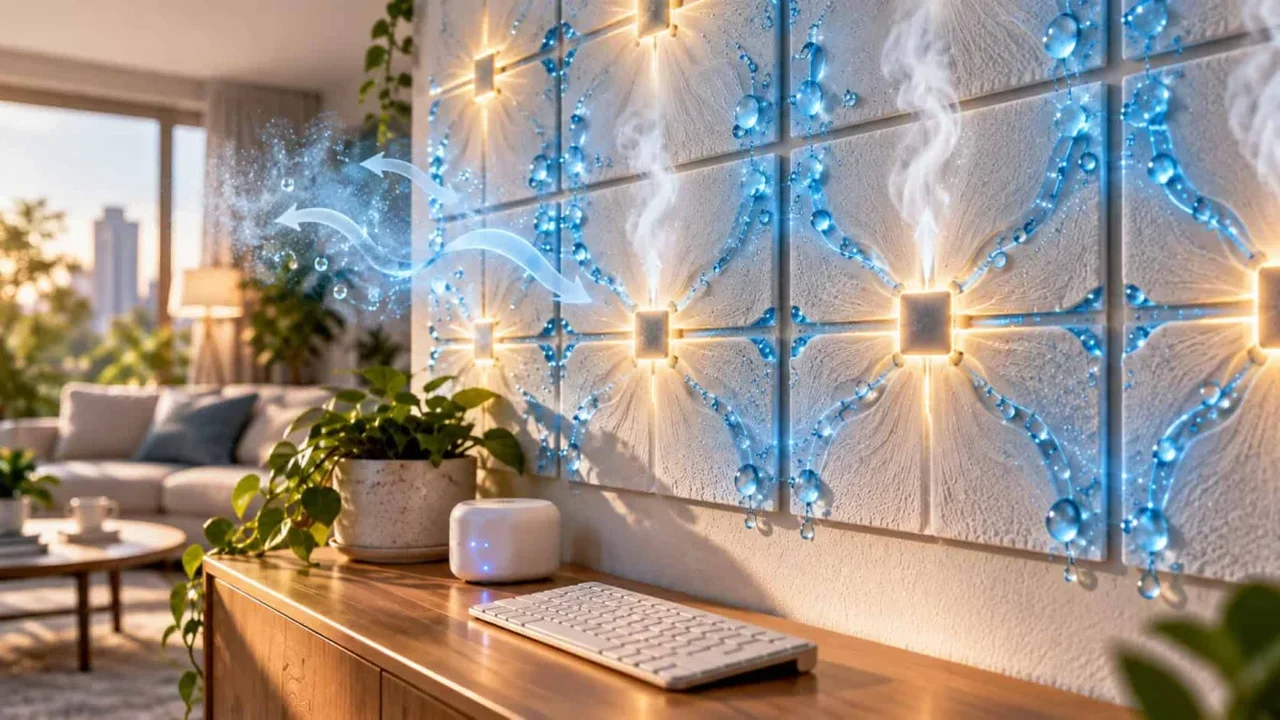
At 80% relative humidity, a single generator produced approximately 0.34 volts. In a larger test, researchers connected 1,596 units into a wall-sized series-parallel array. At roughly 38% humidity, the panel generated about 3.5 volts and powered a wireless keyboard using a capacitor to store energy for brief demand peaks.
The prototype also showed early humidity-control potential. During a 15-minute test, the panel reduced nearby relative humidity from around 38% to 32%. In a sealed chamber, 28 units lowered humidity from approximately 75% to 50% in about four minutes.
The technology is not intended to replace solar power or household electricity systems. Instead, it could offer a complementary energy source for sensors, smart-home controls and other devices with modest power needs. Long-term durability, material stability and large-scale manufacturing will require further study.
By transforming ordinary interior surfaces into active energy-harvesting materials, this approach could help shape future buildings that are more responsive, efficient and connected.