On November 15, 1883, the ship Grecian was caught in a violent storm. A nearby vessel, the Martha Cobb, struggled to launch a rescue boat through the breaking waves. Its captain, Thomas Greenbank, poured about 19 litres of fish oil into the sea. Roughly 20 minutes later, accounts described a calmer patch around the ships: the large swells remained, but their breaking crests had eased. A small boat reached the Grecian and rescued all ten crew members.
Sailors had used oil on rough seas for centuries. The Roman naturalist Pliny the Elder wrote about oil smoothing water, while Benjamin Franklin later tested the effect himself. In 1773, he observed that a small amount of olive oil could spread over a broad area of a wind-ruffled pond, leaving its surface remarkably smooth.
What the oil changes
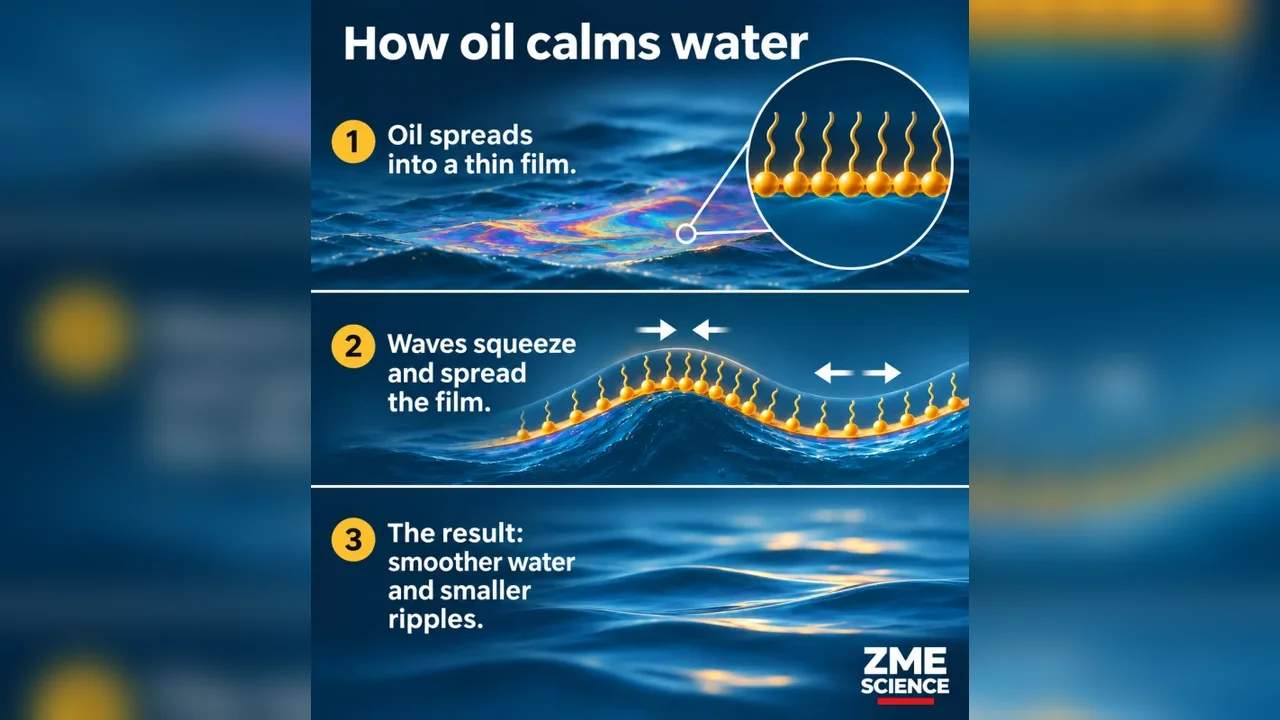
Oil does not stop powerful ocean swells. Instead, a thin film can dampen tiny ripples that help make the water surface rough. As the film shifts with the moving water, changing surface tension creates forces that resist motion and dissipate energy. With fewer small ripples, the wind also interacts differently with the sea, reducing its ability to build some wind-driven waves.
Modern experiments support parts of this explanation. A 2019 study in Ocean Science found that a fish-oil film almost suppressed wind-generated waves in a test tank, while measured wind stress on the water fell by 95%. Research published in the Journal of Fluid Mechanics in 2023 also showed that surface-active substances can alter how breaking waves form.
Oil was once carried as emergency equipment on some ships, but releasing it into the ocean is not a recommended survival method today because of its environmental effects. The old maritime practice nevertheless offers a striking example of observation preceding scientific understanding.
Studying how thin surface films affect waves could deepen understanding of air-sea interactions and help refine future models of ocean conditions.