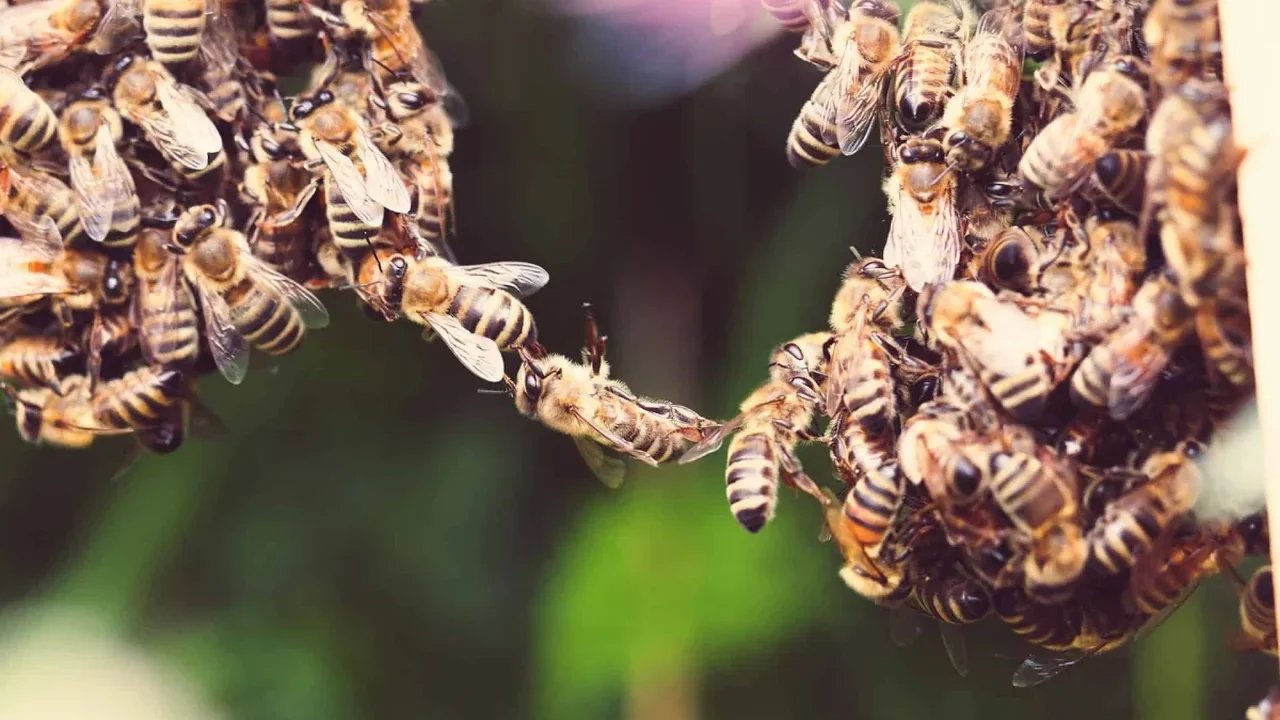
A honeybee hive can remain in the same place for generations, but that does not necessarily mean the colony itself lives on. In a review published in Insectes Sociaux, evolutionary biologists Hannes Bonhoff of Lund University and Heikki Helanterä of the University of Oulu propose a different way to understand the colony's life cycle.
They argue that a queen and her workers form a superorganism: a coordinated living system in which individual bees perform specialized roles. On this view, the colony has a distinct genetic identity tied to its queen and the males she mated with.
Who leaves--and who inherits the hive?
During swarming, the researchers suggest, the queen and the workers who leave are the original colony. The daughter queen that remains behind begins a new one. As she produces workers, they gradually replace the older bees, while the successor colony inherits the established nest.
This challenges the idea that replacing a queen simply renews an existing colony. Instead, the authors say, queen replacement marks the beginning of a new superorganism, even if the hive itself stays occupied. They also distinguish swarming from reproduction: a colony may produce successors through other routes, including queen replacement.
The review extends the analogy to development. A young queen's colony grows through stages as workers care for its brood and sustain the nest until the next generation can take on the colony's essential tasks. The authors suggest that experienced workers may also pass on useful behaviours, such as foraging and communication skills.
Implications for colony research
This framework could change how scientists describe colony lifespan and assess practices such as requeening. A hive recorded as surviving for years may, under this interpretation, have housed successive colonies rather than one enduring organism. The review presents a new reading of existing evidence, not a test proving that beekeeping methods should change.
By treating colonies as organisms with their own beginnings and endings, researchers may gain a clearer way to study bee biology and resilience. That perspective could help shape more precise approaches to understanding and supporting honeybee populations.