Johann Wolfgang von Goethe, one of history's most celebrated intellectuals, is widely recognized as Germany's foremost literary figure. Known for his 18th-century masterpieces such as Faust and The Sorrows of Young Werther, Goethe also made significant strides in scientific fields, particularly in botany and optics.
His insatiable curiosity is evident in his extensive geological collection, which comprises over 18,000 items housed in his former residence in Weimar, Germany. Among these treasures, a small assortment of amber, which he categorized as "combustible substances," has recently garnered renewed attention.
While a 1978 catalog identified only four pieces, a recent assessment revealed the collection contains at least 40 specimens, many of which feature remarkably preserved bioinclusions, including insects trapped in amber.
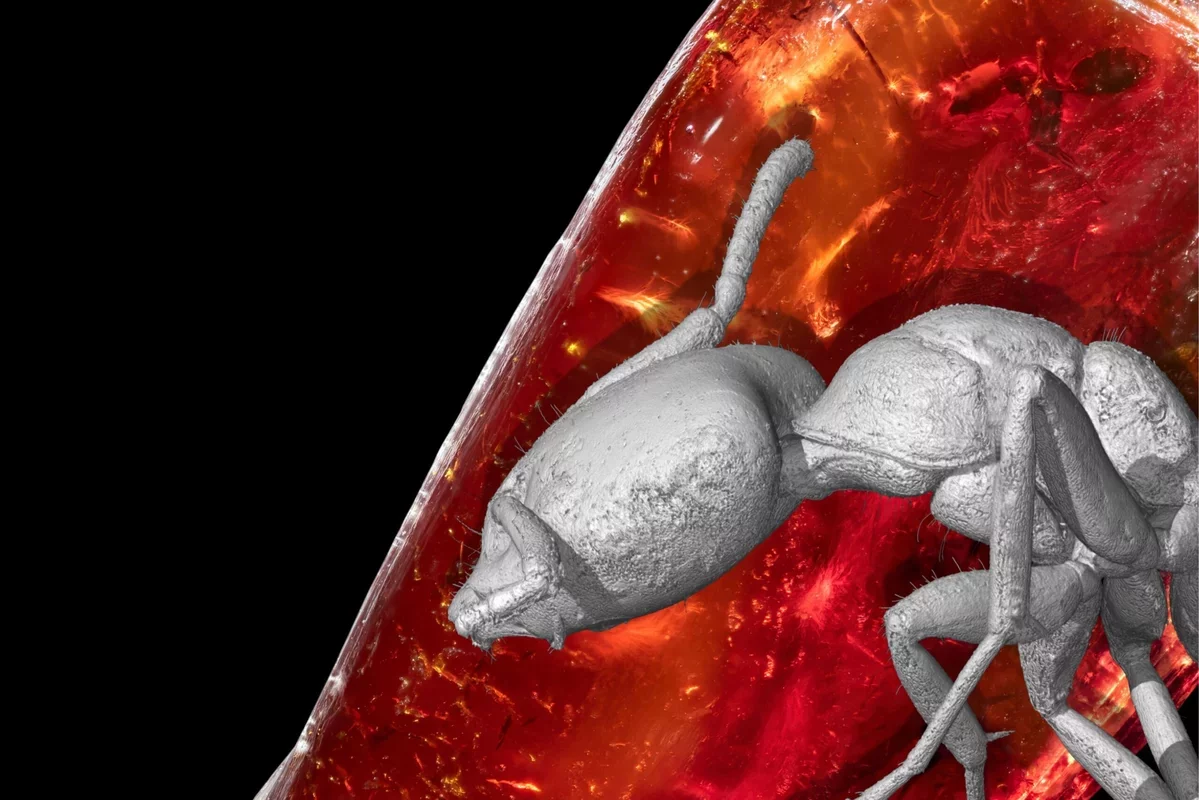
Given the amber's opaque nature and its cultural significance, cutting or polishing it was not an option. Therefore, researchers from Friedrich Schiller University Jena employed advanced imaging techniques, such as synchrotron-based micro-computed tomography (SR-μ-CT), to virtually explore the amber layers without physically altering the specimens.
Goethe's Ant
One particular sample caught their attention, leading to the creation of high-resolution 3D models of the ant species Ctenobethylus goepperti.
This ant belongs to the subfamily Dolichoderinae, known for their speed, chemical defenses, and social structures. However, the Ctenobethylus genus has long been a challenge for scientists due to the small size and obscured nature of its fossils.
The 3D reconstructions are so detailed they reveal the ant's skeleton, including the tentorium and prosternum, which are endoskeletal features never before documented in a Cenozoic fossil ant. This breakthrough helps clarify the ant's position on the evolutionary tree.
Researchers suggest that this ant is likely closely related to the modern genus Liometopum, which you might recognize if you've seen large columns of ants traversing tree trunks in a forest.
"We have fully processed the specimen and, based on the newly acquired information, created a 3D reconstruction that is available online," states Daniel Tröger from the University of Jena. "This model helps colleagues worldwide to identify and compare further fossils of this species."
What This Ant Tells Us
In the warm-temperate coniferous forests of ancient Europe, C. goepperti likely played a significant role as an arboreal "carton-nester," constructing intricate homes in trees and forming expansive colonies. They were probably the dominant species of the canopy.
This discovery introduces a new concept called Collectomics, which treats museum collections as valuable, structured datasets. By applying modern morphological techniques to historical collections, scientists can uncover new evolutionary insights from specimens that are over 200 years old.
Though Goethe's amber collection may seem modest, it has provided enough material, combined with contemporary imaging, to shed new light on this species.
Goethe once remarked that no theory should hinder true observation. Today, through X-ray technology he could never have envisioned, we are finally uncovering the wonders he once held.
Journal Reference: Brendon E. Boudinot et al, Discovery of Goethe's amber ant: its phylogenetic and evolutionary implications, Scientific Reports (2026).