The Venice Biennale this year presents a compelling exploration of decay and resilience, with many national pavilions reflecting on the complexities of history and identity. A notable example is the Slovenian Pavilion, where the Nonument Group transforms materials from past Biennales into a poignant tribute to a mosque built for Bosnian Muslim soldiers during World War I. Similarly, Sara Shamma's work for Syria, marking the nation's first pavilion since the Civil War, poignantly references the ancient site of Palmyra, which suffered destruction during ISIS's cultural campaign.
Germany's pavilion, titled "Ruin," invites visitors to contemplate the pavilion's architecture as a metaphor for the lingering effects of nationalism. Artists Henrike Naumann and Sung Tieu engage with the notion of historical residue, prompting questions about the persistence of nationalist ideologies. Their thought-provoking work, curated by Kathleen Reinhardt, resonates deeply in the context of the Biennale's evolving landscape, especially in light of recent administrative changes, including the resignation of the award jury.
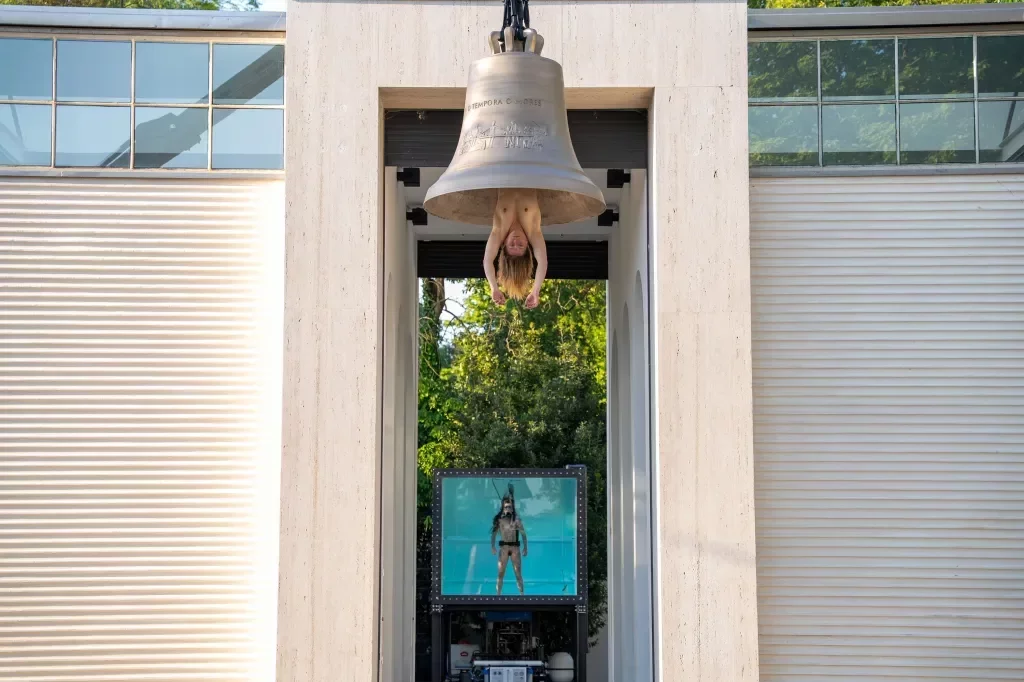
In Austria, Florentina Holzinger's exhibition "Sea World" captivates audiences with its bold performances, challenging perceptions of environmental degradation and societal norms. Holzinger's provocative art invites viewers to reflect on the grotesque aspects of contemporary life, raising questions about what we choose to overlook in our daily existence.
The Peruvian Pavilion, featuring artist Sara Flores from the Shipibo-Konibo community, presents "From Other Worlds," emphasizing ecological balance and cultural heritage. Flores' hand-painted tapestries and video installations explore the intrinsic connection between humanity and nature, urging a dialogue on deforestation and cultural preservation.
Japan's pavilion, transformed by Ei Arakawa-Nash, offers a unique perspective on parenthood through a playful yet profound installation titled "Grass Babies, Moon Babies." Visitors engage with lifelike sculptures that reflect on the joys and challenges of raising children, presenting a gentle critique of societal expectations.
In the Korean Pavilion, artists Hyeree Ro and Choi Goen explore historical connections between Korea and Japan through a monumental installation that symbolizes their shared past. Their exhibition, "Liberation Space: Fortress/Nest," invites contemplation on memory, identity, and the future.
The Brazilian Pavilion showcases the works of Rosana Paulino and Adriana Varejão, addressing themes of resilience and historical trauma through powerful installations. Their art serves as a reminder of Brazil's complex legacy, intertwining beauty with the scars of its past.
As the Biennale unfolds, it becomes clear that these national pavilions are not merely artistic displays but vital dialogues about history, identity, and the future. The conversations sparked within these spaces may inspire new ways of thinking and create pathways for cultural healing and understanding.