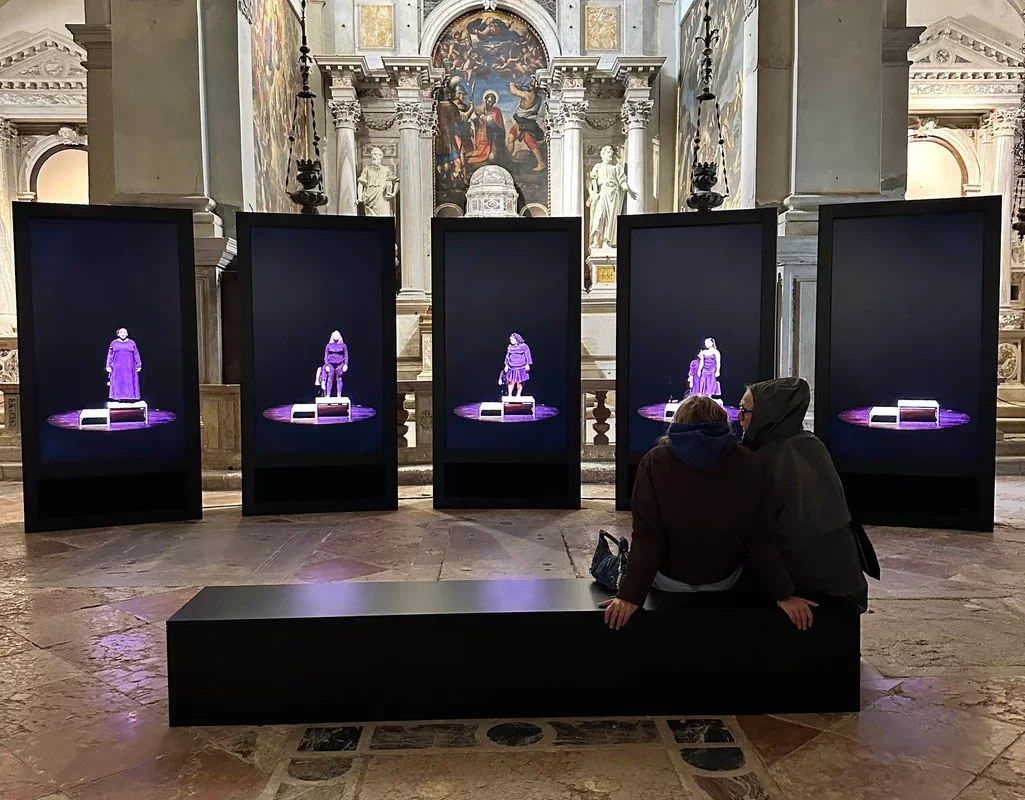
VENICE -- Within the ornate setting of the Chiesa di Sant'Antonin, Gabrielle Goliath's exhibition, Elegy, serves as South Africa's unofficial representation at the 61st Biennale Arte. The event gained this unofficial status after South Africa's Culture Minister Gayton McKenzie intervened just months before the exhibition opened, overruling the independent committee's selection of Goliath. His actions were influenced by concerns that South Africa's platform was being used to convey a geopolitical stance regarding Israel's actions in Gaza, particularly in light of Goliath's intention to memorialize victims of violence in her work.
Despite filing a lawsuit against McKenzie, which was dismissed by South African courts, Goliath's poignant installation remains a powerful statement. The exhibition comprises three significant pieces from her ongoing series Elegy, each honoring victims of violence: Elegy--Ipeleng Christine Moholane (2015) commemorates a South African student lost to the country's femicide crisis; Elegy--for two ancestors (2024) reflects on the historical atrocities faced by the Ovaherero and Nama peoples in Namibia; and Elegy--for a poet (2026) pays tribute to Palestinian poet Heba Abunada, who tragically lost her life in an Israeli airstrike.
The installations utilize freestanding LED screens, showcasing women and genderqueer individuals dressed in dark attire, each taking turns to sound a note of mourning until they can no longer continue. This format varies in number, with one screen for Moholane, two for the Nama women, and five for the victims in Gaza--culminating in an empty dais that invites viewers to engage in this collective act of remembrance.
In the church's acoustically rich environment, the voices blend into a haunting choir, intertwining the narratives of violence through a shared geopolitical lens. Goliath's approach avoids reducing the victims to mere spectacles; instead, their presence is memorialized in a manner that demands viewers' emotional engagement. This artistic expression serves as a profound reminder of the ongoing struggle against violence and the necessity of collective mourning.
Goliath emphasizes that this body of work embodies the "urgent, ongoing life-work of mourning," suggesting that shared grief can foster solidarity and inspire action. The artist poses a poignant question about the role of mourning in social change, highlighting the importance of recognizing and addressing atrocities rather than allowing them to fade into silence. In doing so, she challenges audiences to transform passive observation into active participation in the fight for justice and humanity.
Elegy continues at Chiesa di Sant'Antonin (Salizada S. Antonin, Venice) through July 31, inviting all to reflect on the profound connections between art, memory, and social responsibility.