Researchers are making significant strides in understanding the fundamental nature of matter through the study of mesons--particles composed of a quark and an anti-quark. These particles can form a unique structure known as a mesic nucleus, which allows scientists to delve into the vacuum's properties and the origins of particle mass. Recent experimental findings have brought to light evidence of a novel type of mesic nucleus, marking a pivotal moment in this research.
Unveiling a New Particle State
An international research team has unveiled indications of a previously unobserved state, termed the η′-mesic nucleus. Their groundbreaking results, set to be published in Physical Review Letters, suggest the potential existence of this exotic bound system.
Under specific conditions, fleeting particles known as mesons, which exist for less than ten-millionth of a second, can become momentarily trapped within an atomic nucleus, forming this rare state. Investigating these mesic nuclei is crucial for unraveling the complexities of the strong nuclear force and understanding how vacuum conditions transform in highly dense environments.
Senior author Kenta Itahashi highlights the η′ meson as particularly intriguing due to its unusual weight compared to similar particles. Physicists anticipate that its mass may vary when it resides within nuclear matter, and observing this effect could yield vital insights into the generation of particle masses throughout the universe.
Precision Experiments at the GSI Facility
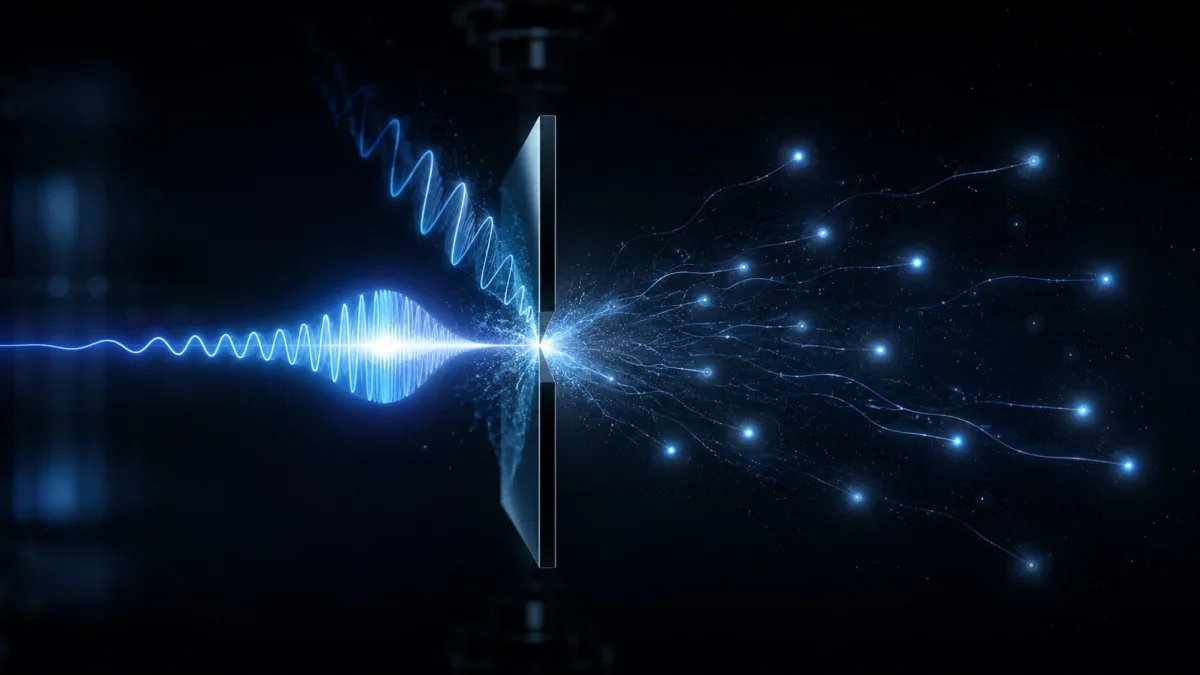
To search for η′-mesic nuclei, the team conducted a high-precision experiment at the GSI Helmholtzzentrum für Schwerionenforschung in Germany. They directed a high-energy proton beam at a carbon target, exciting the carbon nuclei and producing η′ mesons, which occasionally bound to the nucleus. The researchers analyzed the emitted deuterons--composed of one proton and one neutron--to measure the excitation energy of the carbon nuclei using a high-resolution spectrometer known as the Fragment Separator (FRS).
Additionally, the team utilized a specialized detector, WASA, originally designed in Uppsala, Sweden. This device enabled the detection of high-energy protons exiting the target and identifying signals indicative of the creation and capture of η′ mesons within the nucleus. The decay signatures were essential for confirming the existence of this exotic state.
Lead author Ryohei Sekiya explained that the innovative combination of the FRS and WASA allowed for the identification of data structures that correspond with theoretical predictions of η′-mesic nuclei, suggesting their formation.
Insights into Particle Mass
The excitation spectrum measured during the experiment reveals patterns aligning with the formation of η′-mesic nuclei. Notably, the findings indicate that the mass of the η′ meson may decrease when situated in nuclear matter, providing experimental evidence that supports theoretical predictions and enhances our understanding of particle properties under extreme conditions.
Itahashi emphasized that these measurements offer crucial insights into meson behavior within nuclear matter, bringing researchers closer to resolving profound questions about the nature of mass and the vacuum's structure in atomic nuclei.
Future Directions
The team aims to conduct further experiments to enhance measurement precision and seek additional decay signals to confirm the existence of η′-mesic nuclei. Each new discovery will refine our comprehension of the fundamental laws governing matter and the universe.