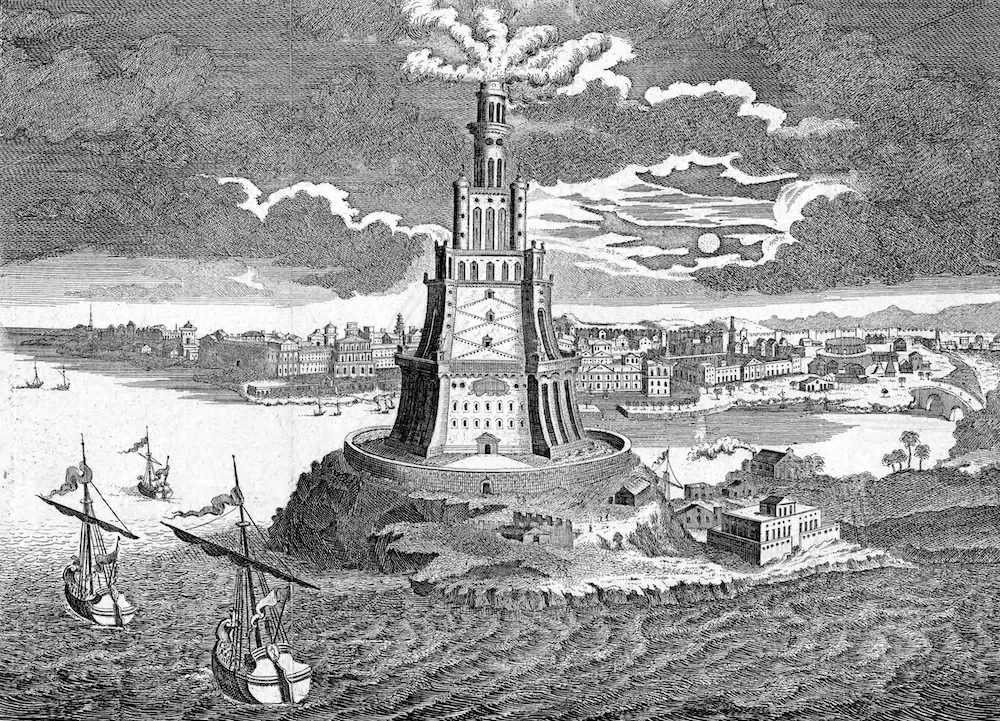
The Lighthouse of Alexandria, renowned as one of the Seven Wonders of the Ancient World, once towered over the harbor of Alexandria during Egypt's Hellenistic period. Standing at an impressive 460 feet, it was the second tallest structure of its time, surpassed only by the Great Pyramid of Giza.
Commissioned by Ptolemy I Soter, a general under Alexander the Great who later became the pharaoh of Egypt, the lighthouse was completed by his son, Ptolemy II Philadelphus. During the Ptolemaic dynasty, which thrived for three centuries, Alexandria emerged as a vibrant center of Greek culture.
Situated on the island of Pharos, the lighthouse was constructed from limestone, featuring a rectangular base, an octagonal middle, and a cylindrical top. It employed mirrors and a furnace to illuminate the way for ships entering the harbor.
Although the lighthouse suffered damage from previous earthquakes, it was ultimately destroyed by the earthquake of 1303, with much of it submerged under rising waters. Yet, a new initiative is underway. A dedicated team of historians, architects, and programmers is collaborating to create a detailed digital 3-D model of this ancient marvel.
Isabelle Hairy, an archaeologist leading the Pharos Project team, noted that the architectural remnants are scattered over an 18-acre area underwater. Last summer, the team used cranes to retrieve granite blocks and other artifacts for scanning and digital reconstruction. A significant find was a pylon that showcased a blend of Greek construction techniques and Egyptian design elements.
Currently, the project has successfully scanned around 5,000 building components and artifacts from the seabed. However, deteriorating underwater conditions suggest that future scans may necessitate retrieving submerged materials for preservation. Hairy expressed that the visibility is extremely poor, complicating the scanning process, and estimates that completing the project could take generations.