Recent experiments conducted by physicists have unveiled a fascinating phenomenon: the dark "holes" within light waves can seemingly travel faster than light itself. This discovery does not contradict Einstein's principles, as darkness is neither a particle nor a wave and does not convey information. The term used for this darkness is "phase singularity," referring to points in a wave where the energy cancels out, resulting in a dark field.
Utilizing an advanced ultrafast electron microscopy system, researchers demonstrated that this form of darkness can move at speeds exceeding that of light, specifically 1.04 times faster. This finding aligns with the laws of relativity since darkness does not possess mass, energy, or information.
Surpassing the Speed of Light
Light travels at an astonishing speed of 299,792,458 meters per second. For perspective, the fastest human can sprint at approximately 12.4 m/s, and the quickest car reaches around 341 m/s. Even the Parker Solar Probe, the fastest man-made object, achieves a speed of 192,220 m/s--still significantly slower than light.
While light is indeed the universe's ultimate speed limit, achieving light speed for objects with mass requires infinite energy, making it impossible to reach or exceed this threshold. Additionally, transmitting information faster than light would disrupt the established cause-and-effect relationship, as messages could arrive before they are sent. In contrast, darkness operates under different rules.
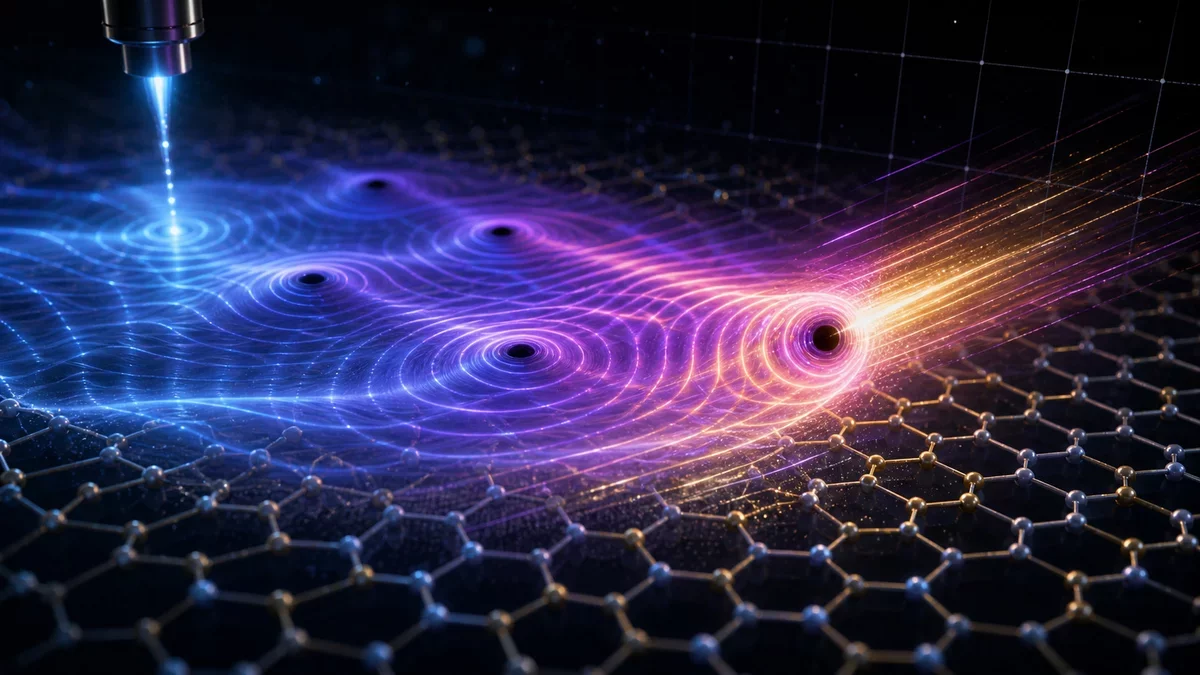
This darkness, resulting from phase singularities, is not a particle or signal traversing space. Instead, it occurs at points within a wave where the phase becomes undefined, akin to the calm center of a swirling storm. Here, opposite charges can cancel each other out, mirroring particle-antiparticle interactions.
Measuring the Unmeasurable
The researchers meticulously tracked these optical singularities as they emerged, moved, and disappeared within a hexagonal boron nitride membrane. Their findings revealed that just before annihilation, some singularities accelerated beyond the speed of light.
To visualize this, consider ocean waves intersecting; at certain points, one wave's crest meets another's trough, resulting in a moment of calm. This zero-point represents the darkness that the researchers monitored.
Employing a sophisticated transmission electron microscope and a technique known as free-electron Ramsey imaging, the team reconstructed the amplitude and phase of the light field, effectively creating a "movie" of the light waves and measuring the speed of the dark regions.
Significance of the Discovery
This groundbreaking evidence that darkness can exceed light speed is not just an intriguing scientific riddle; it holds substantial implications. The methodology developed for this research could facilitate the mapping of nanoscale topological defects in various systems, including superfluids and superconductors. The researchers suggest that this approach may unveil hidden processes in physics, chemistry, and biology at unprecedented timescales.
While Einstein's theory remains intact--no material object can surpass light speed, and no information can escape causality--the universe allows for a more nuanced understanding of speed: the swift movement of absence can indeed outpace the light surrounding it.
This discovery opens new avenues for exploring the fundamental nature of light and darkness, potentially transforming our understanding of physics and its applications in technology.