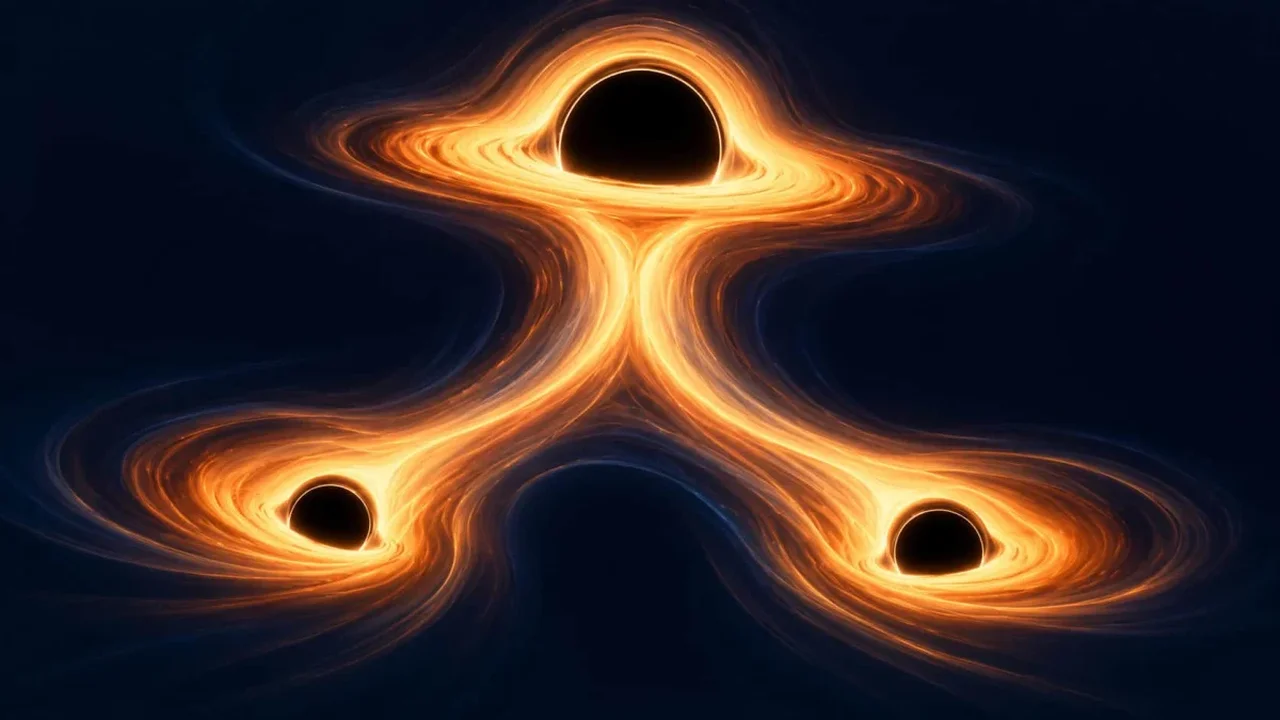
Black holes are known to merge, but could one divide into two? A study published in Physical Review D explores how unusual conditions might make such a scenario mathematically possible, even though it remains unobserved and is forbidden under ordinary assumptions.
Why splitting is difficult
Stephen Hawking's area theorem says a black hole's event horizon cannot shrink under classical general relativity. Since horizon area is tied to entropy, a stationary black hole splitting into two smaller ones would generally reduce the total entropy--contrary to the second law of thermodynamics.
The researchers, including Francesco Sannino of the University of Naples Federico II and the University of Southern Denmark, identify a possible exception involving rapid rotation. A spinning black hole has a smaller horizon area than a non-rotating one of equal mass. If its spin were converted into the outward motion of two fragments, their combined entropy might match or exceed the original. In a spacetime diagram, the horizon's shape would branch like a pair of trousers.
That possibility is highly constrained: the fragments would also need enough momentum to move apart rather than fall back together. The study suggests that only black holes rotating close to their theoretical maximum might leave room for this outcome.
Other theoretical routes
The team also considered higher-dimensional models, where elongated black holes called black strings can develop narrow necks, as well as alternative theories of gravity that change how black-hole entropy is calculated. Other proposed mechanisms could create a smaller black hole from energy associated with a larger one's spin, rather than splitting its horizon directly.
These scenarios are theoretical, and astronomers have not detected a black hole dividing. Researchers say potential clues could include gamma rays from very small black holes losing mass through Hawking radiation, though that radiation has not yet been confirmed.
Future observations and tests of gravity may show whether these mathematical possibilities describe nature, expanding our understanding of how black holes evolve.