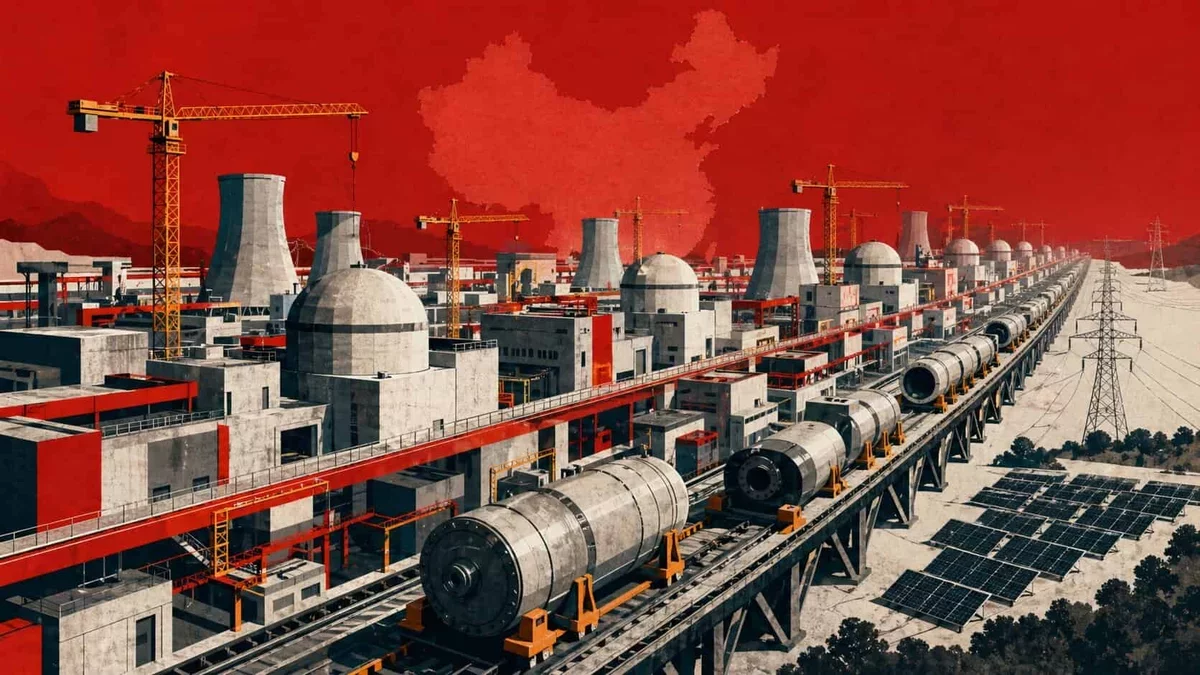
China's nuclear energy sector is undergoing a remarkable transformation, with the latest report from the China Nuclear Energy Association revealing that the nation can now construct up to 50 nuclear reactors at the same time. This capacity encompasses every phase from design to construction.
Currently, China operates 60 commercial reactors and has 36 more under construction--accounting for half of all new reactors globally. In contrast, the United States, despite being the leading generator of nuclear power, has faced significant challenges in bringing new plants online, with projects like the Vogtle Units 3 and 4 in Georgia encountering extensive delays and rising costs.
The key to China's rapid advancement in nuclear infrastructure lies in its integrated approach, which includes state-owned developers, streamlined approvals, affordable financing, standardized reactor designs, and a skilled construction workforce. Unlike many nations that treat nuclear projects as unique endeavors, China applies a factory-like methodology to its nuclear development.
Positioning for Global Leadership
In addition to its ongoing projects, Chinese authorities have greenlit 16 more reactors for future construction, potentially boosting the country's nuclear capacity to 125 gigawatts. By 2040, projections suggest that this figure could reach 200 gigawatts, according to Yang Changli, the rotating chairman of the CNEA.
A recent CNEA report indicates that China's nuclear technology has evolved from merely following global trends to taking a leading role in various areas.
While nuclear power offers substantial electricity generation with minimal carbon emissions, many Western nations struggle with delays and financial hurdles in construction. China, however, has maintained a steady pace of development, avoiding the common stop-and-start pattern that hampers nuclear projects elsewhere.
Understanding the 50 Reactors Capacity
The claim of building 50 reactors at once reflects China's ability to manage numerous nuclear projects concurrently across all stages. This efficiency is crucial, as nuclear energy relies heavily on a robust supply chain that includes reactor designers, engineers, and fuel suppliers. By maintaining a steady flow of projects, China enhances the efficiency of its nuclear infrastructure.
China's success can be attributed to a combination of industrial capacity and strategic policy. The nation currently has more nuclear generation facilities under construction than the rest of the world combined, with innovative designs like the Linglong-1 small modular reactor leading the way.
A Unified National Strategy
China's swift progress is backed by state support, which plays a significant role in all aspects of nuclear project development. This contrasts sharply with the U.S. model, where private developers must navigate complex regulatory environments. In China, nuclear projects are integrated into national planning, ensuring a more predictable pathway from approval to construction.
The U.S. can learn valuable lessons from China's approach, focusing on creating a streamlined regulatory process, reducing financing risks, and embracing standardized designs to facilitate nuclear expansion.
A Climate Solution and Geopolitical Implications
China's nuclear expansion aligns with its goals for energy security and climate policy. As the country aims to reduce its reliance on coal, a steady supply of nuclear power becomes essential for meeting its growing energy demands.
China's ability to construct multiple reactors simultaneously not only enhances its energy independence but also strengthens its geopolitical influence through international nuclear partnerships.
As the landscape of nuclear power evolves, the ability to construct reactors efficiently may define the future of energy production globally, positioning countries that can innovate and scale effectively at the forefront of the energy transition.