A groundbreaking study led by the Changping Laboratory in China, in collaboration with Washington University School of Medicine, has pinpointed a crucial brain region associated with Parkinson's disease. The research highlights the significance of a brain network known as the somato-cognitive action network (SCAN) in the disorder. Utilizing a non-invasive technique called transcranial magnetic stimulation (TMS), the team observed that patients experienced over double the improvement in symptoms compared to stimulation of adjacent brain areas.
Published in Nature on February 4, these findings challenge traditional perspectives on Parkinson's disease, paving the way for innovative and targeted treatment strategies.
Co-author Dr. Nico U. Dosenbach emphasized, "This research illustrates that Parkinson's is fundamentally a SCAN disorder. Targeting SCAN in a personalized and precise manner could enhance treatment outcomes significantly." He noted that modifying SCAN activity could potentially decelerate or even reverse the disease's progression, rather than merely alleviating symptoms.
Exploring SCAN's Functions in Movement and Cognition
Dr. Dosenbach first introduced the SCAN concept in 2023. This network, situated in the motor cortex, is essential for converting planned actions into physical movements and monitoring their execution. Given that Parkinson's disease impacts various functions beyond movement--such as digestion, sleep, motivation, and cognition--senior author Dr. Hesheng Liu collaborated with Dosenbach to explore whether disturbances in SCAN could elucidate the diverse symptoms of the disease and serve as a viable treatment target.
To validate this hypothesis, Liu's team examined brain imaging data from over 800 participants across several research institutions in the U.S. and China. The study included individuals with Parkinson's undergoing deep brain stimulation (DBS) and various non-invasive therapies, alongside healthy volunteers and those with other movement disorders for comparative analysis.
Identifying Abnormal Brain Connectivity
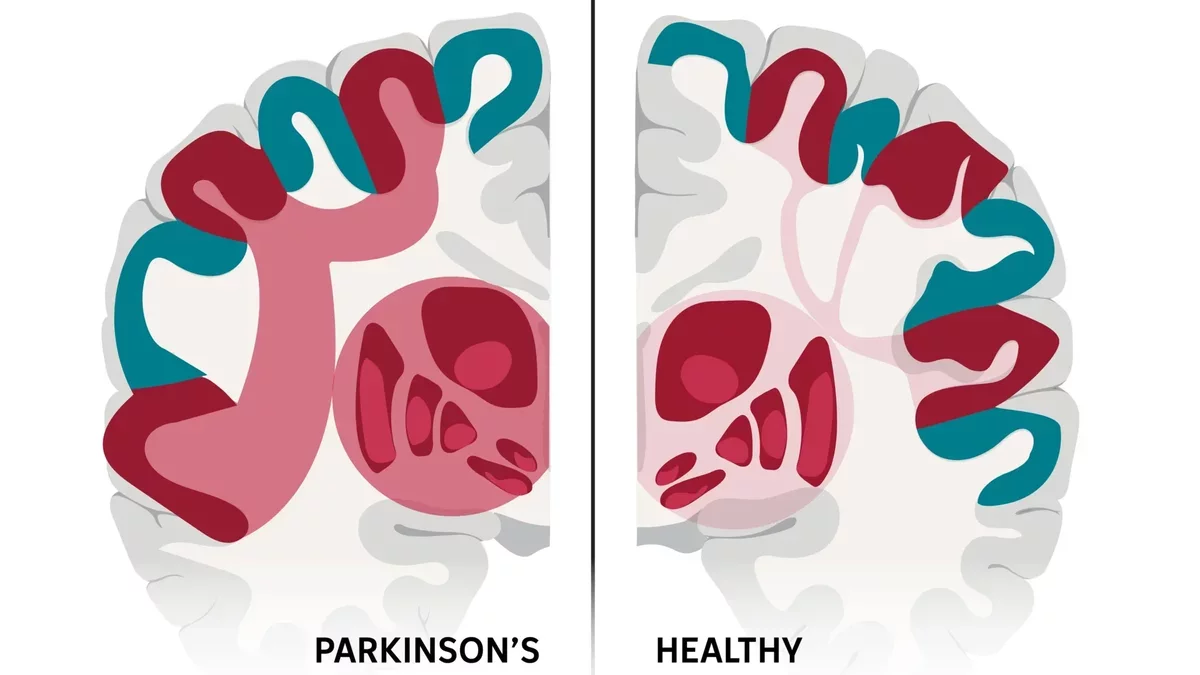
The research revealed that Parkinson's disease is characterized by excessive connectivity between SCAN and the subcortex, a brain region involved in emotional regulation, memory, and motor control. The therapies tested were most effective when they mitigated this overconnection, restoring a balanced interaction between these brain regions and normalizing the circuitry responsible for action planning and coordination.
"Historically, Parkinson's has been linked primarily to motor deficits and the basal ganglia," remarked Liu. "Our findings indicate that the disorder is rooted in a broader network dysfunction. The SCAN's hyperconnectivity to critical areas related to Parkinson's disrupts not only motor functions but also cognitive and bodily processes."
Promising Results from Precision Treatments
Building on these discoveries, the researchers devised a precision treatment system aimed at targeting SCAN with millimeter-level accuracy, without the need for surgery. This method employs transcranial magnetic stimulation to deliver magnetic pulses to the brain via a device positioned on the head. In a clinical trial, 18 patients receiving SCAN-focused stimulation demonstrated a 56% improvement rate after two weeks, compared to only 22% in those receiving stimulation to nearby regions--signifying a 2.5-fold increase in effectiveness.
"With non-invasive methods, we could initiate neuromodulation treatments much earlier than current DBS practices, as they do not necessitate surgical procedures," Dosenbach noted.
Further foundational research is essential to fully comprehend how different components of SCAN contribute to specific Parkinson's symptoms. Dosenbach is set to commence clinical trials with Turing Medical, a startup he co-founded, to evaluate a non-invasive therapy that uses surface electrode strips over SCAN areas to address gait issues in Parkinson's patients. Additionally, he aims to investigate low-intensity focused ultrasound as another non-invasive approach for modifying SCAN activity using acoustic energy.