In a remarkable advancement, researchers have successfully synthesized a previously elusive form of carbon known as lonsdaleite, or hexagonal diamond. Named after the pioneering crystallographer Kathleen Lonsdale, this material was long considered a mere myth, with its existence debated for over six decades.
Historically, lonsdaleite was identified only in meteorite impact sites, thought to be a super-diamond potentially tougher than traditional diamonds. However, skepticism surrounded its authenticity, with many scientists questioning whether the observed structures were distinct from regular cubic diamonds or merely flawed versions of them.
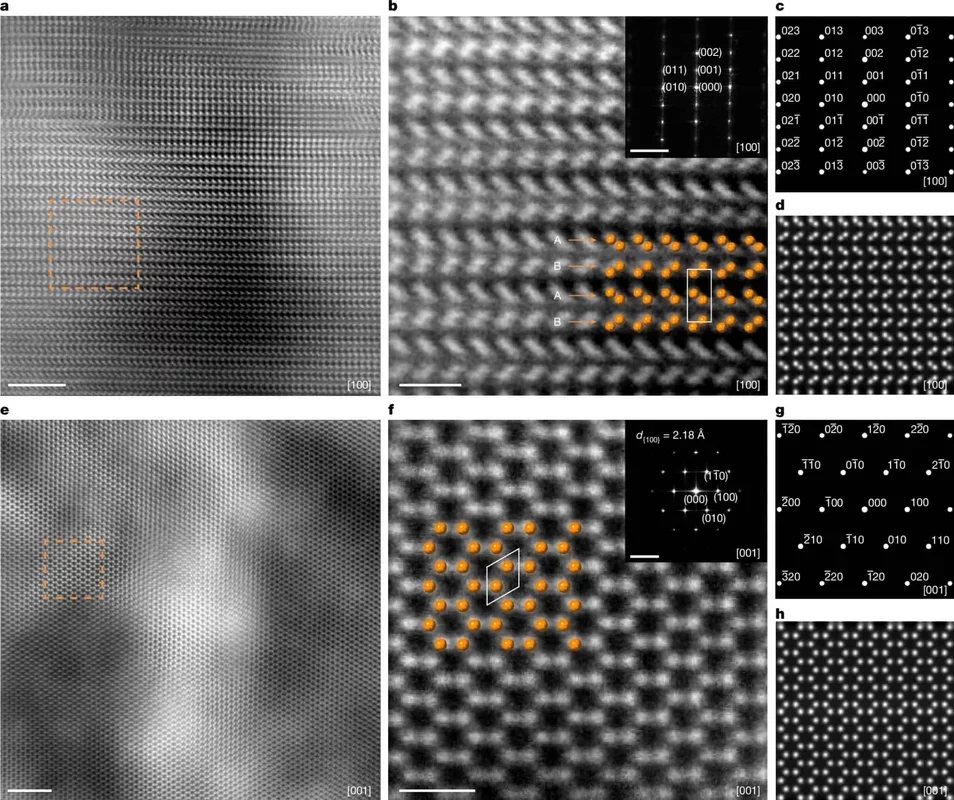
A recent study published in Nature presents compelling evidence that lonsdaleite is indeed real. The research team, led by Chinese scientists Shoulong Lai and Xigui Yang, successfully created pure samples of this hexagonal diamond, measuring millimeters in size. Their findings indicate that lonsdaleite may possess greater hardness and stiffness compared to conventional diamonds.
Understanding the Significance of Hexagonal Diamond
Diamonds are celebrated for their unique crystal structures, where carbon atoms typically form a cubic lattice. However, lonsdaleite showcases a hexagonal lattice arrangement, a phenomenon not previously observed in diamond. This discovery opens new avenues for research in materials science.
To synthesize lonsdaleite, the researchers began with highly oriented pyrolytic graphite, heating it to temperatures between 1,300 and 1,900 °C while applying immense pressure--approximately 20 gigapascals, equivalent to about 200,000 times the pressure at sea level. A crucial factor in their success was the method of applying pressure, ensuring it was directed primarily in one orientation, preventing the chaotic sliding that typically leads to cubic diamond formation.
The Future of Hexagonal Diamond in Technology
The implications of this breakthrough are significant. By confirming the existence of lonsdaleite, scientists can transition from debating its validity to exploring its practical applications. The study suggests that this hexagonal diamond variant is slightly superior in hardness and thermal stability, potentially revolutionizing fields such as electronics. Its unique properties could contribute to advancements in power grids, faster processors, and more efficient electric vehicles.
While the current samples are still relatively small, they mark a crucial step towards understanding and utilizing this new material. Future research may lead to the development of larger, more refined crystals, paving the way for comprehensive studies of their properties.
This significant achievement not only enhances our understanding of carbon structures but also opens new possibilities for innovation in various technological domains, promising a future where lonsdaleite could play a pivotal role in advanced materials science.