Slime molds, fascinating yellow organisms resembling amoebas, thrive in damp environments and are devoid of neurons or brains. Despite this, they exhibit complex behaviors that can rival human engineering.
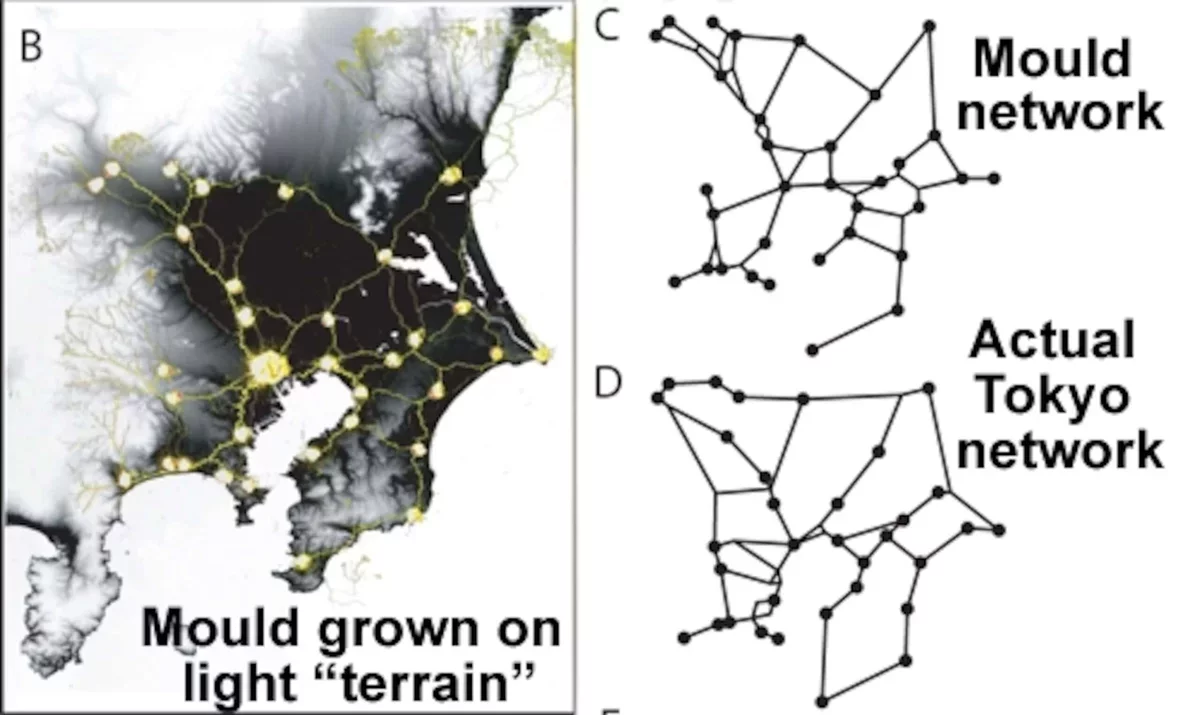
In a groundbreaking experiment conducted by researchers in Japan, the slime mold Physarum polycephalum was placed in a controlled environment where oat flakes represented the cities surrounding Tokyo. The mold, starting from the center, gradually expanded and adapted its form to create a network that strikingly resembled the intricate rail system of the city.
Tokyo boasts the busiest rail network globally, serving around 20 million passengers daily. The system's complexity is a result of extensive human planning and engineering, making it remarkable that a simple organism could replicate such an efficient structure.
Astonishing Intelligence Without a Brain
The slime mold's method of exploration and resource utilization is remarkable. Researchers have utilized its capabilities to navigate mazes and solve various challenges. Physarum can merge into a single giant cell, extending its tendrils in multiple directions and moving at a speed of four centimeters per hour. When it encounters food, it widens its tendrils, while repulsive stimuli cause it to retract.
Through this pulsing mechanism, the slime mold effectively optimizes its foraging strategy, transforming its sprawling network into a streamlined system that prioritizes nutrient-rich paths while eliminating less efficient routes.
The Tokyo Rail Network Experiment
A study published in the journal Science by Toshiyuki Nakagaki and Atsushi Tero from Hokkaido University tested the slime mold's biological optimization abilities. They created a setup where the mold had to navigate a pattern mimicking Tokyo's geography, including obstacles represented by light.
Initially, the mold dispersed evenly, but within a day, it refined its connections, enhancing the pathways linking the oat flakes while allowing redundant routes to diminish. The result was a network nearly identical to the actual Tokyo rail system.
Biologically Inspired Engineering
This discovery has implications for future technological networks. The principles governing the slime mold's behavior could inspire designs for adaptive systems like wireless sensor networks, which need to reorganize rapidly in response to changing conditions.
While some experts express caution about applying these findings universally, the research highlights the potential of biological systems to inspire new methods of technological design.
By studying Physarum, we gain insights into evolutionary adaptations and network optimization, suggesting that intelligence may not solely reside in centralized brains but can emerge from simpler, decentralized organisms.
As we continue to explore the capabilities of such organisms, we may uncover innovative solutions for complex engineering challenges, paving the way for a future where nature-inspired designs enhance our technological landscape.