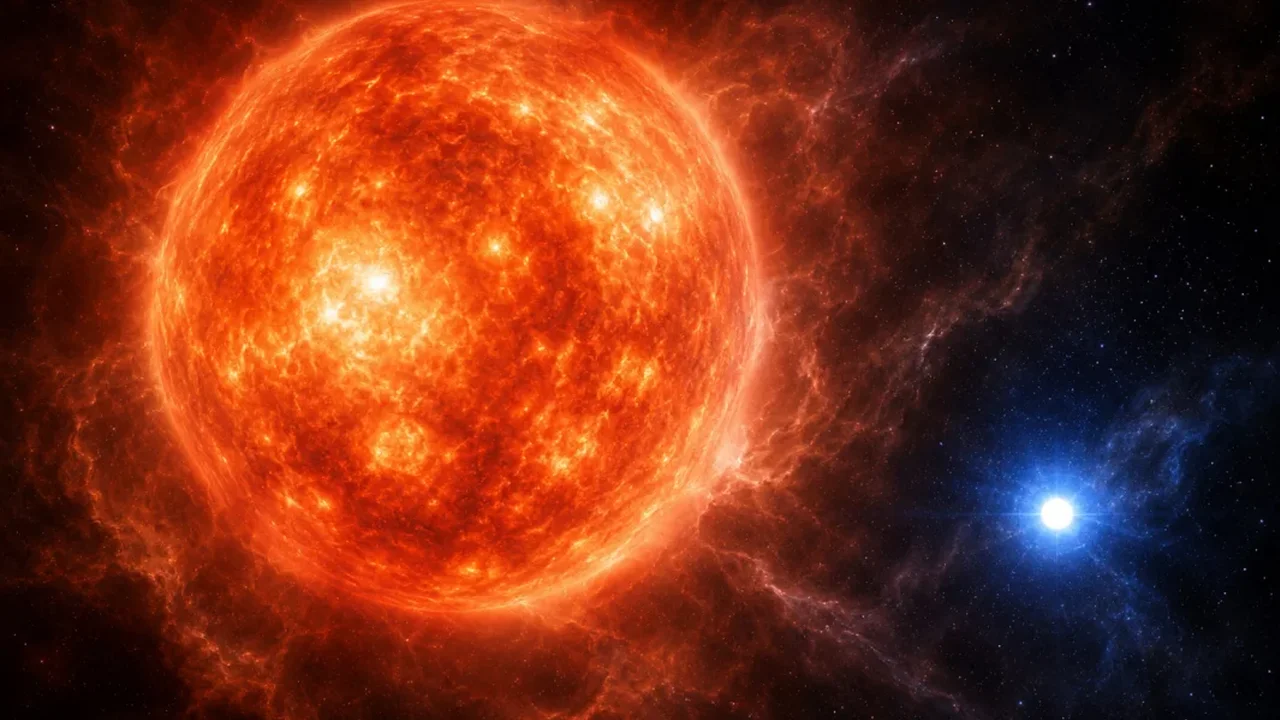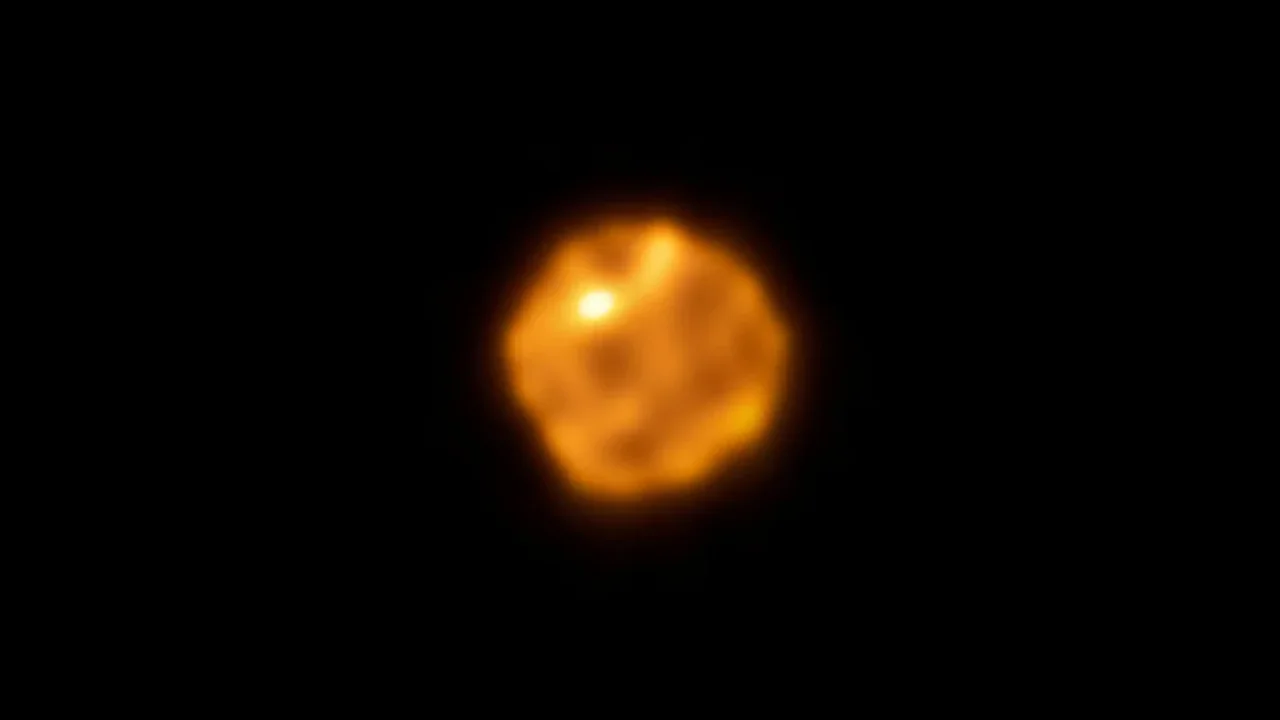
One of astronomy's most iconic stars is looking more complex than ever. New observations from the ALMA telescope have captured Betelgeuse in remarkable detail, showing an irregular, lumpy structure and a bright hotspot that appears to have stayed in nearly the same place for more than seven years.
Betelgeuse, a red supergiant about 600 light-years from Earth, is roughly 800 times wider than the Sun. Using ALMA's most extended configuration, astronomers mapped the star's inner atmosphere with enough precision to resolve features across a significant fraction of its disk. The data show a layer of gas at around 2,300 kelvins, with two standout warm regions, especially one in the northeast.
That northeastern hotspot is the most intriguing result. It is about 500 to 800 kelvins hotter than its surroundings and has remained almost unchanged between observations made in 2015 and 2023. Such stability is unusual, since current models suggest that giant convective structures on stars like Betelgeuse should evolve much faster.
The star's atmosphere is also highly uneven. Its submillimeter shape deviates from a clean circle, and molecular gas traced by silicon monoxide and carbon monoxide appears clumpy and dynamic. Some regions are far brighter than others, and the overall pattern has shifted since earlier observations.
These findings arrive after Betelgeuse's famous Great Dimming in 2019-2020, when the star briefly faded and drew global attention. Earlier research linked that event to a cool patch and a dust cloud, while the new ALMA data suggest the star's atmosphere may host long-lived structures that survive much longer than expected.
Researchers also note that Betelgeuse may have a close stellar companion, and its geometry overlaps with some of the observed features. Still, the team is careful not to assign a single cause to the hotspot. Convection, shocks, rotation, and the companion's influence could all be part of the picture.
With more observations, astronomers may be able to separate these effects and build a clearer model of how red supergiants evolve. In the future, studies like this could reshape how scientists understand the final stages of massive stars.