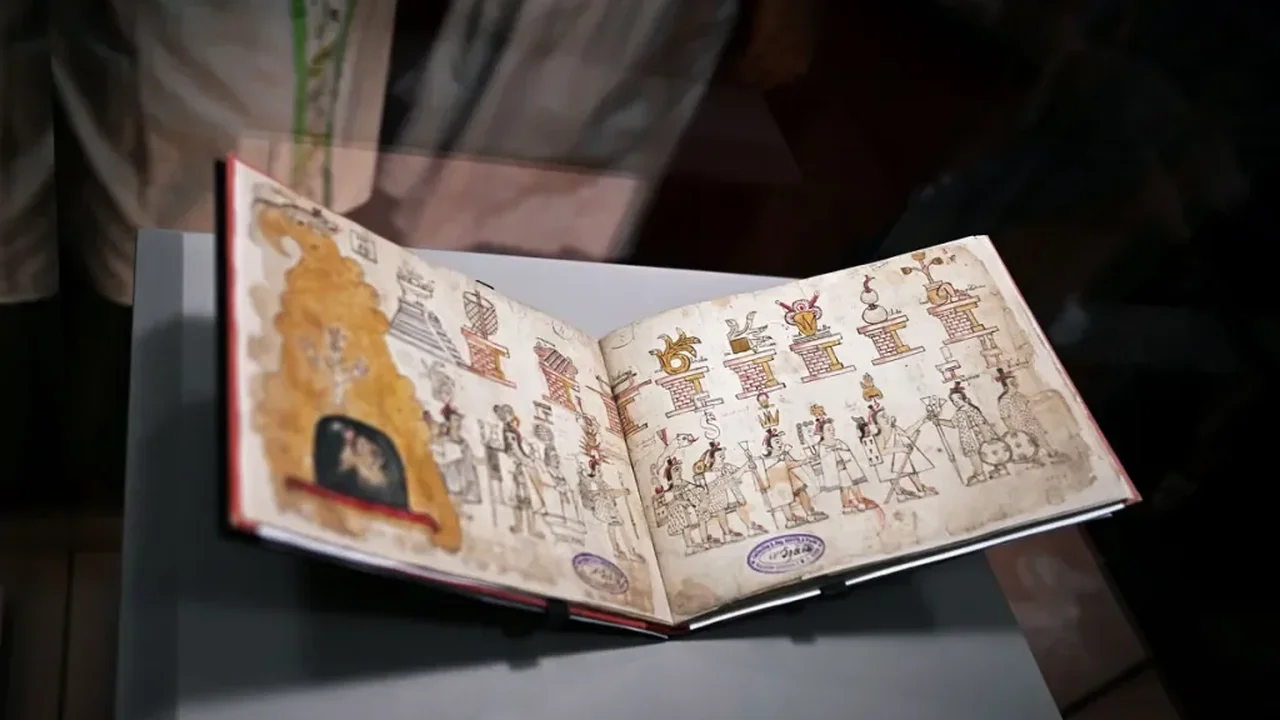
The Azcatitlan Codex, a rare illustrated record of Mexica history, is on display at Mexico City's National Museum of Anthropology for the first time since 1840.
Created between the late 16th and early 17th centuries, the manuscript is on temporary loan from the National Library of France. Its presentation coincides with 200 years of diplomatic relations between Mexico and France, alongside a reciprocal loan of the Boturini Codex to Paris.
A visual chronicle of Mexica civilization
Across 20 folios, the codex brings together Mesoamerican pictorial traditions and European-style writing. It traces the Mexica journey from Aztlan to the founding of Mexico-Tenochtitlan, follows the succession of rulers, and records defining transformations during the early colonial era.
The document offers a valuable perspective on the continuity of Indigenous knowledge and the ways historical memory was preserved through images, symbols and written accounts. Its return creates an opportunity for Mexican audiences to encounter a foundational cultural record in its country of origin.
A shared cultural exchange
The codex's journey has crossed several collections over centuries before entering the French national library in 1896. Mexico continues to support the return of historically significant manuscripts, while this exhibition is framed as a cultural exchange rather than a permanent transfer.
Visitors can view the manuscript through December 6, before it returns to France. The exhibition highlights how international museum partnerships can expand public access to heritage while encouraging broader conversations about cultural stewardship.
As institutions develop new models for sharing historic collections, projects like this may help shape a future in which cultural memory is more accessible, collaborative and globally connected.