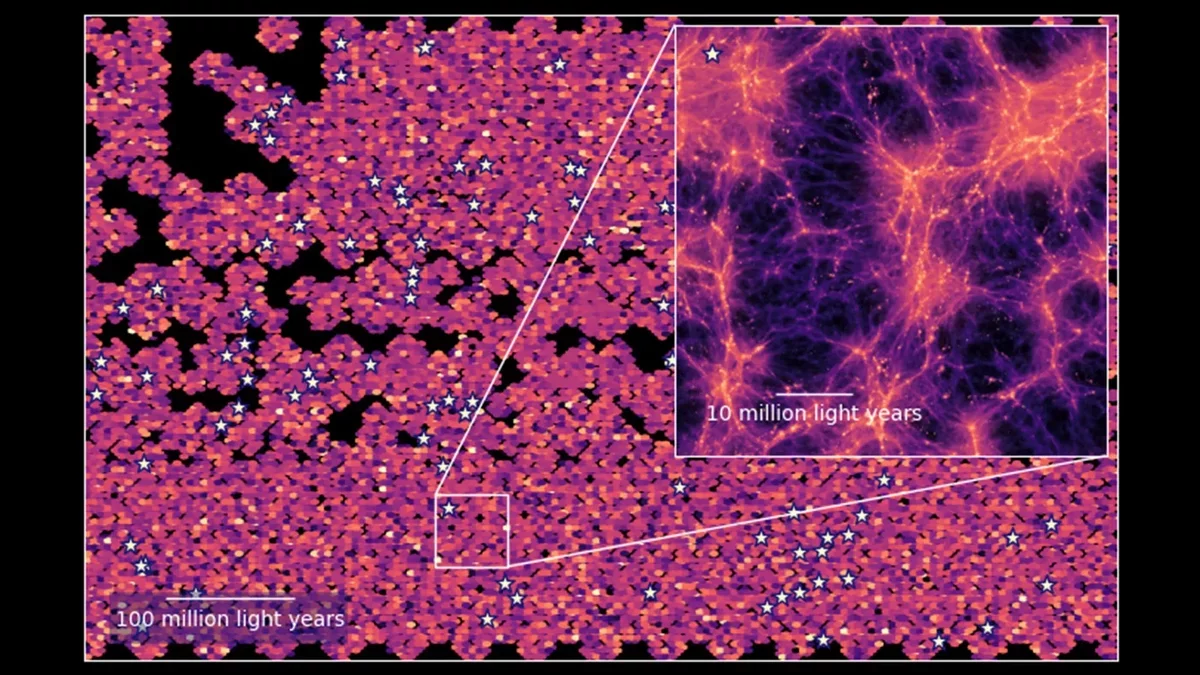
A groundbreaking achievement in astronomy has emerged with the creation of the most extensive 3D map of the early universe, shedding light on the evolution of galaxies and the role of intergalactic gas. Maja Lujan Niemeyer, a scientist from HETDEX and a recent graduate of the Max Planck Institute for Astrophysics, led this innovative project. "Observing the early universe provides insights into how galaxies evolved and the significance of intergalactic gas," she explained, highlighting the challenges posed by the faintness of distant objects.
The research team employed a technique known as Line Intensity Mapping, which allows for the detection of the collective glow from numerous distant sources, thereby constructing a more comprehensive understanding of the young universe. Their findings were published on March 3 in The Astrophysical Journal.
Innovative Techniques in Astronomy
Light can be analyzed by breaking it down into its constituent wavelengths, forming a spectrum. Astronomers utilize these spectra to identify specific elements by observing peaks and troughs. Rather than cataloging individual galaxies, Line Intensity Mapping gauges the intensity of elements across vast regions of space. Julian Muñoz, a HETDEX scientist and assistant professor at The University of Texas at Austin, described the traditional galaxy surveys as akin to mapping only the brightest cities, while intensity mapping captures a broader spectrum of light, revealing more than just the most luminous objects.
This innovative approach marks the first occasion that Lyman alpha emission has been mapped with such a vast dataset and high precision. The Hobby-Eberly Telescope at McDonald Observatory plays a crucial role in this endeavor, collecting extensive data as it tracks over one million bright galaxies to enhance our understanding of dark energy. The survey's scale is impressive, with researchers amassing more than 600 million spectra from a sky area equivalent to over 2,000 full Moons.
Unlocking Potential in Data
Despite this massive data collection, the team utilizes only about 5% of the gathered information, according to Karl Gebhardt, HETDEX principal investigator and chair of the astronomy department at UT Austin. He noted the vast potential for further research using the remaining data. "The galaxies we focus on are merely the tip of the iceberg," Lujan Niemeyer added, pointing to the abundant light in seemingly empty regions of the sky.
Advanced Technology in Mapping
To construct the new map, researchers developed specialized software and utilized supercomputers at the Texas Advanced Computing Center to analyze approximately half a petabyte of data. They then leveraged the known positions of bright galaxies to estimate the locations of fainter galaxies and glowing gas clouds, revealing more detail in previously unexplored areas.
"This foundational map allows us to validate astrophysical theories against real observations," said Eiichiro Komatsu, a HETDEX scientist and scientific director at the Max Planck Institute for Astrophysics.
A Bright Future for Cosmic Mapping
The team plans to compare their findings with other surveys targeting different elements, such as a Line Intensity Map of carbon monoxide, which could enhance our understanding of star formation environments. "This study is not just an initial detection; it signals the dawn of a new era in intensity mapping," Muñoz remarked, emphasizing the significance of the Hobby-Eberly Telescope and the exciting advancements on the horizon for cosmic exploration.