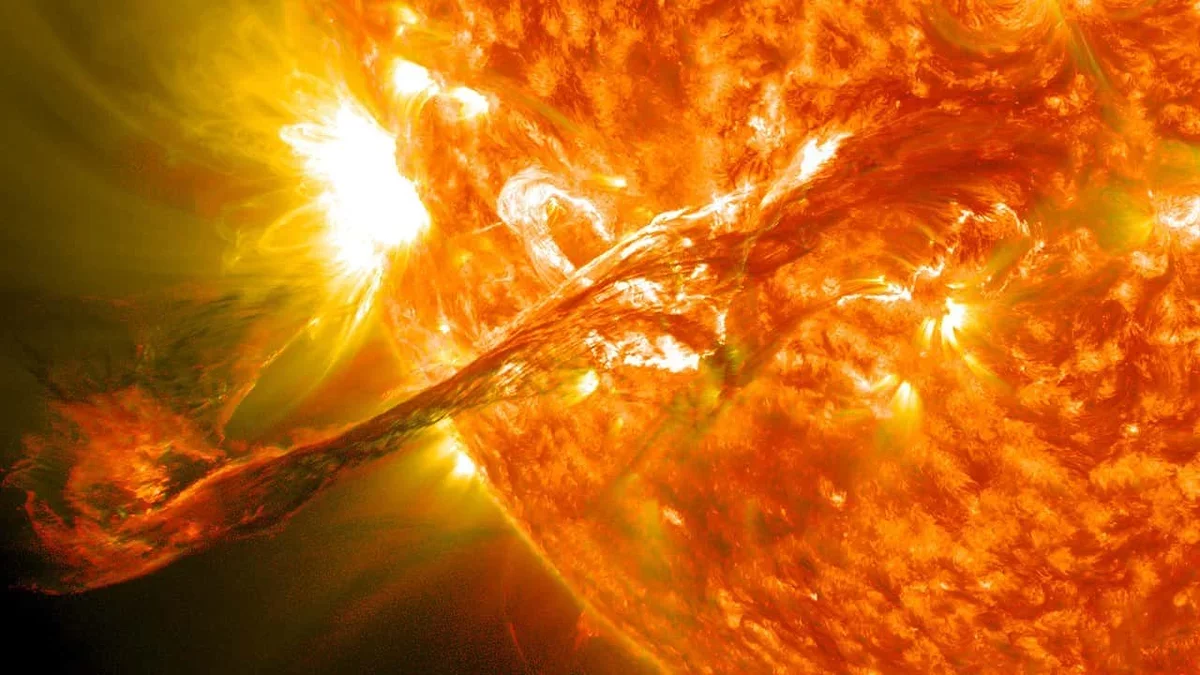
On September 30, 2024, a solar flare erupted from the Sun, following a familiar pattern of brightening in its outer atmosphere, a surge in X-ray emissions, and a release of high-energy particles. These flares can disrupt the space environment around Earth, potentially leading to geomagnetic storms that affect radio communications and power systems.
Recent observations from the European Space Agency's Solar Orbiter spacecraft have shed light on the underlying mechanisms of solar flares, revealing that they may be triggered by magnetic "avalanches." This process is akin to an avalanche on a snowy mountain, where a small disturbance can lead to a massive release of energy.
During its close approach to the Sun, the Solar Orbiter meticulously monitored the M7.7-class flare, capturing detailed data for approximately 40 minutes before the main event. This unprecedented observation allowed scientists to witness the intricate processes leading to the flare.
According to Pradeep Chitta from the Max Planck Institute for Solar System Research, this is the first time such detailed spatial and temporal observations have been made in the solar corona. The team described the flare's development as a series of small magnetic slips culminating in a larger explosive event.
The Solar Orbiter's Extreme Ultraviolet Imager provided high-resolution images every two seconds, enabling the team to observe the rapid changes in magnetic structures. As the flare approached its peak, the spacecraft noted streams of material moving in different directions, indicating significant magnetic rearrangements.
As the flare reached its maximum intensity, a sharp increase in X-ray emissions was recorded, signaling that particles were accelerating and colliding with denser layers of the Sun. The most captivating aspect of this event was the appearance of bright, ribbon-like streams of plasma, resembling "rain" falling through the Sun's atmosphere.
Chitta remarked on the significance of these observations, stating that they provide valuable insights into the energy deposition processes associated with solar flares. The study of these phenomena is crucial, as the Sun's activity can have profound effects on our technological infrastructure.
The findings underscore the importance of understanding the dynamics of solar flares, especially since large flares can lead to substantial disruptions on Earth. By recognizing the early indicators of these events, scientists hope to improve forecasting and mitigate potential impacts on our technology-driven world.