London's Hayward Gallery presents a wide-ranging exhibition by Anish Kapoor, bringing together landmark sculptures and recent works that investigate perception, material and spatial experience.
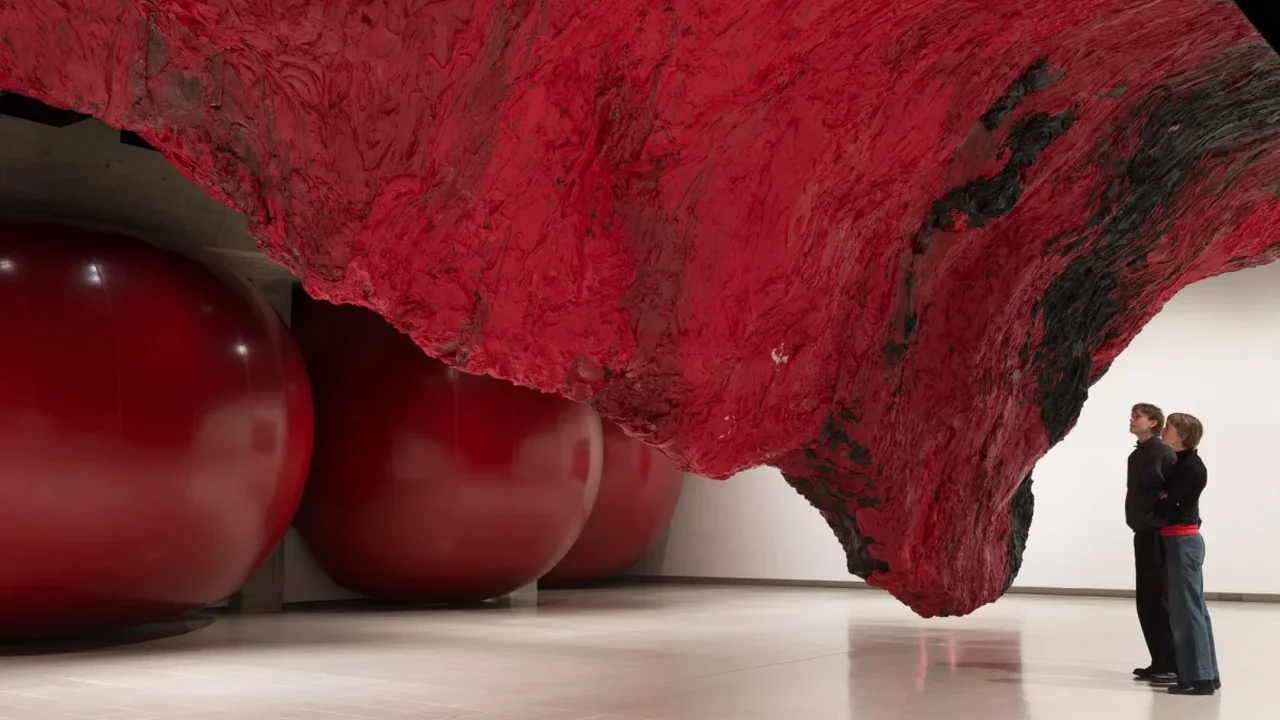
At the centre of the presentation is "All of Nothing" (2026), an expansive red inflatable form that transforms the gallery's industrial-scale interior. The work reflects Kapoor's enduring interest in the body, architecture and the emotional impact of monumental dimensions.
The exhibition also revisits the artist's explorations of visual uncertainty through deep-pigment surfaces, mirrored forms and sculptural voids. Works including "Descent into Limbo" (1992) invite visitors to reconsider depth and solidity, using seemingly simple interventions to challenge the eye's interpretation of space.
Elsewhere, polished stainless-steel pieces such as "Tsunami III" (2025) activate their surroundings through distorted reflections. Kapoor's signature use of curved, reflective surfaces turns viewers and architecture into changing parts of the artwork, making each encounter distinct.
Recent red wax and pigment sculptures introduce more tactile, organic forms. Installed among the building's concrete structure, these works contrast softness and density, while compositions such as "Mount Moriah at the Gate of Ghetto" (2022) extend the artist's investigation into landscape-like relief, gravity and transformation.
The show also includes Kulpreet Singh's "Indelible Black Marks" (2022-24), expanding the wider programme with an examination of environmental change and agricultural life. Curated by Ralph Rugoff, Thomas Sutton and Charlotte dos Santos, the exhibition continues at Hayward Gallery through October 18.
By placing material experimentation alongside immersive scale, the exhibition points to a future in which public art spaces can offer increasingly physical, reflective and participatory cultural experiences.