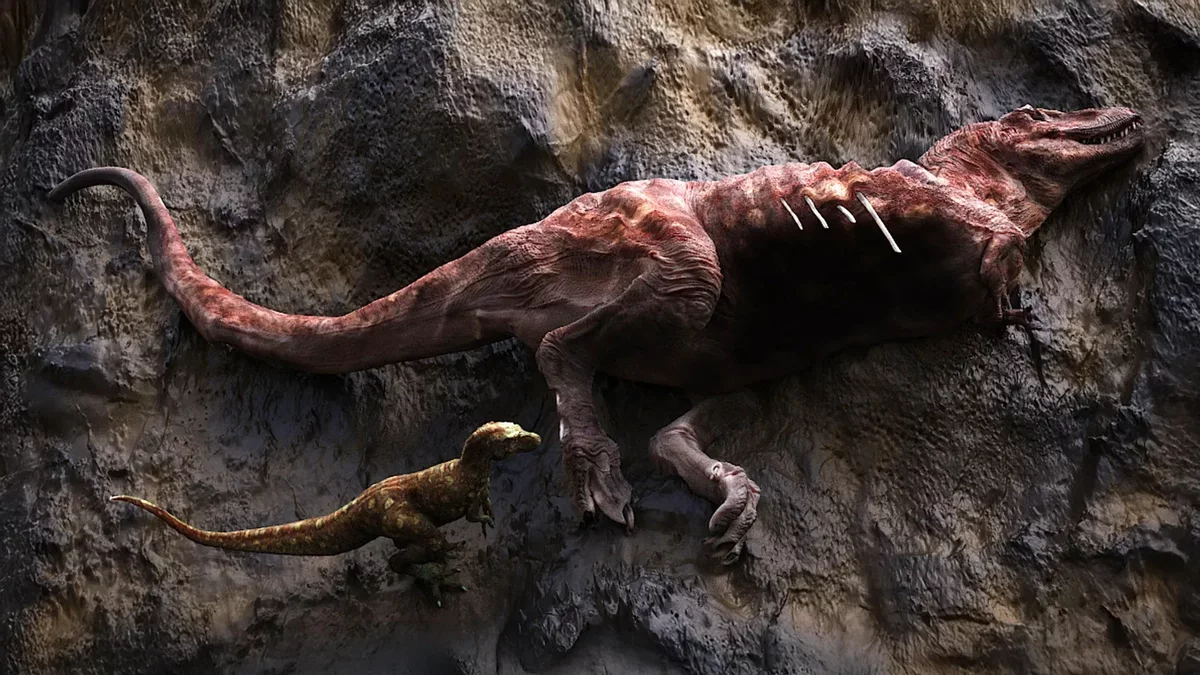
A remarkable discovery from the Department of Geoscience at Aarhus University has shed light on the feeding habits of tyrannosaurs, as detailed in a recent publication in the journal Evolving Earth.
Fossil Evidence of Cannibalism
The research, spearheaded by Master's student Josephine Nielsen, utilized cutting-edge 3D scanning technology to analyze a fossilized metatarsal, or foot bone, belonging to a large tyrannosaur dating back over 75 million years. Nielsen identified 16 distinct bite marks on the bone, indicating a fascinating aspect of dinosaur behavior.
"I meticulously examined the depth, angle, and placement of these marks in a virtual 3D environment, confirming that they were not random. They are definitive impressions from a smaller tyrannosaur that fed on a larger relative," Nielsen stated.
The findings imply that tyrannosaurs were opportunistic feeders, consuming bones even after most of the soft tissue had been depleted. "The absence of healing on the bone suggests that the smaller dinosaur was scavenging the last remnants of a carcass," she added.
Advancements in Digital Analysis
Rather than handling the original fossil, Nielsen worked with a digital model and a 3D-printed replica created at Aarhus University. "While it would have been a unique experience to examine the actual bone, shipping it to Denmark posed too great a risk," she explained.
The metatarsal, measuring 10 centimeters, belonged to a tyrannosaur that likely grew to 10-12 meters in length and weighed several tons. Discovered by an amateur collector in the Judith River Formation of Montana--a site renowned for its rich fossil record--the specimen is now housed at the Badlands Dinosaur Museum in Dickinson, North Dakota.
Digital technology provided significant advantages, enabling the team to scrutinize minute details that might otherwise go unnoticed. "This study not only enhances our understanding of the ancient food chain but also showcases the innovative techniques we can employ. By creating a digital model, I was able to zoom in on intricate details. Employing the systematic CM (Category-Modifier) classification system allowed us to categorize each mark precisely, distinguishing between various types of bites," Nielsen remarked. "It's akin to solving an ancient mystery through metatarsal evidence."
Collaboration and Future Insights
Nielsen's research was bolstered by the guidance of Canadian paleontologist Taia Wyenberg-Henzler and museum curator Denver Fowler, who provided mentorship throughout her project. "I connected with them while volunteering at an excavation camp in Montana in the summer of 2024, which was pivotal for my project and helped forge valuable international relationships during my studies," she noted.
This study emphasizes how modern methodologies can extract intricate details about dinosaur behavior from even the smallest fossil traces. "We can now derive detailed behavioral insights from minimal evidence. The CM system has established a scientific framework to describe bite marks, allowing us to document when and why the smaller tyrannosaur targeted the larger one," Nielsen concluded.