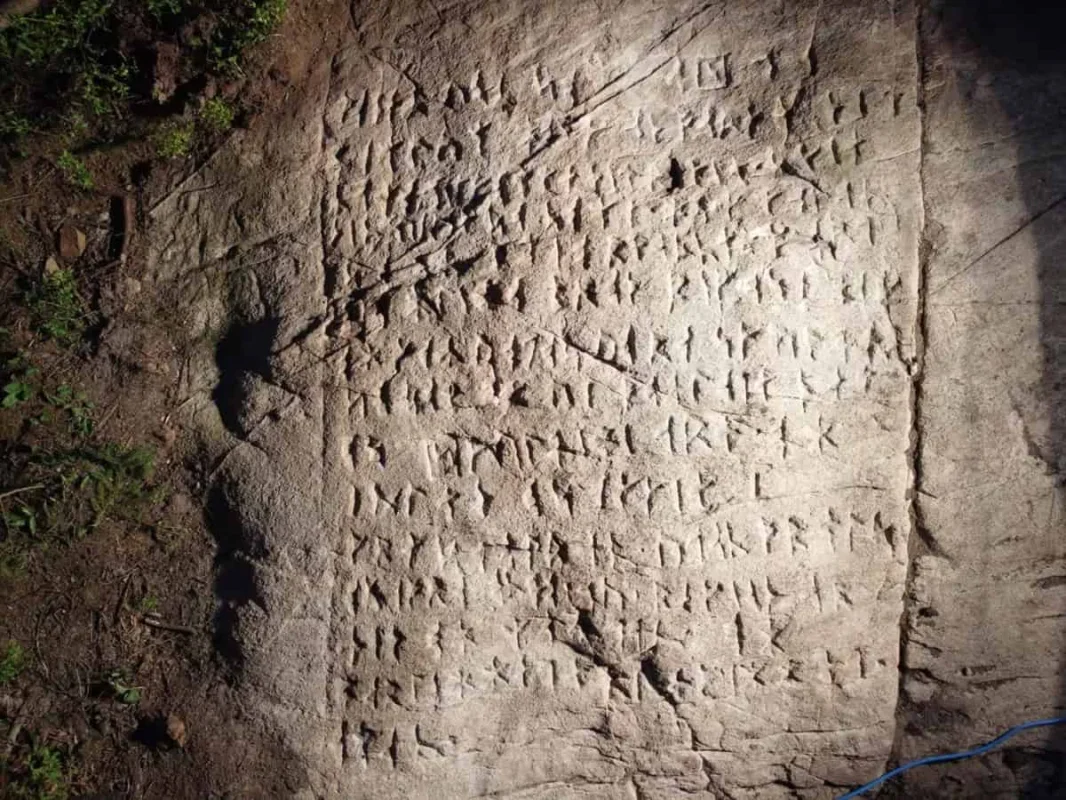
In a remarkable archaeological find, a stone slab inscribed with 255 runic characters has been unearthed in northern Ontario, revealing a rendition of the Lord's Prayer. This discovery, made near the small town of Wawa, is believed to be the longest runic inscription in North America, dating back to the early 1800s.
The slab, measuring approximately four by five feet, features a modern derivative of the Scandinavian runic script, distinct from the Viking-era Elder Futhark. Alongside the prayer, the stone bears an intricate carving of a boat with 16 figures, accompanied by 14 mysterious "X" marks, whose meanings remain elusive.
Ryan Primrose, president of the Ontario Centre for Archaeological Education, expressed his astonishment at the find, stating, "It's certainly among the least expected discoveries of my career. It's absolutely fascinating." Primrose has been investigating the site since 2018, and the analysis has only recently been shared with the public.
A Unique Inscription
The runes have been meticulously carved into the rock, indicating a significant investment of time and effort. Initial assumptions linked the site to Viking exploration, but Primrose cautioned against such interpretations, opting for a more nuanced approach.
To gain further insights, Primrose consulted Dr. Henrik Williams, a noted runology expert from Uppsala University. Williams examined the inscriptions in October, revealing that they spell out the Lord's Prayer in modern Swedish, utilizing a script developed in the early 1600s by Johannes Bureus. This detail effectively eliminates Viking connections.
Tracing the Origins
Historical records suggest that Swedish laborers were employed by the Hudson's Bay Company in the 1800s, with one such post located near the discovery site. This leads to the hypothesis that the carving may have been created by a Swedish trader or employee, serving as a personal or communal expression of faith far from home.
Despite the absence of other artifacts, the site is considered historically significant. The deep carvings reflect a profound dedication, capturing a moment of identity and spirituality in a remote forest.
Preserving a Heritage Site
Plans are underway to protect the site, with efforts to secure conservation funding and construct a shelter for visitors. The goal is to open the site to the public by the summer, allowing individuals to connect with this extraordinary piece of history.
This discovery not only enriches our understanding of cultural exchanges in early North America but also invites further exploration into the lives of those who once traversed these landscapes. As researchers continue to unravel the mysteries surrounding the slab, it stands as a testament to the enduring human spirit and the quest for connection across time and distance.