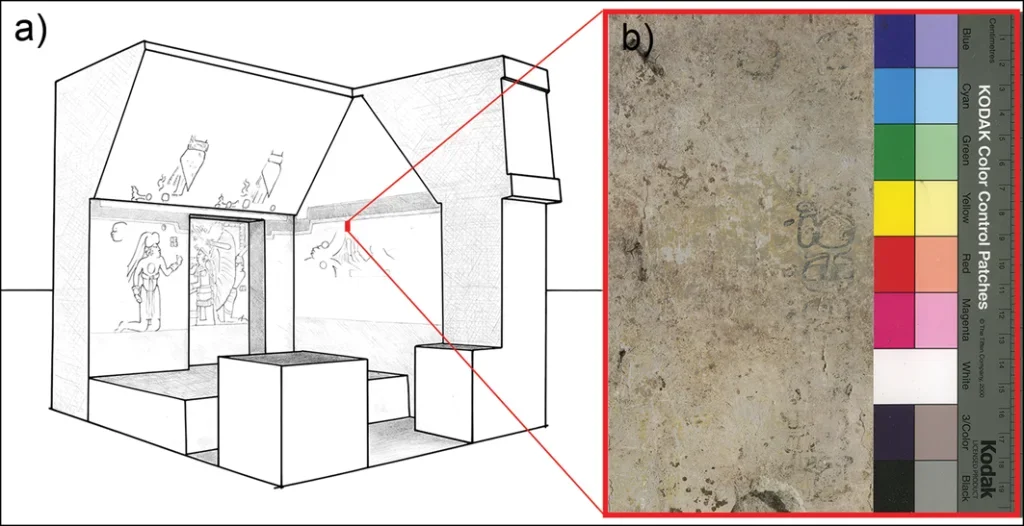
Archaeologists working at Xultun, a major Maya site in northeastern Guatemala, have identified the name of an 8th-century astronomer-mathematician linked to a calendrical formula carved on an interior wall of a small masonry building.
The name, Sak Tahn Waax, is understood to mean "White-chested Fox." The formula, whether written by him or later attributed to him, calculates the orbital patterns of Mars and Venus. A study published in Antiquity says this is the first known case of a Maya mathematician being directly credited for intellectual work.
The building was first excavated in 2010. Its walls also preserve hieroglyphs, painted figures, and evidence of paper-making tools, suggesting the space may have served as a place for teaching, mentorship, and calendrical training during the 8th century CE. Later, the chamber was filled in and became part of the foundation for a new structure.
To decode the text, researchers from MIT, Skidmore College, and the University of Texas at Austin analyzed high-resolution scans and multispectral imagery, comparing the inscriptions with established readings of Classic Maya glyphs. Lead researcher Franco Rossi said the finding highlights how specialized astronomical knowledge was both valued and widely practiced in Maya society.
This discovery adds a rare personal voice to ancient scientific history and may open new paths for understanding how knowledge was recorded, taught, and preserved across the Maya world.