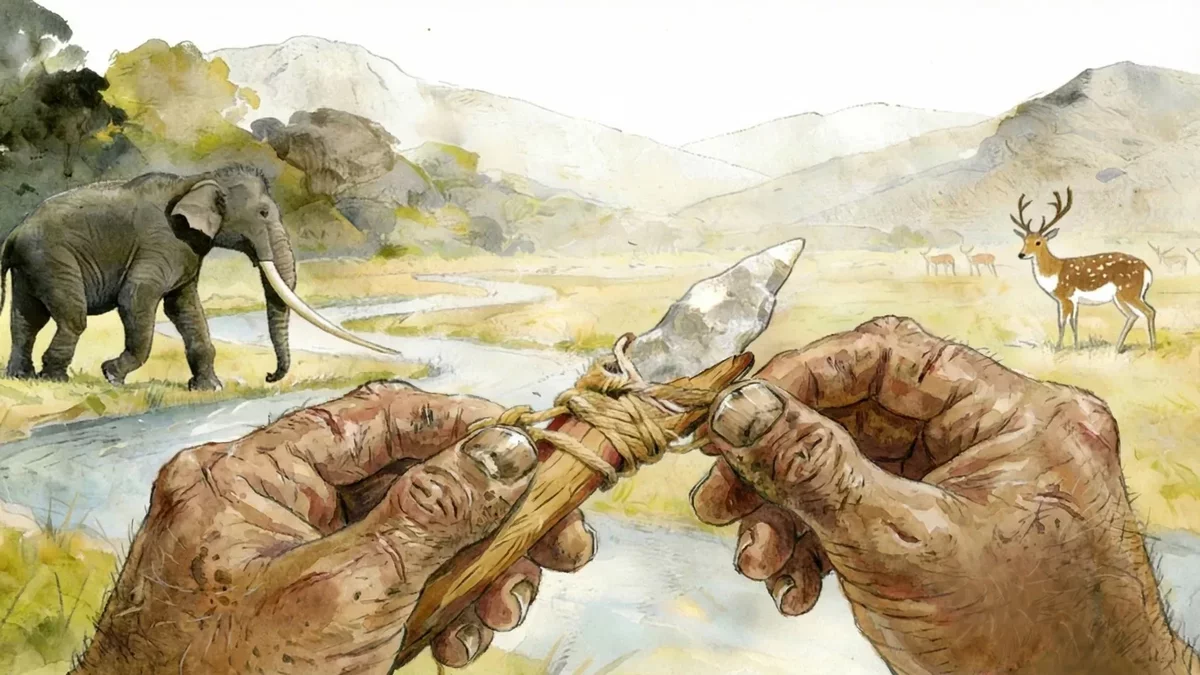
A collaborative research initiative spearheaded by the Chinese Academy of Sciences has unearthed significant findings at Xigou, located in the Danjiangkou Reservoir Region of central China. This excavation has unveiled advanced stone tool technologies dating back approximately 160,000 to 72,000 years.
Co-led by Griffith University, the project highlights the innovative and adaptable behaviors of hominins in this region during a time when various large-brained species, including Homo longi and Homo juluensis, and potentially Homo sapiens, coexisted in China.
Rethinking Perceptions of East Asian Technological Progress
Dr. Shixia Yang, the expedition's leader from the Institute of Vertebrate Paleontology and Paleoanthropology (IVPP), noted that for years, researchers have maintained that while hominins in Africa and Western Europe made significant technological strides, those in East Asia adhered to simpler stone-tool traditions.
Professor Michael Petraglia, a co-author of the study and Director of Griffith University's Australian Research Centre for Human Evolution, emphasized that the findings at Xigou challenge the prevailing notion that early human populations in China were technologically conservative.
The research team's detailed analysis of the artifacts indicates that the inhabitants of Xigou employed sophisticated stone tool-making techniques. These methods resulted in small flakes and versatile tools that facilitated a variety of activities, suggesting a complex behavioral repertoire.
Earliest Composite Tools Discovered in East Asia
Among the most striking discoveries at Xigou were hafted stone tools, which represent the earliest known composite tools in East Asia. These innovative tools integrated stone components with handles or shafts.
This design necessitated meticulous planning, skilled craftsmanship, and an understanding of how to enhance tool performance through material combinations. The findings reveal a sophisticated technological approach rather than simplistic or static traditions.
Lead author Dr. Jian-Ping Yue of the IVPP remarked, "The existence of these tools suggests that the hominins at Xigou exhibited significant behavioral flexibility and creativity."
A Long History of Change and Diversity
The archaeological layers at Xigou extend over roughly 90,000 years, providing a comprehensive perspective on technological evolution. This timeline correlates with emerging evidence of increasing hominin diversity in China during this era.
Large-brained hominins identified at sites like Xujiayao and Lingjing, often referred to as Homo juluensis, may offer biological context for the behavioral sophistication observed in the Xigou stone tool assemblages.
Professor Petraglia noted, "The technological strategies reflected in these stone tools likely played a pivotal role in enabling hominin populations to adapt to the dynamic environments of Eastern Asia over the last 90,000 years."
Rethinking Human Evolution in East Asia
The research team asserts that the discoveries at Xigou are reshaping our understanding of human evolution in East Asia. The findings suggest that early populations in this region possessed cognitive and technical capabilities comparable to their counterparts in Africa and Europe.
Dr. Yang concluded, "Emerging evidence from Xigou and other sites indicates that early technologies in China included prepared-core methods, innovative retouched tools, and even large cutting implements, revealing a more intricate and diverse technological landscape than previously acknowledged."
The study titled 'Technological innovations and hafted technology in central China ~160,000-72,000 years ago' has been published in Nature Communications.