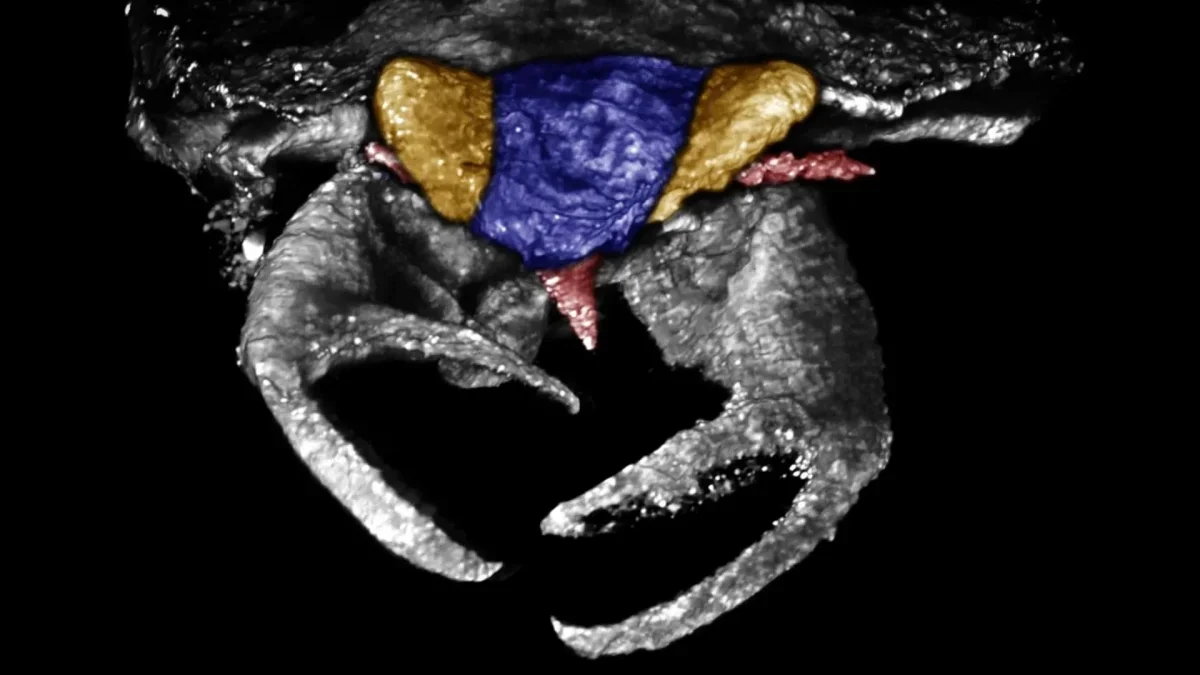
Researchers from Ludwig Maximilian University of Munich (LMU) have unveiled an extraordinary fossil of a true bug (Heteroptera) that showcases an unprecedented feature: its front legs culminate in large claw-like structures reminiscent of crab pincers. These unique appendages, known as chelae, function similarly to forceps and are remarkably rare among insects.
Rare Evolutionary Trait in Insects
According to Privatdozent Carolin Haug, a zoologist at LMU's Faculty of Biology, "Prior to this discovery, chelae were documented in only three insect groups. This fossil marks the fourth instance of such structures evolving independently within the insect kingdom." Haug, alongside colleagues from the University of Rostock and the University of Oulu in Finland, meticulously analyzed the fossil using micro-computed tomography, generating intricate 3D images that revealed the insect's anatomical features. Their findings were published in the journal Insects.
The team conducted an extensive morphological comparison involving over 2,000 chelae and similar grasping appendages from both contemporary and extinct species. Their research indicated that the claws of this ancient bug were significantly distinct from those of other insects, showing a closer resemblance to appendages found in more distantly related arthropods such as decapods (including crabs, lobsters, and shrimps) and tanaids.
Newly Named Species Honors K-Pop Group
This remarkable insect has been classified into a new genus named Carcinonepa, a name that merges the Latinized Greek term for "crab" (carcino-) with nepa, referring to the true water bug group Nepomorpha. The species name libererrantes pays tribute to the popular K-pop group Stray Kids. Haug explains, "The name is fitting as the fossil's chelae posture closely resembles the group's signature pose. Stray Kids is also the favorite band of one of the authors, Fenja Haug."
Based on its preserved characteristics, Carcinonepa libererrantes is categorized within the true water bugs (Nepomorpha) of the broader true bug group (Heteroptera). In addition to its striking claws, the insect's body shares traits with modern Gelastocoridae, known as toad bugs, which are terrestrial predators.
A Glimpse into Cretaceous Life
Haug notes, "The morphology of C. libererrantes suggests it likely led a lifestyle similar to that of modern predators." The oversized chelae were probably employed to capture and hold small insect prey, indicating a predatory existence in a Cretaceous forest, likely near coastal regions.