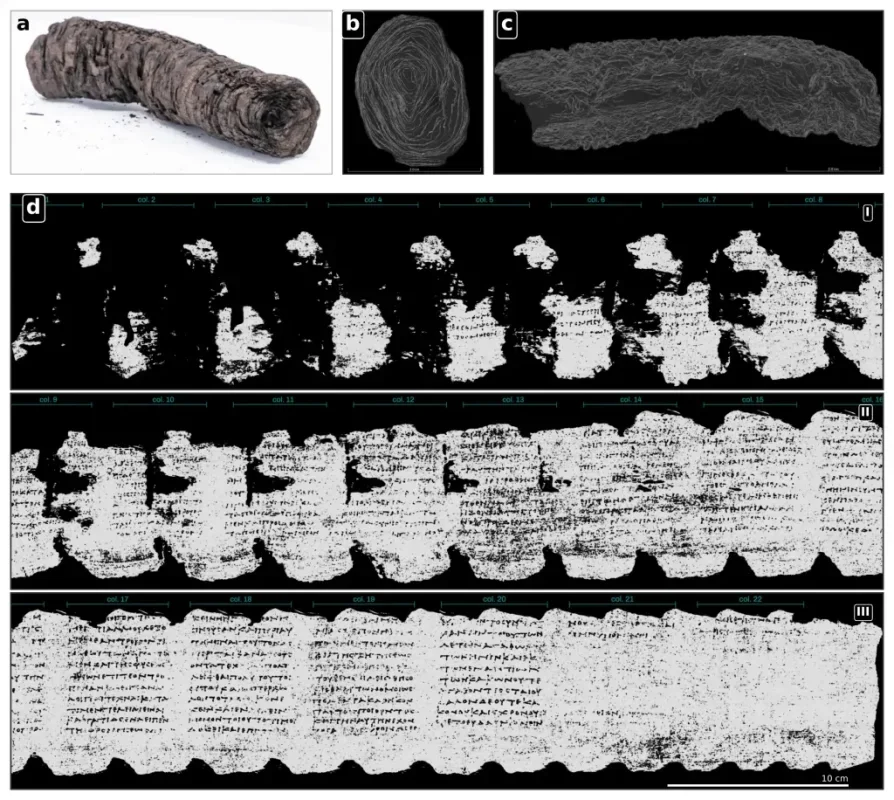
Researchers have taken a major step toward reading the carbonized scrolls preserved at Herculaneum after Mount Vesuvius erupted in 79 CE. Long too fragile to open by hand, these ancient texts from the Villa of the Papyri have now been studied through advanced digital methods.
The Vesuvius Challenge, launched by the University of Kentucky in 2023, has brought together machine learning and X-ray imaging to reveal hidden writing inside the scrolls. The project has already supported researchers with prize funding as they work to recover text that remained inaccessible for centuries.
In a recent breakthrough announced by the University of Kentucky, scholars virtually "unwrapped" one scroll, PHerc. 1667, and read 20 surviving columns of text. They also recovered 70 columns from another scroll, PHerc. 172, preserved at Oxford's Bodleian Library, while identifying new works linked to the Epicurean philosopher Philodemus.
The scans were produced by teams in France and the UK using a particle accelerator and synchrotron, creating exceptionally detailed 3D data. According to the project, the dataset is among the largest ever generated by the European Synchrotron Radiation Facility, reaching up to 300 terabytes per scroll.
Researchers say the improved software now makes it possible to trace arguments across multiple columns, turning once unreadable material into a living source of ancient knowledge. The progress points to a future where AI and heritage science can unlock more of humanity's oldest libraries.