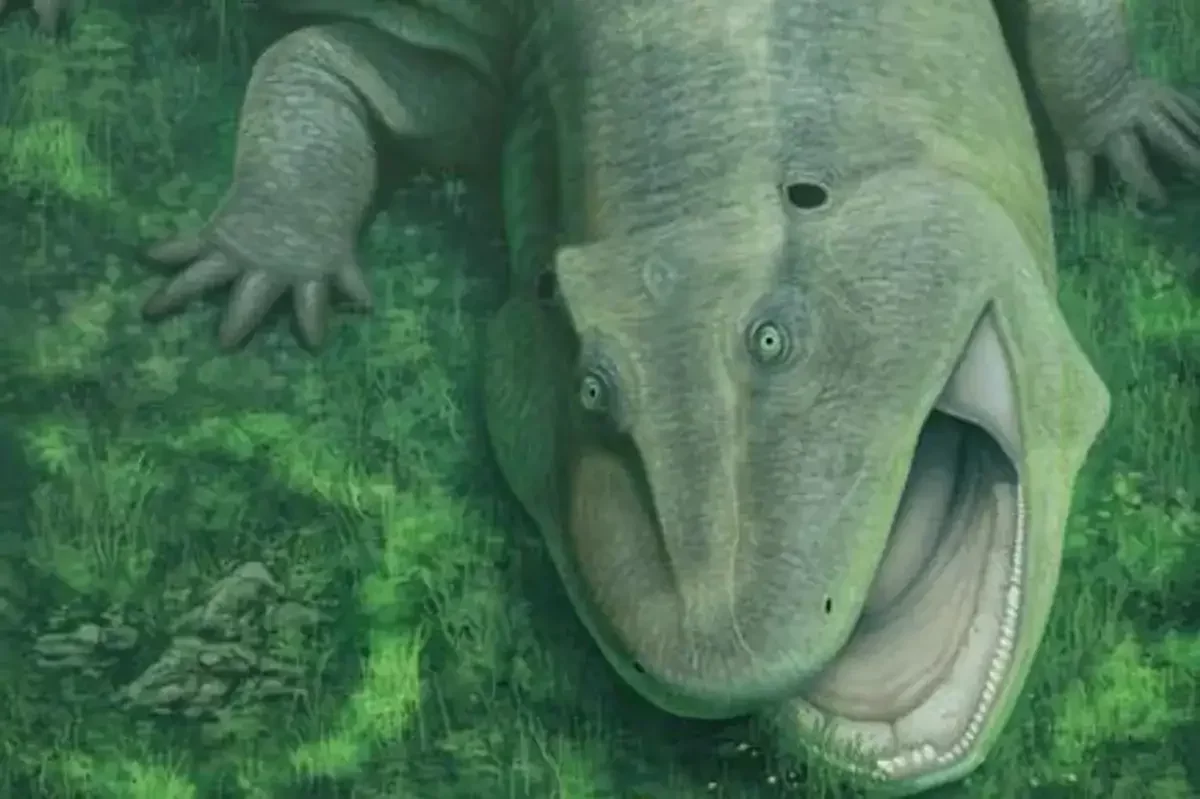
Paleontologists working in a dry riverbed in northeastern Brazil have made an intriguing discovery: a series of fossilized lower jaws, each measuring approximately six inches in length, that exhibit a surprising twist. Initially, one jaw might have been dismissed as an anomaly, but the recovery of nine jaws from the Pedra de Fogo Formation, all displaying the same distinctive three-dimensional rotation, led researchers to conclude that this feature is part of the animal's normal anatomy.
In their publication in the Proceedings of the Royal Society B, the scientists identified these fossils as evidence of a new species with a remarkable feeding mechanism, dating back to the early Permian period, around 275 million years ago. The creature, named Tanyka amnicola, combines the Guaraní word for "jaw" with a Latin term meaning "river dweller." During its time, this region was part of the ancient supercontinent Gondwana, where Tanyka coexisted with early ancestors of modern amphibians, reptiles, birds, and mammals.
Lead author Jason Pardo remarked, "Tanyka represents an ancient lineage that we were unaware had survived this long, and its unique jaw structure posed quite the puzzle for us." The jaw's unusual twist means that, unlike most tetrapods where lower-jaw teeth point upward, the mandible of Tanyka is oriented such that its chewing surface faces outward, suggesting a different feeding strategy.
The Sideways Chew
Unlike typical tetrapods, whose teeth align toward the roof of the mouth, Tanyka features a mandible that twists to allow its chewing surface to face outward. The top edge of the jaw is lined with relatively large teeth, while the main chewing area is located further back on a set of bones called coronoids, which are covered in small, tooth-like bumps known as denticles. These adaptations suggest a specialized feeding mechanism.
The researchers propose that Tanyka likely consumed small invertebrates or possibly some plant material. Co-author Juan Carlos Cisneros noted that the structure of its teeth indicates it may have been herbivorous at least part of the time.
Insights into Gondwana's Ecosystem
Beyond the fascinating jaw structure, Tanyka holds significant implications for understanding the evolution of early tetrapods. Phylogenetic analyses suggest that it belongs to a lineage of stem tetrapods, closely related to forms found primarily in the northern supercontinent Laurussia. This discovery hints at a more complex evolutionary history, suggesting that Gondwana may have been a refuge for species that otherwise disappeared from the fossil record during significant climatic shifts.
While the fossil remains primarily consist of jaw fragments, these findings open new avenues for research into the biodiversity of ancient ecosystems. Future fieldwork may uncover more comprehensive remains, shedding light on the full anatomy of this intriguing creature.