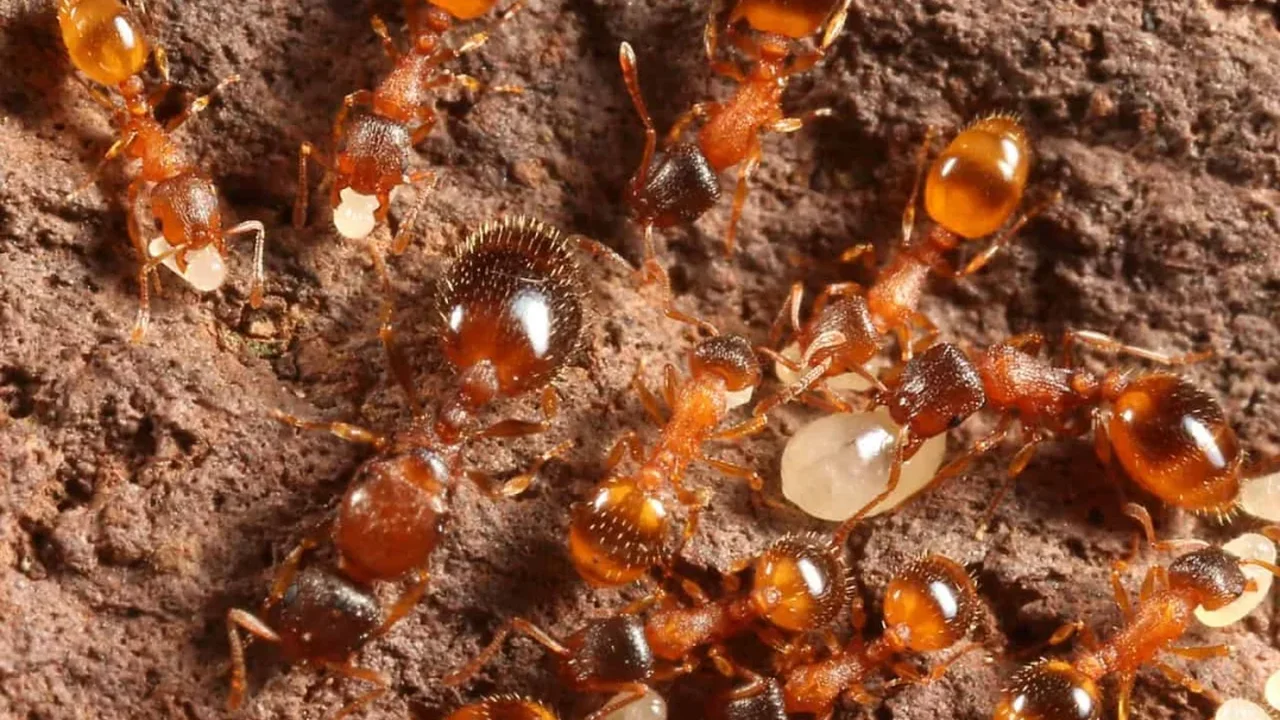
Ant colonies may be far more synchronized than they appear. A new modeling study suggests that the rhythmic bursts seen inside nests can begin with just one ant, setting off a chain of activity that spreads through the colony in seconds.
The research, developed by Michael Napoli, Simon Garnier and Maurizio Porfiri, explores how collective behavior emerges without a central leader. Instead of relying on a quorum, the model shows that a colony can shift into coordinated motion when local interactions become strong enough to amplify a small spark of activity.
A colony that resets itself
In the simulation, each ant can be active, inactive or in a short refractory phase after moving. That brief pause matters: it prevents the nest from staying permanently switched on. According to the model, colony-wide bursts appear when responsiveness and reset timing are in balance.
Active ants move through the nest and can activate nearby nestmates, which then pass the signal onward. When movement, density and contact range cross a threshold, the result is a fast cascade rather than isolated motion.
"Activity bursts emerge as a balance between the responsiveness of the colony to the first ant that activates and the ability of the colony to completely deactivate before the onset of the next burst," Napoli said.
Fast contact, shared rhythm
The study also highlights how quickly information can travel in a busy nest. The model suggests that ants interact fast enough for behavior to spread almost instantly through the group, even though the larger burst cycle unfolds more slowly.
Garnier noted that the most surprising result is that any ant can act as the first mover. No special individual is required. Once the system passes a critical threshold, a tiny change in conditions can transform scattered motion into synchronized pulses.
That pattern resembles phase transitions in nature, where small shifts can produce a major change in state. In this case, the same logic may help explain how colonies respond quickly to changing surroundings while still returning to a ready state for the next signal.
Beyond biology, the findings may inform the design of robot swarms, autonomous systems and distributed sensor networks that need rapid coordination without central control. The paper is published in PRX Life, and the next step is to compare the model with real colony data. This line of research could shape future systems that coordinate efficiently through simple local rules.