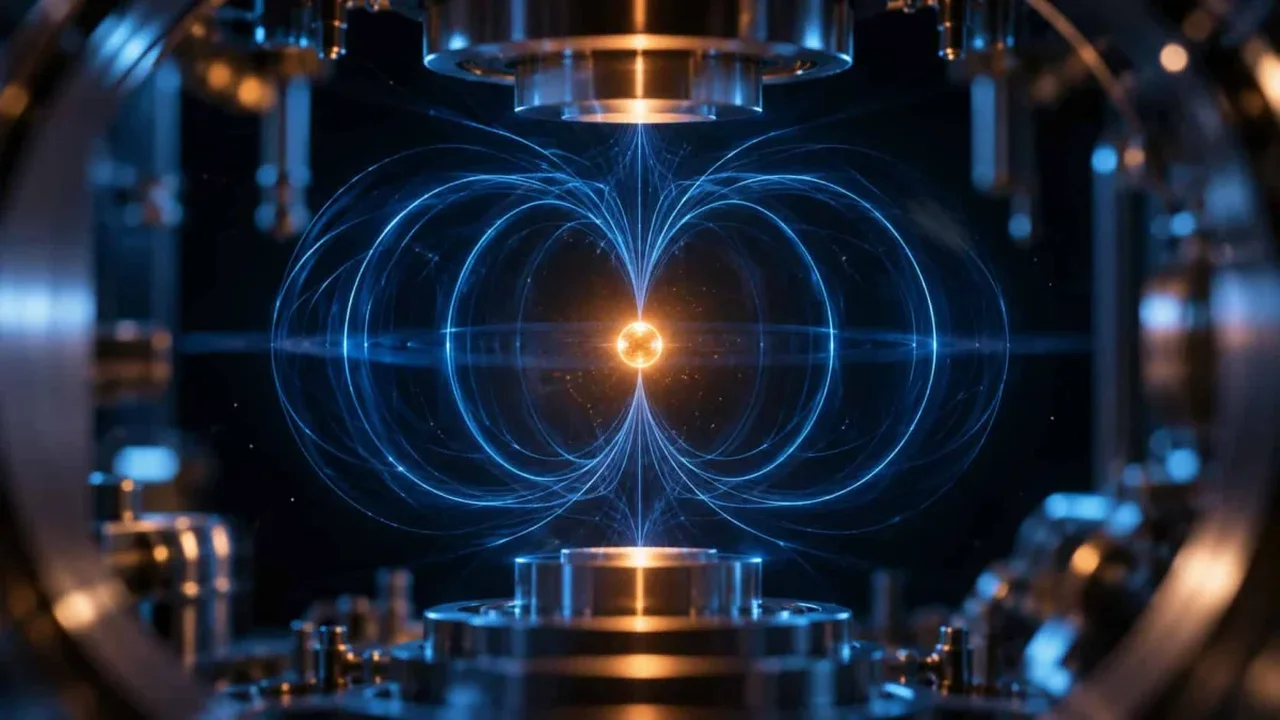
Physicists at Northwestern University have confined a single positron--the antimatter counterpart of an electron--for months, while controlling and observing its quantum behavior. The achievement sets the stage for a more precise comparison of matter and antimatter.
Led by physicist Gerald Gabrielse, the team used electric and magnetic fields to suspend the particle without letting it touch the trap's walls. A specialized system cooled the chamber to about 0.3 degrees above absolute zero, helping limit unwanted interactions.
Controlling quantum states
The researchers applied carefully tuned microwave pulses to move the positron between energy levels and change its spin. They could detect these transitions while preserving the states being measured--a key advance in studying a single antiparticle.
The next goal is to measure the positron's magnetic moment and compare it with the electron's. Current theory predicts that the values should match in magnitude and have opposite signs. The team has not yet reported that comparison; the new apparatus is a step toward carrying it out with far greater precision.
A discrepancy could challenge established ideas about particle physics and offer clues to why the universe contains much more matter than antimatter. The findings were published in Physical Review Letters.
By making individual antiparticles easier to examine, this approach could sharpen future tests of fundamental physics and deepen our understanding of the universe's earliest conditions.