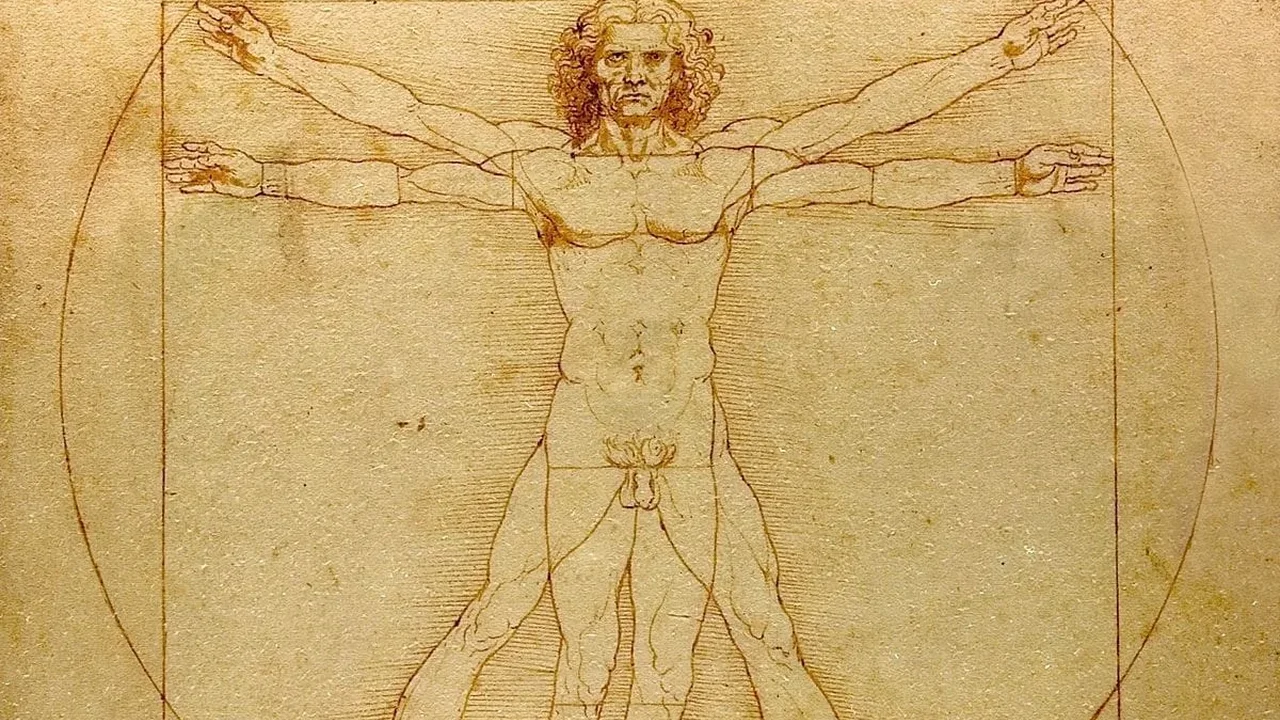
Leonardo da Vinci's Vitruvian Man has fascinated thinkers for more than 500 years, but a new study suggests its geometry may hold an overlooked clue. A London-based dentist and independent researcher, Rory Mac Sweeney, argues that Leonardo's construction may be guided by an equilateral triangle placed between the figure's legs.
A Hidden Shape in the Drawing
Created around 1490, the famous sketch places the human body inside both a square and a circle. For centuries, scholars have asked how Leonardo determined the exact relationship between those two forms. Mac Sweeney's interpretation points to Leonardo's own note that "the space between the legs will be an equilateral triangle," treating it not as a poetic remark but as a practical geometric instruction.
His peer-reviewed study, published in the Journal of Mathematics and the Arts, connects that triangle to Bonwill's Triangle, a dental geometry first described in 1864 by William Bonwill. In modern dentistry, this triangular model helps explain jaw movement and supports the design of dentures.
Geometry, Anatomy, and Proportion
The study also highlights a ratio of about 1.64 to 1.65 between the square's side and the circle's radius in Leonardo's drawing. That figure closely matches the tetrahedral ratio of 1.633, a proportion found in efficient spatial structures and in certain natural and scientific models.
Mac Sweeney suggests that Leonardo may have recognized a universal design principle long before modern anatomy could measure it precisely. The idea is strengthened by later research showing recurring proportional patterns in human skulls and jaw structures, including a 2019 study of 100 skulls that found a similar cranial ratio.
While the interpretation is still open to further testing, it offers a fresh way to read one of the Renaissance's most iconic works: not only as art, but as a bridge between observation, mathematics, and biology. If explored further, this perspective could deepen how future generations connect classical art with the logic of natural form.