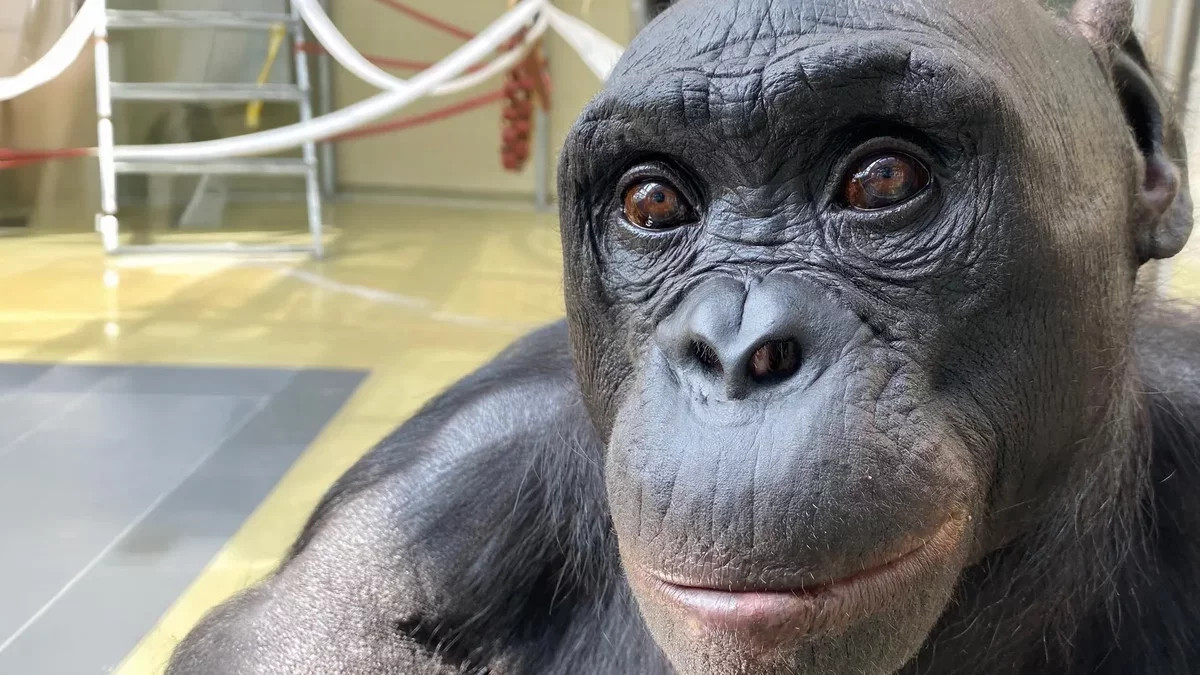
In a series of three meticulously crafted experiments, a bonobo demonstrated the ability to interact with imaginary juice and pretend grapes in a consistent manner. These findings challenge conventional notions of animal intelligence and indicate that some species may possess a more adaptable thought process than previously recognized.
The researchers assert that the capacity to comprehend imaginary objects is likely within the cognitive abilities of at least one culturally aware ape. This skill may have deep evolutionary origins, potentially tracing back 6 to 9 million years to a common ancestor shared by humans and modern apes.
"This discovery is truly revolutionary, as it suggests that their cognitive experiences extend beyond immediate reality," commented Christopher Krupenye, a co-author and assistant professor at Johns Hopkins University, specializing in animal cognition. "Imagination has long been viewed as a uniquely human trait, but the possibility that it may not be exclusive to our species is profoundly transformative."
Krupenye drew parallels to Jane Goodall's groundbreaking work with chimpanzees, which redefined our understanding of humanity. He emphasized that this research invites us to rethink what makes us unique and to explore the mental experiences of other beings.
The study was published in the journal Science.
Understanding Pretend Play in Humans
Typically, human children begin engaging in pretend play, such as hosting tea parties, around the age of two. Even infants as young as 15 months exhibit early signs of grasping make-believe scenarios, often reacting with surprise when someone pretends to drink from an empty cup.
Despite the well-documented behaviors of children, no prior controlled studies had investigated whether nonhuman animals could comprehend or engage in pretend situations, despite numerous anecdotal observations.
In the wild, young female chimpanzees have been observed treating sticks as if they were infants, while in captivity, at least one chimpanzee was noted to drag imaginary blocks after playing with real ones.
Creating a Controlled Environment to Test Ape Imagination
Krupenye and co-author Amalia Bastos, a former postdoctoral fellow at Johns Hopkins now teaching at the University of St. Andrews, aimed to explore pretend play under controlled conditions.
Their experiments mimicked children's tea parties and involved Kanzi, a 43-year-old bonobo residing at Ape Initiative. Kanzi had previously shown signs of pretend behavior and could respond to verbal prompts by pointing.
During the tests, Kanzi sat across from an experimenter at a table set with empty cups and pitchers, designed to resemble a playful social setting.
Investigating Invisible Juice and Imaginary Grapes
In the initial experiment, two empty transparent cups were placed next to an empty pitcher. The experimenter pretended to pour juice into the cups and then acted as if one cup was emptied. When asked, "Where's the juice?" Kanzi consistently pointed to the cup that was supposed to contain the imaginary juice, even as the cups were moved around.
To eliminate the possibility that Kanzi believed real juice was hidden inside, a second test was conducted with one cup containing real juice and the other with pretend juice. Kanzi predominantly pointed to the cup with the real juice when asked what he preferred.
The third experiment followed a similar concept but involved grapes. The experimenter pretended to eat a grape from an empty container and placed it into one of two jars. After pretending to empty one jar, the question, "Where's the grape?" was posed, and Kanzi indicated the jar with the imaginary object.
While Kanzi did not answer correctly every time, his responses were consistently accurate.
Implications of the Findings on Animal Cognition
"It's incredibly striking and exciting that the data suggest apes can conceive of things that aren't physically present," Bastos remarked. "Kanzi is capable of imagining this pretend object while simultaneously recognizing its lack of reality."
The researchers believe these results pave the way for further exploration into whether other apes or even different animals can participate in pretend play or track imaginary objects. They are also keen to investigate related cognitive abilities, like future thinking or understanding others' perspectives.
"Imagination enriches human mental life, and if some aspects of it are shared with apes, it challenges the assumption that other animals lead robotic lives confined to the present," Krupenye stated. "These findings compel us to appreciate these creatures with complex minds and to ensure their continued existence."