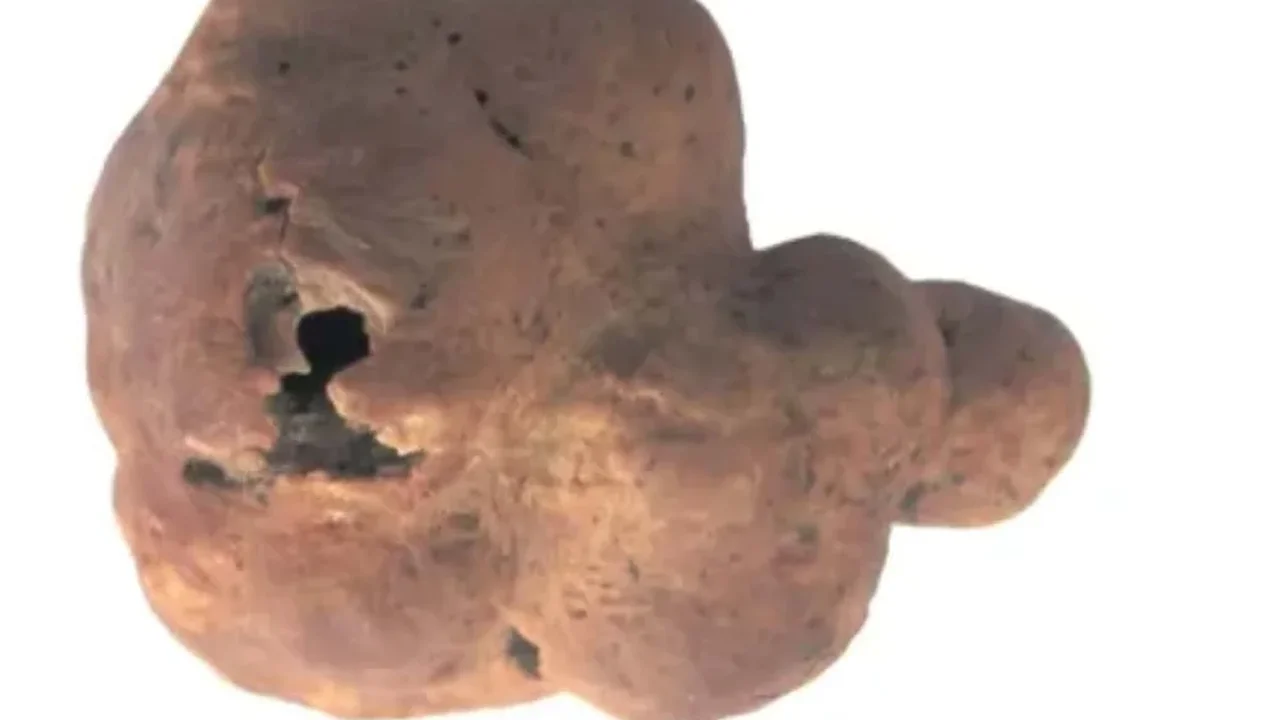
A small stone recovered from a Bronze Age burial is offering researchers a rare glimpse into an illness that would have left little trace on the skeleton. Measuring about 21 by 17 millimeters, the mineralized object was found among the remains of a man who lived roughly 5,000 to 5,300 years ago.
The burial was discovered at Ipatovo-5 in Russia's North Caucasus. The man was estimated to be 40 to 49 years old when he died, around 3300-3000 BCE. His skeleton showed healed fractures and wear to his joints and spine, evidence of a physically demanding life.
Minerals point to infection
Researchers examined the stone using several methods, including high-resolution CT scanning, electron microscopy and X-ray diffraction. Its layered structure and chemical composition identified it as a urinary stone containing calcium phosphate minerals, including whitlockite.
Whitlockite is associated with some stones that form in the presence of bacterial infection. Its presence does not prove infection conclusively, but the researchers say it provides strong evidence. The absence of detectable calcium oxalate and uric acid--common in stones linked to metabolic factors--also supports infection as a likely cause.
The stone may have formed in the kidney during a persistent urinary infection, or in the prostate as a result of chronic bacterial prostatitis. Its original position in the burial was not recorded, and its composition cannot distinguish between the two possibilities. Researchers also cannot determine exactly what symptoms the man experienced or whether the condition contributed to his death.
Published in Archaeological and Anthropological Sciences, the study illustrates how mineral analysis can reveal health conditions that bones alone may not preserve. Such methods may help researchers build a fuller picture of illness and daily life in ancient populations.
As analytical tools advance, small archaeological finds may continue to expand what can be known about human health across deep time.