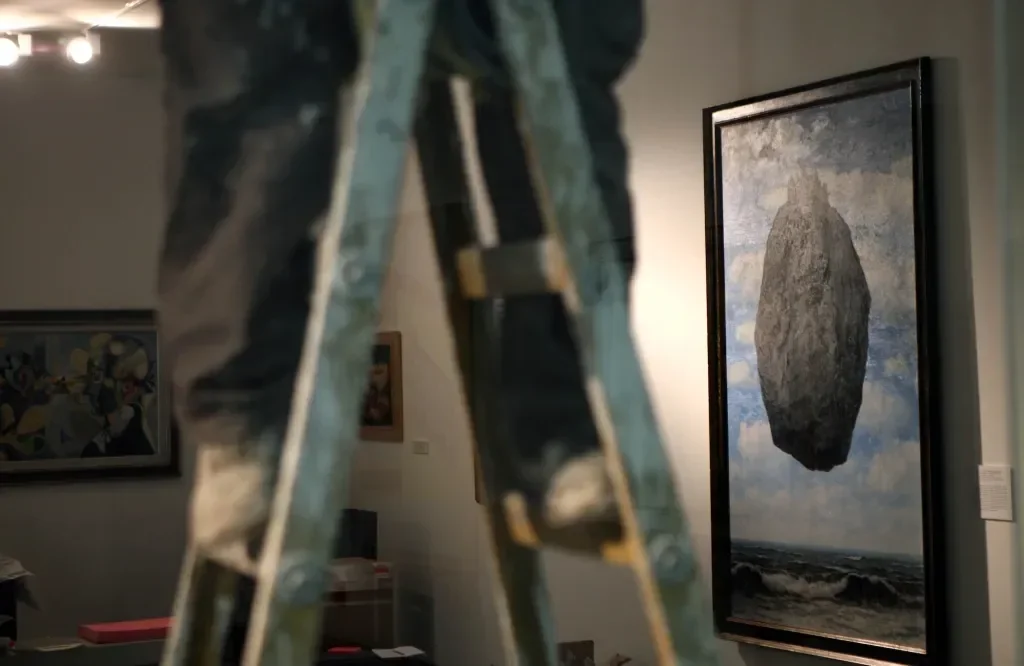
René Magritte's iconic painting, The Castle of the Pyrenees (1959), has been sent to the conservation lab at the Israel Museum in Jerusalem following an unexpected incident involving a young visitor. While exploring the museum with his family, a boy accidentally punctured the artwork with a pinecone before a museum guard could intervene, as reported by museum staff.
Sharon Tager, the head of conservation at the museum, informed Ha'aretz that the restoration process is expected to take several weeks. "Our team is well-versed in the conservation of artworks that arrive in less than ideal conditions, including those from the Holocaust era," Tager explained. "The initial step involves addressing the canvas itself, as the hole has caused it to sag. We will restore the canvas to its original form, followed by stitching and treating the layers of oil paint."
In an effort to enhance visitor engagement, the museum had opted not to place the painting behind glass or install an alarm system. Tager noted, "While we do protect certain artworks with high-quality glass, we aim to provide an immersive experience for our guests. We explore various protective measures, but there are limitations."
The Castle of the Pyrenees depicts a castle perched atop a colossal, floating rock against a backdrop of a partly cloudy sky and seashore. The piece has been a part of the museum's collection since 1985, originally commissioned by Magritte's friend, Harry Torczyner, who sought to obscure an unsightly view from his New York office. Torczyner contributed to the painting's theme, suggesting elements such as the sky and the sea, which Magritte integrated while maintaining his artistic vision.
Torczyner expressed his delight upon receiving the finished work, exclaiming, "LONG LIVE MAGRITTE! The painting floats majestically and proudly. It is superb... and intact!" For nearly two decades, the artwork remained in Torczyner's possession before being donated to the American Friends of the Israel Museum in 1985.
This incident serves as a reminder of the delicate balance between accessibility and preservation within art institutions. As museums strive to create enriching experiences for visitors, they also face the challenge of safeguarding invaluable pieces for future generations.