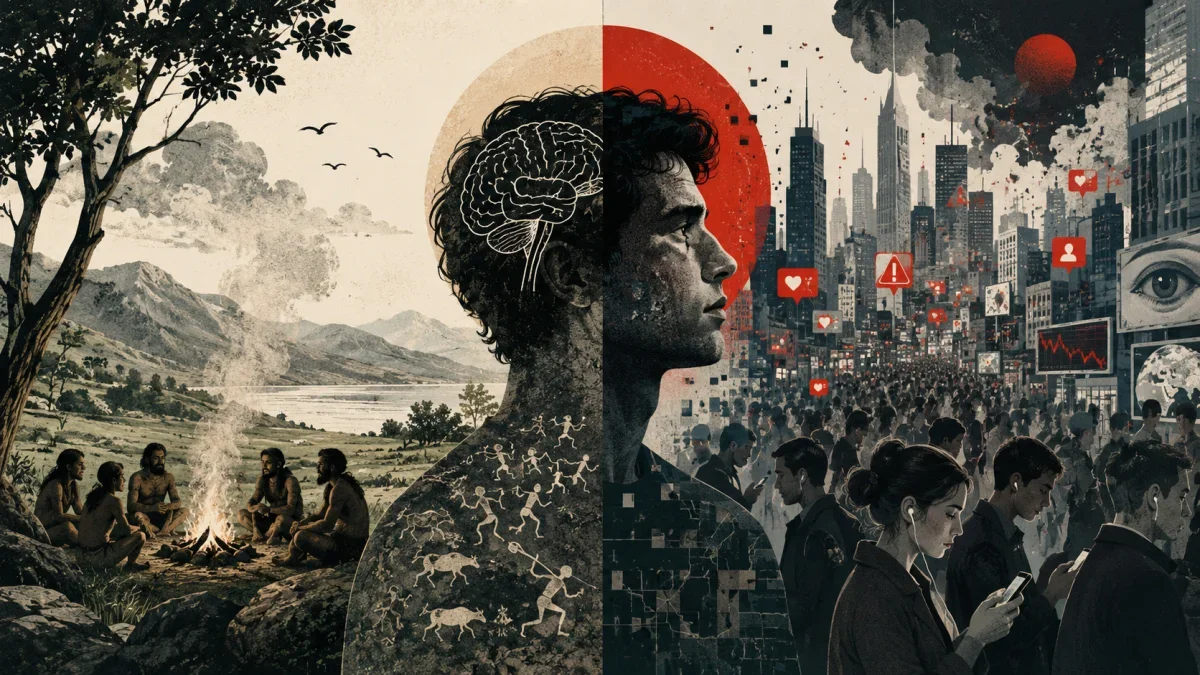
Human beings were not shaped for a world of alarms, endless notifications, and constant social comparison. A new review suggests that many pressures of contemporary life may be understood through evolutionary mismatch -- the idea that older mental systems are now operating in environments they were never designed to navigate.
The authors, psychologists and sociologists based in Singapore, did not run a new experiment. Instead, they synthesized research on cities, social media, inequality, health, and the wider "polycrisis" of overlapping global disruptions. Their argument is that modern life often turns everyday experience into a persistent contest for attention, status, and belonging.
Ancient instincts in a digital world
In smaller ancestral communities, people lived among familiar faces and limited social circles. Today, many navigate crowded cities, workplace hierarchies, dating platforms, and feeds filled with curated success. That shift, the review argues, can intensify comparison and make approval feel more important than ever.
The paper's central idea is the social evolutionary mismatch hypothesis: modern settings may not only create stress, but also amplify the sense that life is a nonstop competition. The authors note that this is especially visible online, where popularity metrics, beauty ideals, and visible validation can shape mood and self-image.
The review also connects the issue to urban design. Dense neighborhoods, noisy transport systems, and limited access to green space can influence wellbeing in different ways. By contrast, repeated face-to-face contact, calmer public spaces, and community-oriented design may help people feel more grounded.
Designing environments that fit people better
The broader message is not to reject modern progress. Medicine, sanitation, transport, and digital communication remain major achievements. But the review suggests that mental wellbeing may improve when cities, workplaces, and online platforms are built with human psychology in mind.
That could mean reducing unnecessary status pressure, making communities more connected, and creating digital spaces that support genuine interaction instead of constant comparison. The findings were published in Behavioral Sciences.
As research on human behavior advances, this perspective may help shape healthier environments that align more closely with how people naturally think, connect, and thrive.