At the Venice Biennale, Helter Skelter has emerged as one of the most discussed exhibitions of the season. Presented by the Fondazione Prada and curated by Nancy Spector, the show brings together Arthur Jafa and Richard Prince in a dialogue shaped by appropriation, identity, and American visual culture.
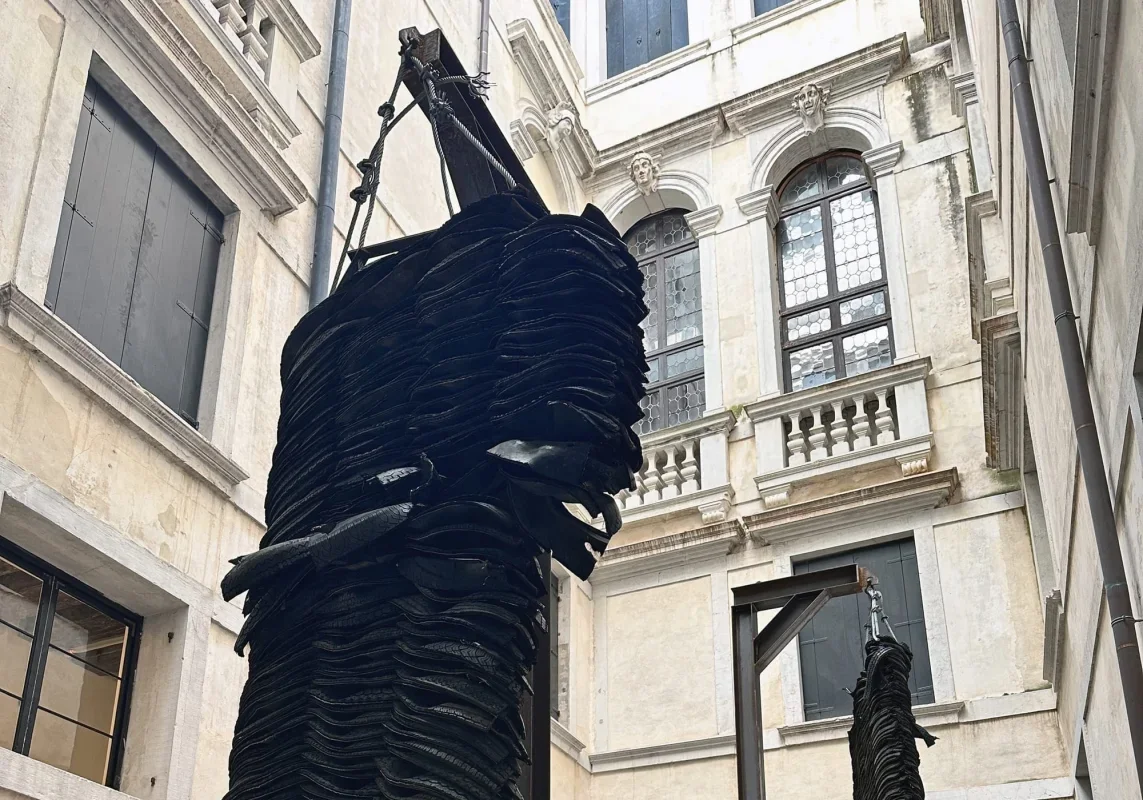
The exhibition opens with a striking contrast: Prince's Folk Songs and Jafa's Big Wheel II. Both works draw from car culture and masculine symbolism, yet they also reveal how materials can carry deeper social meanings. In this pairing, the artists' shared methods create a layered conversation about power, memory, and representation.
Prince's Protest Paintings and works such as Untitled (Cowboy) extend that conversation into questions of race, image ownership, and cultural coding. Jafa's practice, meanwhile, uses montage and found imagery to examine Black life in America with urgency and precision. His film Love is the Message, The Message is Death remains a key reference point in the show.
One of the exhibition's central ideas is appropriation as a creative tool, but the article argues that the curatorial framing softens some of the sharper tensions between the two artists. Even so, the pairing makes visible how both artists challenge viewers to reconsider what images mean, who controls them, and how they shape collective memory.
By placing Jafa and Prince in the same space, Helter Skelter turns Venice into a stage for a broader reflection on contemporary art's role in interpreting culture. The exhibition continues through November 23 at Ca' Corner della Regina. In the years ahead, such cross-genre dialogues may help redefine how museums present identity, authorship, and visual history.