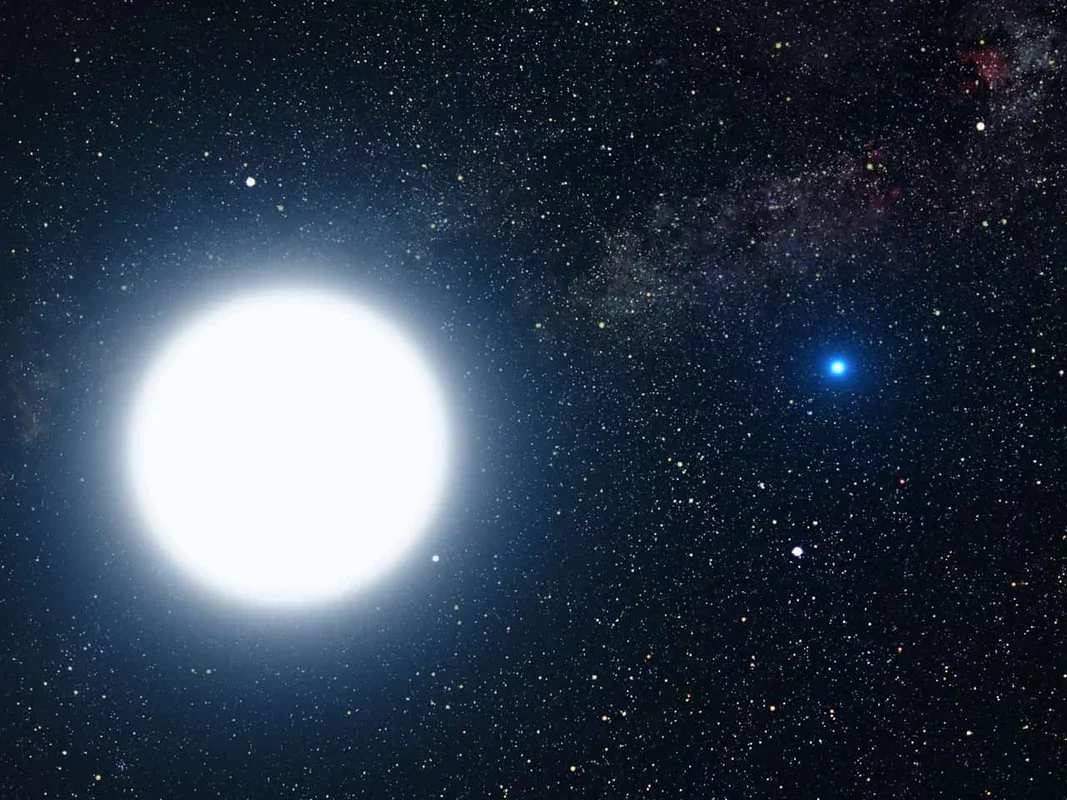
White dwarfs represent the concluding chapter for stars that lack the mass to explode in a supernova. They can be viewed as the retirement phase for most stars in our universe. When a star exhausts its fuel, it doesn't simply disappear; instead, it leaves behind a dense, white-hot core.
A white dwarf is essentially the hot, dense remnant left after a star has depleted its nuclear fuel and shed its outer layers. These stars are remarkably compact, containing a mass comparable to that of the Sun within a volume similar to that of Earth. Just a teaspoon of material from a white dwarf could weigh around 10 million tons, a testament to the immense gravitational pressure that compacts the matter.
Despite their significance in the cosmos, many aspects of white dwarfs remain elusive, making them challenging to study.
White Dwarfs in the Cosmos
"The sky is filled with stars. Most of the visible stars are actively burning hydrogen in their cores, generating energy," explains Boris Gänsicke, a professor at the University of Warwick specializing in white dwarfs. "Eventually, they will exhaust their hydrogen supply, then transition to burning helium, leading to a halt in energy production. At this stage, the core will primarily consist of carbon and oxygen."
Once energy generation ceases, the core shrinks under its own gravity while the outer layers disperse into space. This carbon-oxygen core is what we recognize as a white dwarf.
During the 2023 European Astronomical Society meeting, Gänsicke elaborated on the intriguing nature and importance of white dwarfs.
Stars typically maintain an equilibrium between the inward pull of gravity and the outward pressure generated by heat. However, when a star no longer produces energy, as is the case with a white dwarf, this heat dissipates. Consequently, the star's stability relies on a quantum phenomenon known as degeneracy.
Specifically, white dwarfs are supported by "electron degeneracy pressure." At such extreme densities, electrons are compressed to the point of nearly touching one another. According to quantum mechanics, these electrons resist occupying the same state, creating a powerful outward force that stabilizes the star despite the absence of internal energy.
Small, Dim, and Hard to Find
White dwarfs are diminutive and faint. For centuries, astronomers discovered them largely by chance. Even the nearest one, Sirius B, was a mystery for an extended period.
Due to their small size and low luminosity, locating these stars can be quite difficult. "Their small size and dimness make them hard to detect, which is why they were first identified accidentally," Gänicke notes.
Finding White Dwarfs
As white dwarfs cool, they undergo a remarkable transformation: they crystallize. Lacking an internal heat source, they gradually shift from a white to a red hue.
"Sorting white dwarfs by color and brightness reveals what is known as the white dwarf cooling sequence. Initially very hot, they continue to cool over time, becoming increasingly red," Gänicke explains.
Researchers had previously suspected three branches in the evolution of white dwarfs. Thanks to the Gaia space observatory, launched by the European Space Agency in 2013, astronomers gained access to an extensive catalog of stars, including white dwarfs.
"With Gaia, we suddenly had tens of thousands of data points," Gänsicke says. This wealth of information allowed astronomers to identify the cooling sequences and understand their branching, one of which relates to the crystallization of white dwarfs.
Crystallizing Stars
As white dwarfs cool, carbon and oxygen in their cores solidify, akin to how ice forms from water as it cools. The cores eventually become solid.
Typically composed of carbon and oxygen, higher-mass stars (around 8-10 solar masses) may also fuse carbon, resulting in an oxygen-neon-magnesium white dwarf. However, the majority are primarily made up of carbon and oxygen, making them unique in their structure.
"As white dwarfs cool, the core forms a solid. Similar to how water becomes ice, the cores of white dwarfs transition to solid. This process releases some heat, contributing to the branching of the cooling sequence," Gänsicke adds.
While the surface of a white dwarf remains gaseous, the core begins to crystallize, expanding slowly over time. One could almost liken white dwarfs to diamonds in the cosmos, as half of their mass is carbon, which crystallizes.
Galactic Archaeology
Furthermore, white dwarfs serve as cosmic time capsules, allowing astronomers to trace the history and formation of stars. By studying these remnants, scientists can glean insights into the life cycles of stars, the evolution of galaxies, and the universe's future.
"White dwarfs are the remnants of stars that have ceased to exist in their normal forms. Our Sun, for instance, was born around 5 billion years ago and will eventually evolve into a white dwarf in another 5 billion years," Gänsicke explains.
By examining white dwarfs today, scientists can understand their past characteristics. From a white dwarf's temperature and mass, researchers can estimate its age and the mass of the star that formed it. This information aids in reconstructing the star formation history of the Milky Way.
However, the exact number of white dwarfs remains uncertain. Many are small and faint, suggesting that our galaxy may harbor countless undiscovered white dwarfs. New observatories, like the Vera C. Rubin Observatory, will enhance our understanding of these stars and their role in stellar evolution.
White Dwarf FAQ
Here are some key insights about white dwarfs:
A white dwarf is a compact, dense star that remains after a star like our Sun has depleted its nuclear fuel.
They form from the remnants of main-sequence stars that have exhausted their nuclear fuel, shedding their outer layers to leave behind a hot core.
Typically composed of carbon and oxygen, the thin outer atmosphere is usually made of hydrogen or helium.
No, they no longer undergo nuclear fusion and instead shine from residual heat from their previous life.
White dwarfs can exist for billions to trillions of years, gradually cooling over time.
Yes, our Sun is expected to evolve into a white dwarf in about 5 billion years after exhausting its nuclear fuel.
A black dwarf is a theoretical stellar remnant that forms when a white dwarf cools sufficiently to no longer emit heat or light.
Current estimates suggest there are around ten billion white dwarfs in our galaxy alone, with potentially many more across the universe.